This will be a two-part post starting with this, not far from where I live there is a nature reserve called Blackbutt Nature Reserve.
It is in the western suburbs of Newcastle, NSW, centred around Kotara and New Lambton, with major entrances at Carnley Avenue and Richley Reserve. It is one of the most accessible natural areas in Newcastle.
It sits just a few minutes inland from the coast and forms one of the city’s largest continuous bushland corridors.
Blackbutt spans roughly 182 hectares across several connected bushland pockets. There are three main public areas, these are, Carnley Avenue entrance, which is the most popular entrance, with wildlife exhibits, picnic shelters, playgrounds, and walking tracks.
Then there is the Richley Reserve entrance with large open lawns, ponds, BBQ areas, and access to longer bush trails.
There is also an entrance from Lookout Road which edges bushland buffers and has trail access points.
It is about a 10-minute drive from Newcastle’s CBD.
Because it is in the middle of suburban Newcastle it acts as a wildlife refuge for koalas, wallabies, birds, and reptiles. It is also a green corridor linking smaller bushland patches across the city.
It is very popular place for family gatherings as well as a popular place for school excursions and of course those who like to go on bush walks.
Next week I will share some of the history of the reserve
Good morning, everyone Daemon is Sue’s grandson, my great-nephew. Anyway, I slept well getting 8.5hrs waking when the alarm would have gone off it was set.
My BGL was 5.8 the temp at 5am was 21c or 70f we are looking at a top temp of 31c or 87f.
I swept out the front and vacuumed the house, cleaned the kitchen read and comment on some blog posts, did my own blog post by 10am I was exhausted.
The weather reporter on the news said it reached 33c, but Tim said the thermometer in the back yard reached 40c.
Steps: 5,959=3k’s or 1.8 miles.
ANNIVERSARY OF MICK’S PASSING IN 2016
Hello Monday, I had a good 8.5hrs of sleep been up since 4.40am as I woke to pee and felt awake, it is currently 24c or 75f we are heading for another stinking hot day. My BGL was 5.8 this morning.
At 10am I have a dental appointment; Sue will come and take me it is only 2 minutes down the road.
The dental appointment went well the woman I saw was so nice and gentle she filled the two broken teeth on the top; she wants me to ring and tell hunter health I need another two broken teeth on the right side repaired. She also wants me to ask about being placed on the waiting list for a plate.
The temp reached 35c or 95f today.
Steps: 6,532 = 3.2k’s or 1.9miles
THEA’S BIRTHDAY SHE IS 3 TODAY
I had another good night; I slept for around 9hrs & 30 minutes. My BGL was 5.9 and it is currently 23c or 3f the time is 5.30am.
By midday it has reached 31c or 88f, I have a shocking headache I suspect the heat is part of the cause.
I received the BeechBand arrived I have charged it and I am now wearing it, now to see if it helps at all.
I notice a slight change in myself after wearing it, but it can take a week or two to feel the full effect.
I am wearing the Beechband this morning and I have noticed I was able to walk and sweep the ramp out the front without any problem. I noticed at some point that it wasn’t working did some checking and yeah it needs to be charged every 3hrs, so I recharged it and all good again. It can take up to 6 weeks to really notice a difference.
By 4.30n I was able to turn the air con off and open the front door.
I had to put the beechband on to charge and within 5 minutes of removing it I went from ok to shocking.
Steps:6,532 = 3.2k’s or 1.9 miles
Slept well, woke to find it was raining, it’s 22c or 71f only supposed to read a top of 26c today or 79f, I had a good 9hrs of sleep and a hot shower after Tim left for work.
I did the usual morning stuff and I even emptied the recycle boxes into the recycle bin.
Around 1pm after Tim went back to work, I turned the air cons on as I was dripping in sweat.
Steps: 3,939 = 3k’s or 1.2 miles
Another good night had 9hrs of sleep it is currently 21c or 70f my BGL was high at first 7.8 then I washed my hands and tried again it came down to 6.4, still higher than I would like but better.
Sue and I had doctors’ appointments this morning, then we went to Woolies to get a few things. Mine was for a care plan so I could get my Medicare letter, so I don’t have to pay to see the podiatrist. Sue has been started on Metformin for her diabetes. She has to go back next week to do a care plan herself.
This afternoon it started raining and it is not hot at all today; well, I wasn’t hot.
Steps: 5,52=2.8k’s or 1.7 miles
Another good night had 7hrs of sleep it is currently 21c or 70f my BGL was 5.0 at 5am, I was sweeping the floor and Tim comes out asking if he slept in and what day is it. I informed him it is Saturday and he hasn’t slept in, so he went back to bed.
It is a cool, dry day and this morning Tim hung the photos I wanted hung so I am happy now.
Tasha came down and told us that there was a huge blow up with Blain’s housemates and that him and Ta’lia have had enough and want to move somewhere else.
Here it is Saturday and it is around 3.15pm and I am at last posting this.
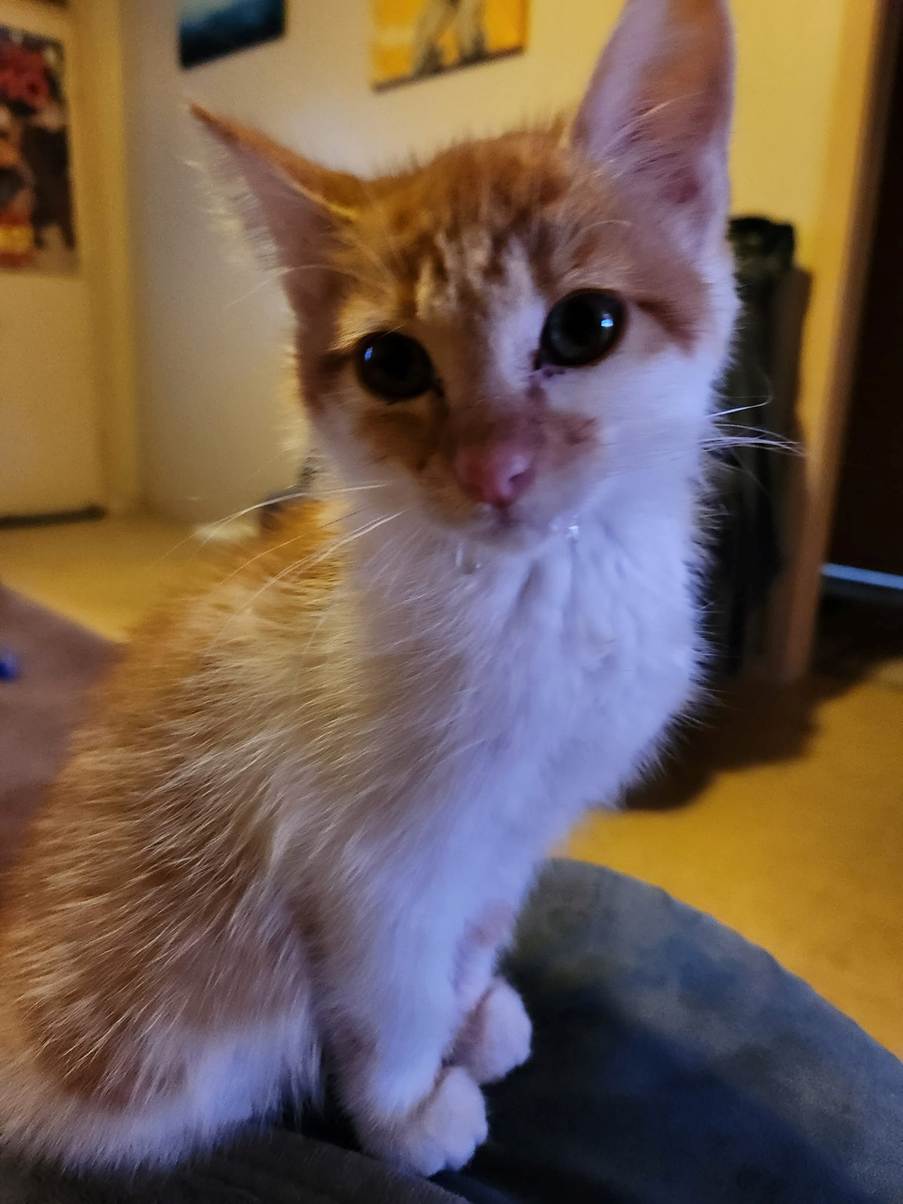
Hi everyone, this is Archie the most adorable ginger kitty and this is not Saturday it is Caturday and I am the star of this weeks show.
Of course back then I didn’t know what a phone or camera was but now I do and there are times when I see mum pick up her phone and points it at me and I jump up and run and hide fast.
Hi everyone, for the next few Friday’s I will be just sharing a photo, this weeks is an old school photo with me in it. I am in the front row second from the fold line on the right.
I’m pretty sure we all know that both our eyes work together which is one of the reasons humans are so good at judging distance, catching things, and navigating the world smoothly.
Each eye is sending slightly different views to the brain, which then blends them into a single, rich picture of the world.
Because your eyes are spaced apart, each one has a unique angle on whatever you’re looking at.
The left eye sees a bit more of the left side
The right eye sees a bit more of the right side
These differences are tiny but incredibly important.
The brain combines the two images in the visual cortex, and compares the differences then merges them into one seamless picture. This process is called fusion it’s so automatic you don’t notice it happening.
Depth perception comes from the differences
The slight mismatch between the two images is called binocular disparity. Your brain uses this to calculate distance, which gives you 3D vision accurate depth judgment with the ability to catch a ball, pour water, or thread a needle.
This is why closing one eye makes the world look flatter.
Eye muscles keep both eyes aligned with six tiny muscles around each eye coordinate perfectly, so both eyes point at the same target. This allows smooth tracking of moving objects, quick jumps when reading and stable vision even when your head moves.
If the eyes don’t align properly, the brain may suppress one image to avoid double vision. The brain chooses the best information even though both eyes send data, but the brain can prioritise the clearer image. It can switch dominance depending on the task ignore conflicting information if needed.
This is why many people have a dominant eye, like having a dominant hand.
It’s an elegant partnership between biology and brainpower.
I have been thinking about todays post since last night unsure about what I was going to write and decided to do another post about snakes as in what is the largest snake in the world?
Since the word largest has two definitions there are two answers one is the reticulated python, which is the longest snake species on Earth.
They can be up to 7.2 metres or 23 feet in length with rare reports of some reaching over 30 feet in length. Generally, adults are between 3 and 6 metres in length.
Reticulated pythons are native to South and Southeast Asia, living mainly in tropical forests and nearby wet, warm environments. Think countries such as Bangladesh, Myanmar, Thailand, Malaysia, Singapore, Vietnam, Cambodia, Laos and The Philippines.
Now if we are thinking about the heaviest snake, it would be the Green Anaconda which can exceed 200–250 kg in extreme cases. Its length is usually between 5 & 6 metres.
Green anacondas are native to tropical South America, especially in wet, swampy, slow‑moving freshwater environments.
Think areas such as the Amazon Basin (Brazil, Peru, Colombia) the Orinoco Basin (Venezuela, Colombia) The Guianas (Guyana, Suriname, French Guiana) and Trinidad.
They are semi‑aquatic and move far more easily in water than on land. Their eyes and nostrils sit on top of the head, letting them stay almost fully submerged while hunting.
Hello everyone, this Monday I am writing a bit about the Bathurst 1000, for those who don’t know it is a car race.
In fact, the Bathurst 1000 is Australia’s most iconic motorsport event, it’s a 1,000 km (621 miles) endurance race held every October at Mount Panorama Circuit in Bathurst, NSW.
It’s the crown jewel of the Supercars Championship and a cultural institution for racing fans.
The Mount Panorama Circuit is a public road for most of the year but transformed into a world‑class racetrack during events. The circuit has dramatic elevation changes of 174 metres, tight technical sections, and the blisteringly fast Conrod Straight, where cars can hit 300 km/h, (187 mph).
The race involves 161 laps which is a total distance of 1,000.29km’s, with teams consisting of two drivers sharing one car. It is known for unpredictable weather, safety cars, crashes, and strategy battles.
It was first run in 1960 as the Armstrong 500 at Phillip Island. It moved to Bathurst in 1963, the distance was increased to 1,000 km in 1973.
The winners receive the Peter Brock Trophy, named after the nine‑time Bathurst champion known as the “King of the Mountain.”
Last year the winners were Matt Payne & Garth Tander, it was Payne’s first Bathurst win and Tander’s sixth, placing him equal third all‑time. It was a chaotic, rain‑affected race with late‑race drama, including a penalty reshuffling the final order.
This year’s race is scheduled for 8–11 October it is promoted as another massive chapter in the Enduro Cup, with fan events, displays, and family‑friendly entertainment.
There’s also the Bathurst 12 Hour, a GT endurance race held earlier in the year. It features GT3 supercars and international drivers. Recent editions have included major crashes and dramatic red flags. I have not heard of this race.
Another early start up at 4.20am, it is 19c or 66f again this morning but like yesterday I expect it will heat up.
Tim and I went to the Reject shop, and I bought a number of things.
Tasha and Blain are still at it, Tasha said he blocked her on Facebook he said he didn’t, but he has a new account, and she hasn’t been added and he isn’t planning to do so. I feel this is somewhat childish.
Tasha sent me a long text about how she is feeling, which I am not sharing here but it hurt me how she is feeling so unloved and unappreciated and there is nothing I can do. It all started because Blain didn’t come to see his mum on her birthday.
Steps: 5,114 = 2.5k’s or 1.5 miles
Good morning and hello Monday, I slept through to 4.55am getting around 7hrs of sleep as it took me a while to settle last night but once settled, I slept well.
It is a wet morning but not cold temp at 5.30am was 19c or 66f, the rain has been heavy twice since I got up.
Got a text message from Hunter New England Oral heath about my appointment I had to ring them to arrange the appointment they have issued a voucher for me to see someone at Warners Bay Dental, rang them and made the appointment it is next Monday at 10am.
Around 6pm I started to feel unwell; I think I need to eat but can’t find anything. Rang Tasha she was out but on her way home so she swung by Macca’s and got me
Tim’s juror duty has been pushed back another day.
Steps: 5,140 = 2.7k’s or 1.6 miles
Had another good night, Tim is working all day, this I know because he took his lunch.
I have had a good start to the day it is only 17c or 62f I had a good 8hrs sleep.
I did a load of washing and hung it up to dry.
Tasha went to use her powerfit which I returned to her yesterday and wouldn’t you know it, its not working. I told her to come and get mine and try it out as it was half the price of the Powerfit brand at first, she said no but changed her mind and came down to get it.
Steps:5,470 = 2.7k’s or 1.6 miles
Had a good night slept of 9hrs it is currently 19c or 66f we are looking at a top of 37c yeah hope that’s wrong. My blood glucose level was 5.4
I went with Sue have her blood test done followed by the ultrasound, however, pathology was so crowded and there was only one woman working we had to leave before Sue’s number was called.
The ultrasound went well, the guy who did the scan said she has a fatty liver.
This afternoon while watching YouTube on the TV I dropped the remote and stood on it when I tried to pick it up deleting my account, I was annoyed but thought I would just have to re-add it. Yeah, not so easy keeps coming up that something went wrong try again after I don’t know how many tries, I gave up and turn the TV off for a while I will try again soon.
I decided to reboot my Foxtel box and after that it worked on the second try.
It is currently 4pm and 36c or 97f
Steps: 6,258 = 3k’s
Good morning world, it is going to be another hot day, I am up dressed and will soon get ready to go shopping with Sue.
It is currently 23c or 73f and my BGL was 5.4 and the time is 5.15am, I had 8hrs of sleep.
When I got back from shopping, I turned the air con on as it was 28c or 82f the time was 10.30am.
I am thankful that Sue helps me change my clothes.
I was able to turn the air con off at 5.30pm
It reached a top temp of 30c or 86f
Steps: 8,164 = 4k’s or 2.4 miles
Good morning, everyone, hope everyone are doing well, I slept well got around 8hrs of sleep. It is currently 23c or 73f only supposed to reach 26c, my BGL was 5.8 at 5am.
Sue came over and picked me up and we took Summer’s birthday present and lever in in the boot of Kathy’s car.
After that went over and saw Dave at work for a few minutes then back home again. That was good I like it when we go and see Dave even if it’s only for 10 minutes.
Steps: 6,515 = 3.3k’s 2 miles
SUMMER’S BIRTHDAY SHE IS 13 TODAY
Good morning, everyone who is reading this, I hope all are well and if you are reading this in the evening, I hope you have a good night.
I have been up since 5am slept right through the night getting 8hrs of sleep.
It is 22c or 77f we are heading for a top of 35c 95f, my BGL was 5.8.
Damn its hot today and the heat has drained me and gave me a headache. The temp is 38c or 100f.
Tim let for work around 3.40 and won’t be home to around 1am.
It is now 8pm the temp has come down to 25c or 77f, Tasha hasn’t turned up to help so I will put myself to bed.
Hello everyone, it’s the handsome tuxedo here, you know me I’m Luca, I have had a stressful week my human has been upset as she didn’t get to see my boy aka her son on her birthday. Thankfully the have patched things up and that makes me feel happier. Anyway, this week I am showing you some photos of me hiding in shopping bags hoping to go shopping with my human, it didn’t work.







 Jo-AnneRamplings