Hello everyone since the year is drawing to a close, I will be taking a short break from my usual daily post, I will still be posting just not the normal content, till January.
Christmas is usually a happy and cherished time around the world, although in some parts of the world there is war and civil unrest, and such things can make it difficult for some to truly appreciate this time of year.
Christmas means different things to everyone, for some it is about presents, for some it’s about spending time with family but what it should be about is remembering who’s birth we are celebrating.
I do not believe one needs to go to church to praise and honour God and Jesus as long as one does. We do not need to be on bended knee to pray, God hears our prayers even if one is sitting on the toilet.
I feel we should spend Christmas with those who love and care for us and yes exchange gifts, enjoy some food have some grog if you want and feel loved and accepted for who you are. If you are alone on Christmas Day turn on some music or turn on your telly and feel at peace. I just hope you don’t feel lonely.
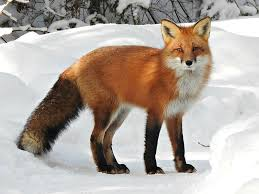
Ok let’s have a look at the red fox which I think may be the most well know of foxes it is in my opinion a handsome looking creature.
It is the largest of the true foxes and one of the most widely distributed members of the order Carnivora, being present across the entire Northern Hemisphere including most of North America, Europe and Asia, plus parts of North Africa.
They have long snouts and red fur across the face, back, sides, and tail. Their throat, chin, and belly are grayish white. Red foxes have black feet and black-tipped ears that are large and pointy. One of the most noticeable characteristics of the red fox is the fluffy, white-tipped tail.
They have been called bold, cunning, and deceitful, particularly in children’s stories. In fact, they are shy, secretive, and nervous by disposition, and they appear to be very intelligent.
They are extraordinarily opportunistic, omnivorous predators. Nonetheless, most studies agree that they feed predominantly on small mammals, particularly rodents (rats, mice, voles and the occasional squirrel) and lagomorphs (rabbits and hares); in rural areas these groups together typically account for about 50% of the diet.
Red foxes are the most widespread wild canid and have the largest natural distribution of any non-human land mammal.
Red foxes can be found in many countries, including, most of Europe, Russia, Kazakhstan, Iraq, Iran, Pakistan, northern India, China, and Thailand. They can be found in the northern and eastern United States, north through Canada and Alaska to Baffin Island. In parts of North Africa as well as here in Australia they were introduced to Australia in the 1800s and have spread throughout much of the country. However, it wasn’t till the late 1990’s that they were introduced to Tasmania.
They are hunted for sport and for their pelts. Red foxes are also the primary carrier of rabies in much of their range
Both the male and female red fox, care for their pups, or kits. The mother, or vixen, spends a lot of time grooming and cleaning the cubs. The father brings food to the mother during the first few weeks. The parents take turns hunting and bringing food back to the kits.
The vixen gives birth to 1–10 or more pups in a den, which is often a burrow abandoned by another animal. The pups are born brown or gray, but usually grow a new red coat by the end of the first month.
Their dens are usually located on the edges of forests, near fields, or under porches.
The pups start playing outside the den when they are about a month old. The mother feeds them regurgitated food at first, but eventually brings them live prey to play with and eat.
The young remain with their parents at least until the fall of the year they were born in. They disperse in the fall once they are fully grown and independent.
Hello everyone, this week see’s us visiting the country of Chad.
Chad, officially the Republic of Chad, is an independent state at the crossroads of North and Central Africa. The landlocked country is bordered by Libya to the north, Sudan to the east, the Central African Republic to the south, Cameroon to the southwest, Nigeria to the southwest, and Niger to the west. It is often called the “Dead Heart of Africa” due to its central and landlocked location.
It has a diverse landscape with an arid centre and a desert dominated north and a more fertile south. The country is divided into 23 regions.
The regions are represented in the country’s bicameral parliament, which includes a Senate that represents autonomous communities. The Senate’s members are indirectly elected by an electoral college of provincial and communal councillors.
Chad’s regions have different social structures and ethnic groups, and local or regional society is often more important to Chadians than national society:
The Sara, the country’s main ethnic group, live in the south. The Sara are sedentary people, and their essential social unit is the lineage.
It is often called the “Dead Heart of Africa” due to its central and landlocked location.
The north is inhabited by nomads, mostly Toubous.
Most of the population lives by agriculture; cotton is grown in the south, and cattle are raised in the central region. Chad joined the ranks of oil-producing countries in 2003, raising hopes that the revenues generated would improve the country’s economic situation.
It has a population around 18.5 million, the official languages are French and Arabic.
The currency is the Central African Franc.
N’Djamena is the capital and largest city in the country. It is also a special statute region, divided into 10 districts or arrondissements. The city serves as the centre of economic activity in Chad.
The country has an Executive President who is head of state and a Prime Minister as well as a council of minister
Branches: Executive–president (head of state), prime minister, Council of Ministers.
Chad’s Flag
The national flag of Chad is a vertical tricolour of indigo, yellow, and red. It was adopted on 6 November 1959, almost a year after the founding of the autonomous Republic of Chad. Since the 1990s, its similarity to the flag of Romania has caused international discussion.
Romania’s Flag
Like many African countries Chad is not considered a safe country to visit due to the high risk of violent crime, terrorism, kidnapping, and civil unrest.
The main religions in Chad are Islam and Christianity, with Islam being practiced by the majority of the population.
Chad’s constitution establishes the country as secular and affirms the separation of religion and state. The government generally respects religious freedom and observes several religious holidays as national holidays. It’s common for Muslims and Christians to attend each other’s festivities.
I had a good night slept straight through up with the alarm at 5am, it is 23 degrees my BGL was 5.3 and I am feeling great.
I had to have a nap between 11.30 & 1pm as I was falling asleep while sitting in my armchair.
Tim did crumb lamb chops and veggies for our lunch, it was really nice.
No steps today, I forgot to put my counter on.
I changed the sheets on my own despite the knee problems I am having.
I had a good night slept straight through up with the alarm at 5am, it is a pleasant 20 degrees, my BGL is 5.5.
I had to change from shorts to longer pants for around 3hrs then I changed back into shorts.
It is a cool overcast day, I walked down and posted of a stack of letters and Christmas Cards.
I went to bed at 8.30pm settled fast, woke at 10.15pm due to a hot flush, couldn’t settle again was just too restless so I go up and used the powerfit now I am just doing a couple of things on the computer before I go back to bed.
Steps:10,971
After I went back to bed at midnight, I slept well till the alarm went off at 5am, I would have loved to stay in bed longer but that would throw out my day.
It is 21 degrees and my BGL is 5.0
Not as hot today, my upper body is constantly moving, and it is so frustrating.
I walked down and post off a heap more Christmas cards.
I have had very little issue with my left knee today.
Steps: 4,571
A pretty good night, I don’t remember waking at all last night, it is 18 degrees this morning, my BGL is 5.5 and even though I am up, showered, dress and doing stuff I don’t feel that with it.
When I returned from seeing Sam off this morning, I found 2 cockatoos in my lounge room eating birdseed out of the bag, after they flew off, I cleaned up the mess they made. Well, I was sitting at the computer when I heard a noise and turned to find a cockatoo eating birdseed straight out of the bag again.
This afternoon we received a new TV, this is Jessica’s Christmas present to me and Tim.
Steps: 7,780
A pretty good night, I don’t remember waking at all last night, it is 18 degrees this morning, my BGL is 6.5, I wonder why it is so high.
After I did the washing and hung it up to dry, I was drenched in sweat, checked the temp and it was 27 degrees so turned the air con on.
By 3pm I was feeling really drained of energy and very tired, but I am sticking it out to at least 8pm before going to bed.
Steps:5,290
I had a shocking night woke at 11.50pm needing to go to the toilet, then for the next 3.5hrs I was unable to settle. I may need a nap today.
It is 21 degrees at 5.30am and we are looking at a top temp of 30 degrees. My BGL was 4.3, which is better than I expected as I woke with hunger pains.
I asked Sue if she would take me shopping and to drop some Chrissie Pressies off for Tom’s girls and Samantha’s kids and she was happy to do that for me.
Damn it is a stinking hot day at midday it was 32 degrees.
Steps: 4,522
I had a god night slept straight through but when I woke at 5am, I went to the loo and took my tablets and found myself just standing there trying to keep my eyes open, so I went back to bed for another hour.
It is 22 degrees and my BGL is 5.0
This afternoon Kathy and family came over and Michael helped Tim install the air con in the bedroom.
I asked Kathy is she could hand deliver some things to Kelli as she lives closer than us, she said she would.
This week we are looking at New Zealand’s national anthems, yes, they have two national anthems.
The main one is “God Defend New Zealand” but they also use “God Save the King” at formal ceremonies involving the King, the Governor-General, or the royal family.
The anthem’s lyrics were written by Thomas Bracken in the 1870s, and the music was composed by John Joseph Woods in 1876. The song was translated into Māori in 1878 and was called ‘Aotearoa’.
In 1976 a petition was presented to Parliament asking “God Defend New Zealand” to be made the national anthem. With the consent of Queen Elizabeth II, it was gazetted as the country’s second national anthem on 21 November 1977, on equal standing with “God Save the King/Queen”.
The anthem was officially adopted in 1977. The lyrics are in both English and Māori, with slightly different meanings. At major events, one verse is sung in Māori and then repeated in English.
Some people find the lyrics to New Zealand’s national anthem, confusing because of their antiquated or obscure words and concepts. For example, some of the words used include “thy”, “thee”, “ramparts”, “assail”, and “nations’ van”. Some also find the song difficult to sing at its original pitch.
E Ihowā Atua O ngā iwi mātou rā Āta whakarangona Me aroha noa Kia hua ko te pai Kia tau tō atawhai Manaakitia mai Aotearoa
God of Nations at Thy feet In the bonds of love we meet Hear our voices, we entreat God defend our free land Guard Pacific’s triple star From the shafts of strife and war Make her praises heard afar God defend New Zealand
Men of every creed and race Gather here before Thy face Asking Thee to bless this place God defend our free land From dissension, envy, hate And corruption guard our state Make our country good and great God defend New Zealand
Peace, not war, shall be our boast But, should foes assail our coast Make us then a mighty host God defend our free land Lord of battles in Thy might Put our enemies to flight Let our cause be just and right God defend New Zealand
Let our love for Thee increase May Thy blessings never cease Give us plenty, give us peace God defend our free land From dishonour and from shame Guard our country’s spotless name Crown her with immortal fame God defend New Zealand
May our mountains ever be Freedom’s ramparts on the sea Make us faithful unto Thee God defend our free land Guide her in the nations’ van Preaching love and truth to man Working out Thy glorious plan God defend New Zealand
Good afternoon I didn’t get around to writing this earlier.
This will be the last post about Newcastle during the second world war.
The 15 August 1945 was a day of celebration here in Newie as this was VP Day, VP stands for Victory in Pacific this was the day Japan surrendered. Yes, in May Germany had surrendered which of course people were excited about but as Japan was the direct threat to Australia.
The darkest days of the war for most Novocastrians when the Japanese attacked Newcastle. So, when Prime Minister Ben Chifley broadcasted the wonderful news, the city erupted in a joyous and uninhibited celebration. Of course, for most this meant that their loved one would be able to come home.
As soon as the news broke hundreds of sirens, whistles and horns on ships and trains as well as the factories sound, starting a wild chorus that lasted all on and off all day. People poured into the streets, dancing and celebrating with wild spontaneity.
Those in the suburbs poured into the city as well to join in the celebrations and await the afternoon’s formal parade and speeches.
It was almost impossible for people to hear the Prime Minister’s speech due to the noise, everyone knew her was talking and what he was talking about, after his speech a radio station put on dance music and in flash the city streets were filled with people dancing.
On that day no one thought about what would happen after the war,or gave much thought to how the war ended as in with the dropping of atomic bombs in Japan. All that mattered then was that the war was over
This week we are moving onto foxes which still fall under the wild dog banner, there are 12 true fox species and many other that are not considered true foxes. I think this because they have other non-fox genes in them.
Foxes and dogs are both members of the Canidae family, which is also known as the dog family.
Foxes are similar in appearance to dogs and coyotes, and share many other characteristics with other canids, such as their long muzzles, bushy tails, long legs and bone cracking flesh slicing teeth.
They are also similar to cats in some ways, such as being most active at night, having vertical pupils, they use a similar hunting style, and sometimes sleeping in trees.
Foxes are solitary scavengers that eat a variety of foods, including mice, voles, bird eggs, roadkill, wild fruits, vegetables, berries, and nuts. They are nocturnal predators that have evolved to see at night.
While it may be legal to keep a fox as a pet in some places, foxes are wild animals and should not be kept in the home.
I will write more about some of the different breeds of foxes over the next few weeks.
Good morning all it is a much cooler day here in my part of the world, this week we are looking at another African country but this one you should all have heard of it is South Africa.
It is on the southernmost tip of the African continent, it is known for its great diversity in cultures, languages, religious beliefs and ethnic groups.
When we think of the capital most of us would say Cape Town but in fact, South Africa has three capitals as each branch of government has its own capital city. The administrative capital of South Africa is Pretoria, the legislative capital is Cape Town, and the judicial capital is Bloemfontein.
Why is this well in 1910, when the Union of South Africa was formed, there was a great dispute about the location of the new country’s capital city. A compromise was reached to spread a balance of power throughout the country, and this led to the three capitals of South Africa.
The population is around 63 million, with Black South Africans as the majority, with around 80% the rest is made up of coloured South Africans at around 8%, Indian or Asian South Africans at around 2.6% and White South Africans being around 8%.
The country has nine provinces:
The Eastern Cape
The Free State
Gauteng
KwaZulu-Natal
Limpopo
Mpumalanga
The Northern Cape
North West
The Western Cape
Each province has its own government, including a premier, legislature, and executive council. The provinces also have their own distinct landscapes, populations, economies, and climates.
South Africa’s provinces were increased from four to nine in the lead-up to the 1994 general election.
This was done by reintegrating the country’s former homelands, known as Bantustans, into the country.
The flag is a horizontal bicolour of red and blue with a green band in the middle that splits into a “Y” shape. The flag also features a black triangle on the hoist side, with narrow yellow or gold bands separating the triangle from the arms of the “Y”.
The flag was adopted in 1994 after the end of Apartheid to represent the country’s new democracy.
The country has a diverse religious population, with Christianity being the most widely practice with around 85% of the population being Christian. The largest group of Christian churches are the African Independent Churches, which include the Zion Christian Church and the Apostolic Church.
Around 7% of the population practices Indigenous beliefs. Many Indigenous people combine Christian and Indigenous religious practices.
It is believed that about 6% of the population is atheist or agnostic.
There is also Hinduism, Islam, Buddhism, and Judaism practiced in the country.
South Africa is a secular state with a constitution that guarantees freedom of religion. The state’s relationship with religion is more moderate and tolerant, allowing for voluntary religious observances within state institutions.
Like many African countries South Africa isn’t considered a safe country to visit due to crime, civil unrest, and kidnapping. Violent crime is common and includes armed robbery, rape, carjacking, and mugging. There are also “smash-and-grab” attacks on vehicles. It is the 20th worst country in regards of safety and security.
Many would know of Apartheid which was in South Africa from 1948 to 1994 and was the racial segregation under the all-white government of South Africa which dictated that non-white South Africans (a majority of the population) were required to live in separate areas from whites and use separate public facilities and contact between the two groups would be limited. The different racial group were physically separated according to their location, public facilities and social life.
In 1948, after the National Party won that year’s elections, Apartheid became a social project of the government based on a series of laws which made it legal.
There are at least thirty-five languages are spoken in the country with twelve of them being regarded as official languages, they are Ndebele, Pedi, Sotho, Swazi, Tsonga, Tswana, Venda, Afrikaans, Xhosa, Zulu, English and South African Sign Language.
English is the primary language used in parliamentary and state discourse, though all official languages are equal in legal status.
The South African Rand is the currency of South Africa and is issued by the South African Reserve Bank. The South African rand has the symbol R. It is subdivided into 100 cents. The name is derived from the word ‘Witwatersrand’, which means ‘ridge of white waters’.








 Jo-AnneRamplings