
This week we will have a look at Russia during the twentieth century, this was a period of immense political, social, and economic upheaval, marked by revolution, civil war, and the rise of communism.
The century began with the Tsarist empire, ended with the collapse of the Soviet Union, and saw the country transform into a communist state. Key events include the Russian Revolution, World War I, the rise of Joseph Stalin, the Cold War, and the eventual disintegration of the Soviet Union.

St Petersburg early 20th Century
Russia’s participation in the war contributed to the social and political unrest that led to the February Revolution in 1917. This is when the monarchy was overthrown, and the Bolsheviks, led by Vladimir Lenin, seized power, establishing the world’s first communist society. This marked a shift from autocratic rule to a communist regime. This was known as the Russian Revolution’.

The country found themselves with a civil war which lasted between 1918-1922, this saw the Bolsheviks fighting against various anti-communist forces, ultimately solidifying their control over the country.
After the civil war Russia united with other republics to form the Union of Soviet Socialist Republics (USSR).
The Soviet Union was composed of 15 Soviet Socialist Republics (SSRs). These republics were: Russia, Ukraine, Belarus, Moldova, Lithuania, Latvia, Estonia, Georgia, Armenia, Azerbaijan, Kazakhstan, Uzbekistan, Kyrgyzstan, Tajikistan, and Turkmenistan.

It was at this time that Joseph Stalin became the dominant leader, implementing policies of industrialization, collectivization of agriculture, and widespread repression.
During the second world war The Soviet Union fought against Nazi Germany and the Axis powers, suffering immense casualties but ultimately contributing to the Allied victory.

At first The Soviet Union officially maintained neutrality during WW2 but cooperated with and assisted Germany. However, after Nazi Germany attacked the USSR on June 22, 1941, the country allied with the United Kingdom and then the United States after the latter joined the war in December 1941.
On 22 June 1941, Adolf Hitler launched Operation Barbarossa, an invasion of the Soviet Union with the largest invasion force in history.
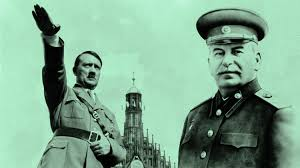
Hitler had always wanted to see Germany expand eastwards to gain Lebensraum or ‘living space’ for its people. After the fall of France Hitler ordered plans to be drawn up for an invasion of the Soviet Union. He intended to destroy what he saw as Stalin’s ‘Jewish Bolshevist’ regime and establish Nazi dominance.
Soviet forces launched a counteroffensive against the Germans arrayed at Stalingrad in mid-November 1942. They quickly encircled an entire German army, more than 220,000 soldiers. In February 1943, after months of fierce fighting and heavy casualties, the surviving German forces—only about 91,000 soldiers—surrendered.

After the second world war the country known as East Germany, officially the German Democratic Republic (GDR), was formed in October 1949 within the Soviet occupation zone of Germany following World War II. The Socialist Unity Party of Germany (SED), led by Walter Ulbricht, played a key role in its establishment and subsequent governance. The GDR was established as a communist state within the Soviet zone, marking the beginning of the Cold War division of Germany.
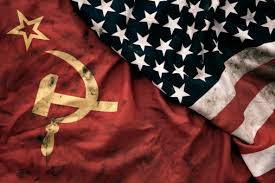
Between 1947-1991 saw what was known as the Cold War, this was the ideological and political rivalry between the Soviet Union and the United States shaped global politics and led to an arms race.
The Cold War was a period of geopolitical tension between the United States and the Soviet Union. It was characterized by an ideological struggle between capitalism and communism, a nuclear arms race, and proxy wars, but no direct military conflict between the two superpowers.
The Soviet Union collapsed in 1991 due to a combination of internal factors like economic stagnation, overextension of the military, and rising ethnic tensions, along with the influence of the Cold War and US policy of containment.

Mikhail Gorbachev’s reforms, including perestroika (economic restructuring) and glasnost (openness), while intended to revitalize the Soviet system, inadvertently accelerated its demise.
The Soviet economy was struggling with low productivity, inefficient planning, and a lack of innovation. They were heavily invested in a large military, especially during the Cold War, which strained its economy.
As the USSR was a vast empire with numerous ethnic groups, it was natural that many would feel oppressed and sought greater autonomy or independence.
Gorbachev’s reforms, while intended to address the economic problems, also opened the door for more political and cultural freedom. This led to increased criticism of the government, rising nationalist sentiments, and the weakening of the Communist Party’s grip on power.
In 1991, hardliners attempted to overthrow Gorbachev, but the coup failed due to a lack of support from the military.
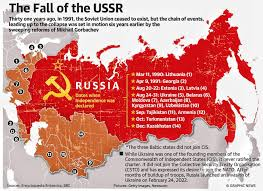
After the failed coup, the Soviet Union’s republics began declaring their independence, and Gorbachev resigned as president. The Soviet Union was formally dissolved on December 26, 1991.
The collapse of the Soviet Union had a profound impact on the world, leading to the end of the Cold War, the emergence of new nations in Eastern Europe and Central Asia, and a shift in global power dynamics.
That will do it for this post more about Russia next Monday.

 Jo-AnneRamplings