
Sun Bear

This week we are looking at a species of bear I have never heard of, that being the sun bear it is found in the tropical forests of Southeast Asia. It is the only species in the genus Helarctos and they are the smallest bear species and are only around half the size of an American black bear, measuring 4-5 feet tall when stood on their hind limbs, and weighing up to 68kg.

Sun bears are named for the bib of often sunshine-yellow fur adorning their chests. Each sun-bear bib is unique and can be used to distinguish one bear from another. Their fur is thick, short and generally jet-black, although some bears have a reddish or silvery hue.

Despite their name, recent research on wild sun bears suggests these animals are crepuscular, meaning their activity levels peak during the twilight hours of dawn and dusk.
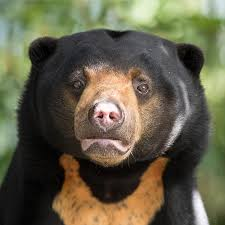
They are known to be very aggressive and may attack without apparent provocation. Except for females with cubs the bears are solitary although there is a suggestion that same may form long-term monogamous relationships. Litters are of from 1 to 3 cubs with no apparent set period for mating or birth.

Relative to their skull size, sun bears have the largest canine teeth of any bear species. For context, sun bear canines are the same size as those sported by polar bears, and species some 5 to 10 times larger.

Sun bears have long, curved claws, are well adapted for gripping bark and are the most arboreal of all the bear species. These bears will climb trees to forage for wild fruits and beehives and to evade predators such as tigers, leopards and dholes, an Asian canid. One of the characteristic signs of the presence of wild sun bears is claw marks on trees they have climbed. 
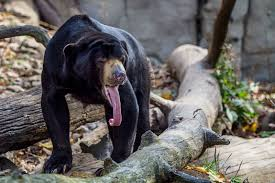
They have exceptionally long tongues, the longest among all bear species, reaching up to 25-30 centimetres (10-12 inches). These long, sticky tongues are essential for their diet, allowing them to extract insects and honey from hard-to-reach places like tree crevices and termite mounds.

Sun bears primarily inhabit dense tropical and subtropical rainforests throughout Southeast Asia. Their range includes areas in northeastern India, Bangladesh, Myanmar, Thailand, Peninsular Malaysia, Laos, Cambodia, Vietnam, southern China, and the Indonesian islands of Sumatra and Borneo. They are typically found at lower altitudes in these forests but can be seen at higher elevations in some regions like India. 
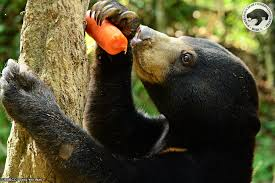
They are omnivorous, favouring fruits, insects, small animals and bee nests (for insects and honey). Large teeth and long claws enable sun bears to tear into logs and termite mounds in search of insects an important component of their diet. Their tropical habitat generally provides food resources year-round, so sun bears do not hibernate.

Sun bears face significant threats from habitat loss due to deforestation and conversion of forests for agriculture, particularly oil palm plantations. They are also targeted by commercial hunting for their bile, paws, and other body parts, and are affected by the illegal pet trade. 

Kazakhstan

This week we are visiting Kazakhstan, a Central Asian country and former Soviet republic, it extends from the Caspian Sea in the west to the Altai Mountains at its eastern border with China and Russia.

It was once called the Kazakh Soviet Socialist Republic and was one of the constituent republics of the Soviet Union from 1936 until its dissolution in 1991. 

Its largest metropolis, Almaty, is a long-standing trading hub whose landmarks include Ascension Cathedral, a tsarist-era Russian Orthodox church, and the Central State Museum of Kazakhstan, displaying thousands of Kazakh artifacts.

The capital is Astana although before 1997 the capital was Almaty, it has population of 1,423,726 it is the second largest city in the country. The population of the country is around 20 million.

Kazakhstan is officially a bilingual country those languages are Kazakh and Russian. The currency is the Tenge.

The flag is a light blue field with a gold sun and soaring golden steppe eagle in the centre. Along the hoist side is a vertical band of national ornamentation in gold. The blue represents the endless sky and the unity of the Kazakh people, while the sun and eagle symbolize prosperity and freedom, respectively. The current flag was adopted in 1992, replacing the flag of the Kazakh Soviet Socialist Republic. 

When it comes to religion the main ones are Islam and Christianity, the majority of Kazakhs, particularly ethnic Kazakhs, identify as Muslim. Most practice Sunni Islam of the Hanafi school. There are also smaller communities of Shia, Sufi, and Ahmadi Muslims.

A significant portion of the population, especially ethnic Russians, Ukrainians, and Belarusians, identify as Orthodox Christian. Other Christian denominations include Catholics, Lutherans, Presbyterians, Baptists, Pentecostals, and members of The Church of Jesus Christ of Latter-day Saints.

Smaller communities of Jews, Buddhists, and followers of other faiths like the Baha’i faith and Scientology also exist. 

Kazakhstan is a presidential republic, where the President holds significant power. The President serves as both head of state and commander-in-chief, and also appoints the Prime Minister and other cabinet members. The country has a bicameral parliament, consisting of the Senate and the Majilis.

While the constitution outlines democratic principles like freedom of speech and religion, Kazakhstan’s political system is described as semi-presidential with a strong executive branch, and there are concerns about the fairness of elections and restrictions on freedoms. 

That will do for now, part two next week.

Week 27 of 2025

My watch says I slept for only 4hrs and 17mins and I was awake for 14 mins.

Tim and I went shopping, Tim cashed in the bottles, I bought a new pair of trackies and a new Tee shirt. I also went to Woolies to get a few things. By the time I got home I was exhausted.

It has been warm enough outside for Tim to do some work out the back.

I spent a couple of hours reading and commenting on blogs and cropping some photos.

BGL:5.5

Steps:7,953 = 4.4klms

My watch says I slept for 7hrs and 21mins and I was awake for 9 mins, much better than the night before.

When I got up to pee at 4.15 the bathroom was so damn cold, I turned the heater on and left it on when I went back to bed so that it could warm the room a bit before I went in for my morning wash.

Tim rang me to let me know he wouldn’t be home till this arvo, so I cooked my own lunch chicken schnitzel and chips.

Steps: 10,938=5.80 Klms

It is a wet morning, and I woke with a headache.

My watch says I slept for 7hrs and 34mins and I was awake for 34 mins. My watch analyses changes in physical activity to estimate sleep time and status. It is designed to give one a pretty good idea of how they are sleeping.

It was raining lightly when I went with Sam to wait for her transport this morning.

While I was getting my pizza out of the oven for my lunch my left knee gave way and if I hadn’t been leaning against the bench I would have ended up on the floor. So, I had Jess go and meet Sam this arvo.

Blain came down to check on me and was here for about half an hour just chatting.

Sue has dropped Archie off at Tasha’s while she goes to Qld to visit Kirsty she will be gone 6 days.

It has been a really cold day.

9,310=4.55

It is a wet morning, and I am waiting for Tim to leave for work so I can have a shower.

My watch says I slept for 9hrs and 52mins and I was awake for 30 mins.

Sue caught her flight to Qld to spend some time with Kirsty’s family.

Tasha said Archie is hiding under Blain’s bed, he hasn’t eaten or drank anything.

This afternoon Blain came down and told me they had to remove the mattress and slates on Blain’s bed in order to get Archie out, he said he had to put a towel over Archie’s heard in order to get him out from under the bed. Tasha put Archie into his carry case to settle down.

I am very restless this arvo and cannot stay still.

BGL:5.8

Steps:12,737=6.49Klm

It is a wet morning, and I am waiting for Tim to leave for work so I can have a shower.

I had the worse night I have had in ages; my watch says I slept for only 4hrs and 9mins and I was awake for 33 mins.

I am so cold this morning from around 10am and have a headache. I tried to have a rest during the day but didn’t happen, so I expect to be in bed early tonight.

Thankfully the day warmed up some and I was able to get motivated to answer some letters I have here.

Tim found out we need to go to Centrelink which for those who don’t know is our social security anyway I need a letter from them stating I do not get a payment to hand in to housing so they can stop charging us rent on money we don’t have. I found a phone number and Tim said he will ring them tomorrow.

BGL 5.6

Steps: 7,966=4.06Klm’s

I had a much better night my watch says I slept for only 9hrs and 15mins and I was awake for 39 mins.

Today is the last day of term 2 for school, some schools finished last week like the school Tim does but most in NSW finish up today.

I rang Centrelink using the cordless house phone I was waiting for around 1.5hrs then after I explained what I wanted I was asked to hold while things were checked and after another 25 mins the phone died. I decided I will ring back on Monday as I had enough.

Steps:8,886=4.48 Klm’s

My watch says I slept for only 9hrs and 22mins and I didn’t wake at all during the night.

I have been really cold this morning and have a headache I think due to the cold.

Tim left for work around 5.30am, he said he should be home mid-afternoon.

Tim got home around 2pm, the first thing he did was changed his clothes and went out the back to work on the yard.

I am having a rough arvo and night, unable to settle I got up and used the powerfit

BGL:5.6

Steps: 9,603= 4.85Klm’s

Ecuador’s Anthem

Ecuador’s anthem is a Latin American epic anthem. The lyrics were written in 1865 (the author, Juan León Mera, later served as president of the Ecuadoran senate) and set to music the following year. Except in formal occasions (where the second verse is performed, followed by the third verse and the second verse is repeated), the second verse is the verse that’s sung out of the seven verses of the poem (six of which make up the complete lyrics of the anthem.)

The anthem was first performed publicly on August 10, 1870, in Independence Square, Quito, with Neumane conducting the orchestra. 

While the anthem was in use, it wasn’t officially adopted by the Ecuadorian Congress until September 29, 1948. 

The anthem’s lyrics and music evoke a sense of patriotism and celebrate the nation’s history and aspirations. It is a powerful symbol of Ecuadorian identity and a source of national pride.

Chorus:
Hail, O Homeland, a thousand times hail!
O Homeland, glory to you! Your heart overflows
with joy and peace, and your radiant face
shines brighter than the sun we behold.

I
Indignant, your children rose against the yoke
imposed by Iberian audacity,
against the unjust and horrendous suffering
that fatally weighed upon you.
They raised a holy voice to the heavens,
a voice of noble and unmatched commitment,
to avenge you from the bloody monster,
to break that servile yoke.

Chorus

II (official verse)
The first, the sons of the soil
which Pichincha proudly adorns,
acclaimed you as their eternal lady,
and shed their blood for you.
God saw and accepted the sacrifice,
and that blood was the fruitful seed
of other heroes whom the world, astonished,
saw rise around you by the thousands.

Chorus

III
Against the iron arm of these heroes,
no land was invincible,
and from the valley to the highest sierra,
the roar of battle could be heard.
After the battle, victory flew,
freedom followed the triumph,
and the lion, broken,
was heard roaring in helplessness and despair.

Chorus

IV
At last, Spanish ferocity yielded,
and today, O Homeland, your free existence
is the noble and magnificent heritage
given to us by felicitous heroism.
We received it from paternal hands,
let no one attempt to wrest it from us now,
nor does any foolish or audacious one
wish to provoke our vengeful anger against themselves.

Chorus

V
Let no one, O Homeland, attempt it. The shadows
of your glorious heroes watch over us,
and the valour and pride they inspire
are omens of triumphs for you.
Bring forth the iron and the fulminating lead,
for at the thought of war and vengeance
awakens the heroic strength
that made the fierce Spanish succumb.

Chorus

VI
And if new chains are prepared
by the unjustness of barbaric fate,
great Pichincha! may you foresee the death
of the homeland and its children in the end.
Sink swiftly into your deep entrails
all that exists on your land. Let the tyrant
tread only ashes and in vain
seek any trace of being beside you.

Launceston

This week we are in Launceston the second largest city in Tasmania.

It’s famed for the Cataract Gorge, with panoramic views, walking trails, sculpted gardens and a chairlift. The Queen Victoria Museum, in a 19th-century railway workshop, has exhibitions on Tasmanian history. Its sister Art Gallery lies across the river, by sprawling Royal Park. The vineyards of the Tamar Valley stretch northwest along the Tamar River.

The estimated resident population of Launceston, Tasmania is 71,889. This figure is based on the 2022 estimates from the City of Launceston. The population of Launceston has been steadily increasing since 2016. 

The traditional owners of the Launceston area in Tasmania are the Palawa people, specifically those belonging to the North Midlands Tribe. They are the original inhabitants of the region and have a long-standing connection to the land, including the Tamar River (kanamaluka) area. The broader Tasmanian Aboriginal people, also known as the Palawa, are acknowledged as the traditional owners of all of Tasmania (lutruwita).

The town was established by Lieutenant Colonel William Paterson in 1804. He initially set up a settlement at Outer Cove, later named George Town, before moving to York Town and then to the present-day site of Launceston. The settlement was initially called Patersonia before being renamed Launceston in honour of Governor King. 

Polar Bear

This week we are looking at the polar bear, the polar bear is a large bear native to the Arctic and nearby areas. It is closely related to the brown bear, and the two species can interbreed. The polar bear is the largest extant species of bear and land carnivore, with adult males weighing 300–800 kg.

They are a powerful symbol of the strength and endurance of the Arctic. The polar bear’s Latin name, Ursus maritimus, means “sea bear.” It’s an apt name for this majestic species, which spends much of its life in, around, or on the ocean–predominantly on the sea ice. In the United States, Alaska is home to two polar bear subpopulations.

They are good swimmers and can sustain a pace of six miles per hour by paddling with their front paws and holding their hind legs flat like a rudder. They have a thick layer of body fat and a water-repellent coat that insulates them from the cold air and water.

These bears spend over 50% of their time hunting for food. A polar bear might catch only one or two out of 10 seals it hunts, depending on the time of year as well as other things. Their diet mainly consists of ringed and bearded seals because they need large amounts of fat to survive.

They rely heavily on sea ice for traveling, hunting, resting, mating and, in some areas, maternal dens. But because of ongoing and potential loss of their sea ice habitat resulting from climate change–the primary threat to polar bears Arctic-wide–polar bears were listed as a threatened species in the US under the Endangered Species Act in May 2008. As their sea ice habitat recedes earlier in the spring and forms later in the fall, polar bears are increasingly spending longer periods on land, where they are often attracted to areas where humans live.

 They can run as fast as 40 kilometres per hour—but only for short distances. Younger, leaner bears are the best runners and are able to cover two kilometres’ without stopping. Older and larger bears, on the other hand, quickly overheat. However, they can only swim up to 10 kilometres per hour.

They have 42 razor sharp teeth: With jagged back teeth and canines larger than grizzly teeth, that would be quite the bite. Their paws are 30 cm wide which is big which act as a natural snowshoe that helps the bear trek across treacherous ice and deep snow. They also have 3 eyelids: The third helps protect the bear’s eyes from the elements and they have 4 inches of fat under their skin to keep it warm. Their skin is black, and their fur is transparent, and they have a blue tongue.

During autumn pregnant polar bears make dens in earth and snowbanks, where they’ll stay through the winter and give birth to one to three cubs. In spring the mother emerges from her den followed by her cubs. During that time, she will protect them and teach them how to hunt. They have a gestation period of between 195 and 265 days. They can live 20 to 30 years, but only a small percentage live past 15 to 18 years.

The oldest known polar bear in the Arctic lived 32 years. The oldest known polar bear in a zoological park lived 45 years.

When it comes to predator’s adult polar bears have no natural predators except other polar bears. Cubs less than one year old sometimes are prey to wolves and other carnivores.

Newborn cubs may be cannibalized by malnourished mothers or adult male polar bears.