Iraq National Anthem

This week we are looking at Iraq’ national anthem it is titled Mawtini which in English mean My Homeland, it is a poem written by the Palestinian poet Ibrahim Tugan and is a popular patriotic song amongst the Arab people as well as being the official national anthem of Iraq.

It was adopted as the country’s anthem in 2004, the song formerly served as an unofficial anthem of Palestinians and other people of the Middle East during much of the 20th century. In 1996, Palestine formally adopted it as their official anthem. Even though it has since been superseded by something else, many Palestinians still identify strongly with it and consider it the unofficial national anthem of their country.

It has been described as a reflection of the shared experiences and struggles of Arab peoples, evoking strong emotions tied to national pride, hardship, and the aspiration for freedom. It is regarded as a symbol of resistance and a representation of the collective longing for liberation during periods of occupation and oppression. The anthem conveys emotions such as sorrow, anger, and hope, fostering a sense of renewal and solidarity among those who have endured similar adversities. Its lyrics express a deep love for the homeland, a commitment to its liberation, and a vision of a united and free nation. This message resonates widely across the Arab world, reflecting the shared struggles for independence, identity, and sovereignty.

The national anthem of Iraq between 2003 and 2004 was “Mawtini”, an instrumental composition composed by Iraqi Assyrian musician Louis Zanbaka. 

Also, the “Arḍu l-Furātayni”, also known as the “Land of The Two Rivers”, was the national anthem of Iraq from 1981 to 2003, during the Ba’athist regime of Saddam Hussein. 

My homeland, my homeland,
Glory and beauty, sublimity and splendour
Are in your hills, are in your hills.
Life and deliverance, pleasure and hope
Are in your air, are in your air.
Will I see you, will I see you?
Safely comforted and victoriously honoured.
Will I see you on your eminence?
Reaching to the stars, reaching to the stars
My homeland, my homeland.

My homeland, my homeland,
The youth will not tire
Their goal is your independence.
Or they die, or they die.
We will drink from death, and this will not be our enemies.
Like slaves, like slaves.
We do not want, we do not want
An eternal humiliation, or a miserable life.
We do not want to, but we will take it back.
Our storied glory, our storied glory.
My homeland, my homeland.

My homeland, my homeland,
The sword and the pen, not talk nor the quarrel
Are our symbols, are our symbols.
Our glory and our covenant, and a faithful duty
Moves us, moves us.
Our glory, our glory,
It is an honourable cause and a waving flag.
O, behold you, on your eminence,
Victorious over your enemies, victorious over your enemies.
My homeland, my homeland!

US Troops Down Under During WW11

This week we will look be looking when the USA invaded Australia during WW11. Kinda…

In my area of Australia there was the Joint Overseas Operations Training Services.

The Port Stephens area was the centre of much activity during 1943-44, 20,000 US servicemen and 2,000 Australian servicemen trained for beach landings. 

A country club became headquarters for amphibious warfare training area know as JOOTS (Joint Overseas Operations Training Services).

Port Stephens an area in the Hunter Region of New South Wales, Australia, it is just north of Newcastle.

This came about due to Australia asking for help from the States to dissuade the Japanese from trying to invade and it worked.

For America, Australia was a natural springboard for a major counterattack against Japan and the Newcastle area saw plenty of evidence of the American commitment.

HMAS Assault was a naval training centre established by General Douglas MacArthur. The base was chosen because it was a safe haven from Japanese submarines and was a small, isolated fishing village. The HMAS Assault was used to train landing craft crews, beach parties, and signal teams.

Tomaree Head was a critical part of Australia’s defence of the east. It includes a curved concrete wall with a gun that protected Newcastle and the Williamtown airbase. 

You can take a guided tour of the historic gun emplacements at Tomaree Head in Tomaree National Park.

In total nearly one million US troops passed through Australia during World War II. The first US troops arrived in Brisbane in December 1941. 

By 1943, there were 250,000 Americans stationed in Melbourne, Sydney and Brisbane.

The US Army used Australia as a base of operations to support US forces in the Philippines. 

Their main role in north Queensland was to provide services and supplies, and there was a large presence in Queensland mostly around Brisbane, Rockhampton, and Townsville. 

The US Army also had a joint command with the British, Dutch, and Australian forces in the Pacific. 

They had a substantial impact on the local economy and influenced fashion, consumerism, and domestic technology. 

Of course, at times there were tensions with some Australians, which sometimes erupted into fighting. 

There was also a large social impact on Australia, including many Australian women marrying US servicemen. 

The US Army’s presence in Australia was part of a larger US deployment to combat zones overseas during World War II. 

Sechuran Fox

This week we are looking at the Sechuran fox, also called the Peruvian desert fox or the Sechuran zorro, is a small South American species of canid closely related to other South American “false” foxes or zorro. It gets its name for being found in the Sechura Desert in northwestern Peru.

It has sandy-coloured fur and distinctive facial markings, this fox species is adapted to the harsh and arid conditions of its habitat, where it plays a crucial role as a predator and scavenger.

The Sechuran fox is nocturnal and spends the daylight hours in a den dug into the ground. It is generally solitary, although occasionally seen travelling in pairs. Pups are born in October and November, although little else is known of its reproductive behavior.

When conditions allow, Sechuran foxes are omnivores, but can also survive on a completely herbivorous diet when necessary. They can eat seed pods and fruit of Cordia and mito plants. More commonly, however, they also eat insects, rodents, bird eggs, and carrion. It is thought that they can survive for long periods without drinking, receiving the water in their food.

Iraq

This week we have moved onto Iraq, officially known as the Republic of Iraq, is a country in West Asia, bordered by Saudi Arabia to the south, Turkey to the north, Iran to the east, the Persian Gulf and Kuwait to the southeast, Jordan to the southwest, and Syria to the west. 

The country is dominated by two famous rivers: the Tigris and the Euphrates. They flow southeast from the highlands in the north across the plains toward the Persian Gulf. The fertile region between these rivers has had many names throughout history, including Al-Jazirah, or “the island,” in Arabic and Mesopotamia in Greek.

Many parts of Iraq are harsh places to live. Rocky deserts cover about 40 percent of the land. Another 30 percent is mountainous with bitterly cold winters. Much of the south is marshy and damp. Most Iraqis live along the fertile plains of the Tigris and Euphrates.

Baghdad is the capital and largest city of Iraq, located along the Tigris in the central part of the country. With a population exceeding 7 million, it ranks among the most populous cities in the Middle East and Arab World and forms.

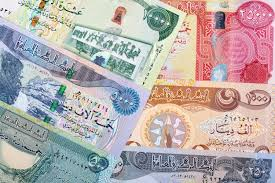
The Iraqi dinar is the currency of Iraq. The Iraqi dinar is issued by the Central Bank of Iraq. On 7 February 2023, the exchange rate with the US Dollar was US$1 = 1300 dinars.

The Iraqi flag has four horizontal stripes of red, white, green, and black. The colours are inspired by a poem by Safi al-Din al-Hilli. The flag also has an Arabic inscription that means “Allah is the Greatest”. 

The current version of the Iraqi flag has been in use since 2008. 

The flag was modified in 1991 by President Saddam Hussein.

In 2004, the Iraqi Governing Council proposed a new flag, but it was almost universally rejected by Iraqis. 

The colours of the Iraqi flag are inspired by a poem by Safi al-Din al-Hilli. 

The poem refers to red as willingness to shed blood, green for Arab fields, black for battles, and white for purity of motives and deeds. 

The three green stars on the flag represent a desire to unite with Egypt and Syria. 

It is one of the most culturally diverse nations in the Middle East. Arabs, Kurds, Turkmen, Assyrians, Mandaeans, and Armenians, among others, speak their own languages and retain their cultural and religious identities.

Iraqis once had some of the best schools and colleges in the Arab world. That changed after the Gulf War in 1991 and the United Nations sanctions that followed. Today only about 40 percent of Iraqis can read or write.

The country is a federal constitutional democracy. The Head of State is the President. The Head of Government is the Prime Minister, who appoints the Council of Ministers (Cabinet). The Council of Representatives (CoR) is the unicameral legislature. The Iraqi people elect the 329 members of the CoR through an open-list, proportional representation electoral process. Nine seats are set aside for representation of Iraqi minorities. The Constitution sets a quota of 25 per cent of CoR seats to be held by women. Members serve four-year terms. The Prime Minister and Cabinet Ministers do not have to be elected members of the CoR but the CoR must approve their nominations. Ministers must forgo their CoR seats to serve in Cabinet.

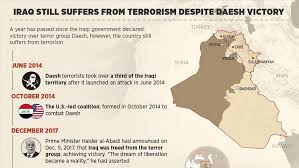
During late 2013 and 2014, the terrorist organisation Da’esh seized territory in west and northwest Iraq, including the city of Mosul. Da’esh systematically persecuted ethnic and religious minorities and committed abuses against vulnerable groups including women and children. On 9 December 2017, then-Prime Minister Haider al-Abadi announced the defeat of Da’esh in Iraq. 

Despite the territorial defeat of Da’esh in Iraq and Syria (announced by the Syrian Democratic Forces in March 2019), Da’esh remains a very real threat to the region. At the request of the Government of Iraq, the Global Coalition to Defeat Da’esh continues to support the Iraqi Security Forces to combat the threat posed by remnants of Da’esh.

Iraqi women today suffer from insufficient educational opportunities and healthcare and limited access to the labor market, as well as high levels of violence and inequality.

The status of women has been affected by wars, Islamic law and the Constitution of Iraq as well as Cultural traditions. Abusive practices such as honour killings and forced marriages still persist.

The security situation in Iraq is volatile and could deteriorate with little warning. There’s a risk of violence, armed conflict, kidnapping and terrorist attacks.

Week 9 of 2025

After a much better night, I am up washed and dressed. Sue came over to see if she could help Tasha with her studies about massage and she could help a bit but said she has a book at home that may help, and she will look for it.

It is a hot day, but I haven’t turned the air con on. It reached 31C but I didn’t turn the air con at all. However, I will have the bedroom air con on when I go to bed.

I was in bed for an hour and was unable to settle so I got up to use the powerfit and update this entry, then I will go back to bed and try to settle.

Steps: 10,650

THEA’S BIRTHDAY SHE IS TWO TODAY

After I went back to bed it still took at least an hour to settle and fall asleep.

When I woke up, I wasn’t feeling good I don’t know if the reason is lack of sleep or lack of food, I didn’t eat much yesterday.  

Sue and I went and had a massage, it felt good

I am extremely tired this afternoon.

Steps:5,577

I slept straight through the night, I woke up feeling tired, I hope that passes soon.

It has been a coldish and wet day, I walked up to get Sam in the rain this afternoon, I am glad I bought a rain poncho.

Sue was telling me that she thinks Dave & Leigh have helped Dawson get a car.

I have a headache and stinging eyes this arvo.

I am off to bed a bit early it is 7.30pm and I am done for the day.

Steps: 10,087

I slept ok, not great it was after midnight before I settled fully.

Sue rang and let me know her car is out of rego till next week when she gets paid. She also noticed that she had a flat tyre, and she has a $600 power bill so right now she feels like she is drowning in debt.

Sandy rang to tell me she is moving again, as she has been offered a 4-bedroom place at Elermore Vale, a 10–15-minute drive from me, this is wonderful news.

Later Sandy rang to ask if Tim could loan her $2,500 for a removalist, DCJ just paid one to move her to Raymond Terrance and will not pay for one to move her to Elermore Vale 

Steps:11,560

I slept ok, not great it was after midnight before I settled fully.

We are in for another hot day, this the last day of summer and the last day of February. It is currently 19C at 6am, my BGL was 5.0.

I have already vacuumed and fold the clean clothes up.

Now to read some blogs and do my Friday post.

It got to 34C here I had the air con on from 10.30am.

Didn’t do much other then put the clean clothes away, emptied the dishwasher, vacuumed a second time and I ironed a few things. I also managed to write three letters to penpals.

Steps:5,521

Kuwait National Anthem

The national anthem of Kuwait was written by poet Ahmad Meshari Al-Adwani with music composed by Ibrahim Al-Soula and arranged by Ahmad Ali. It was first broadcast on 25 February 1978. Prior to 1978, the “Amiri Salute” was used.

After the proclamation of Kuwait’s independence, the Kuwait national anthem was written by the poet Meshari Al-Adwani and was broadcast for the first time on 25 February 1978. The music was composed by Ibrahim Al-Soula and arranged by Ahmad Ali. The Amiri Salute was composed by Yusuf Adees in 1951 and was used until February 1978.The National Salute consists of the first six bars of the National anthem. 

The anthem is played every day at the beginning of the day in most Kuwaiti schools and on TV and radio stations.

The words of Kuwait national anthem are: 

Kuwait, My Country, May you be safe and glorious!
May you always enjoy good Fortune! 
You are the cradle of my Ancestors, who put down its memory, 
With everlasting symmetry, showing all eternity, 
Those Arabs were Heavenly, Kuwait, My Country, 
May you be safe and glorious! 
May you always enjoy good Fortune. 
Blessed be My Country a homeland for harmony, 
Warded by true sentry Giving their soils aptly, 
Building high its history, Kuwait, My Country, 
We’re for you My Country, 
Led by faith and loyalty, 
With its Amir equally, Fencing us all fairly, 
With warm love and verity, Kuwait, My Country, 
May you be safe and glorious, 
May you always enjoy good Fortune

Women in uniform in WW11 Australia

Ok this we are going to look at the brave and strong women who decided to join the military during the second world war.  Three of the organisations that put these women into uniforms were The Land Army, The National Emergency Services (NES) and the Australian Women’s Army (AWAS).

The Land Army was voluntary group where women worked on farms, performing tasks like milking cows, harvesting crops, and tending livestock, to maintain food production while men were fighting overseas.

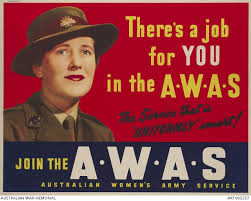
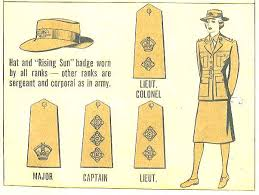
The AWAS was an official military unit within the Australian Army where women could enlist to serve in roles like driving, clerical work, communications, and even some combat support positions.  

The Australian Women’s Army Service (AWAS) was formed in August 1941 to release men from some military duties to serve with fighting units. Women worked in traditional roles such as clerks, typists and cooks.

The NES was a general term for civilian volunteer organizations that provide support during emergencies like fire, flood, or medical crises, not specifically related to wartime service

There was a network of searchlights and listening posts that formed part of Newcastle’s defences were largely operated by women. These women were carefully selected for good eyesight and hearing as they would be on high alert lookout for the distant hum of aircraft engines.

They also had to maintain the searchlights in a high state of readiness, constantly polishing the lights and greasing their mechanisms. The searchlights batteries were connected by telephone to headquarters and each battery had a command post with a plotting board to track the positions and courses of aircraft.

Some of the hardships the women had to deal with things like having to bunk down in unlined shed in the bush, they were given hessians bags and a pile of straw to make their mattresses. They also had to shower under a modified kerosene tin full of water. Just because they were women didn’t mean they got an easy ride, they had route marches with full packs and training with live ammunition on .303 rifles, bren and Thompson guns.

The Australian Women’s Army Service served in New Guinea during World War II, making it the only non-medical women’s service to serve overseas during the war. 

The Land Army and the AWAS were both disbanded shortly after the end of World War II, between 1945 and 1947.

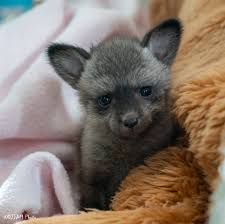
Bat-Eared Fox

This week we are look at the bat-eared fox, another fox I hadn’t heard of.

The bat-eared fox is a species of fox found on the African savanna. It is the only extant species of the genus Otocyon and a basal species of canid. Fossil records indicate this canid first appeared during the middle Pleistocene.

As the name indicates, this fox has unusually enormous ears in proportion to its head, like those of many bats. Their bodies are generally yellow-brown with a pale throat and under parts. The outsides of the ears, the racoon-like “face-mask,” lower legs, feet, and tail tip are all black. 

They can be found living in groups of mating pairs and their young. They are a very social species and spend lots of time grooming each other, as well as playing and sleeping together.

Their hearing is remarkable, but bat-eared foxes are also known for their social nature. They often live in family groups of up to 15 animals. They do not mark or defend territories aggressively against other packs.

They seldom drink water as they obtain most of the moisture they need from their food; 3. Unlike other canids, the male undertakes most parental care duties, while the female forages for food that maintains her milk production

Termites and dung beetles make up about 80 percent of their diets. In addition to termites and dung beetles, they also eat other insects and arthropods, small rodents, lizards, the eggs and chicks of other birds, and plant matter. They obtain much of their water from the body fluid of the insects they consume.

Predators include cheetahs, jackals, spotted hyenas, rock pythons, African wild dogs, and leopards. Bat-eared foxes are named for their large ears, which are also used for thermoregulation. To escape from predators, bat-eared foxes rely on speed and their incredible dodging ability.

They typically live for 6 years in the wild but can be up to 13 years in captivity. 

They reach sexual maturity at 8–9 months old, both male and female. They usually leave their family groups at 5–6 months old. 

They breed annually, producing litters of 3–6 pups, with a gestation period of 60–75 days.