
My post with links to other posts.
https://jamfn.blogspot.com/2025/07/sunday-stealing-on-wednesday.html
https://jamfn.blogspot.com/2025/07/tuesdays-four-on-wednesday_16.html
https://jamfn.blogspot.com/2025/07/my-left-shoulder-results.html
Remember Your Life Matters


I have spent most of the day trying to decide what the topic of today’s post would be, and I ended up picking the town of Alice Springs.
Aussies commonly refer to Alice Springs as “The Alice” or simply “Alice”.

This is one town I would like to visit one day my parents visited the Alice and enjoyed the visit, I do remember mum & dad telling me that when the bought wine from a bottle shop, they were told to make sure it was covered so it couldn’t be seen by looking in a window and to get in their car and drive to a different area. This was because some of the local aboriginals would break into the car if they saw grog inside and if they were seen placing alcohol in the car and walking away the car would be broken into.
Alice Springs is a remote town in Australia’s Northern Territory, halfway between Darwin and Adelaide, both 1,500km away. It’s a popular gateway for exploring the Red Centre, the country’s interior desert region. Its 1872 origin as part of the Overland Telegraph Line (linking Darwin and Adelaide) is preserved in the vintage buildings and equipment at the Alice Springs Telegraph Station Historical Reserve.

It has an estimated population of around 28,922. This is based on the Alice Springs Town Council LGA profile, which was last updated in January 2025. The town is the major settlement in Central Australia and a significant population centre in the Northern Territory.
The population of Alice Springs is an estimate because it is based on projections and statistical modelling rather than a direct head count. The Australian Bureau of Statistics (ABS) uses various methods, including census data and estimated resident population (ERP) figures, to calculate population numbers, but these are subject to revision and may not perfectly reflect the actual population at any given time, especially in smaller areas like Alice Springs.

Alice Springs was established in 1872 with the construction of the Alice Springs Telegraph Station, part of the Australian Overland Telegraph Line (OTL) connecting Adelaide to Darwin. It was originally named Stuart, but the settlement near the telegraph station was later renamed Alice Springs in 1933. The name Alice Springs was given by W.W. Mills, after Alice Todd, wife of Sir Charles Todd, who was instrumental in the construction of the telegraph line.
The Arrernte people are the traditional owners and custodians of Alice Springs, also known as Mparntwe in the Arrernte language. They have a deep and enduring connection to the land, dating back tens of thousands of years. The Arrernte have stories and significant sites related to the creation of the landscape, including the MacDonnell Ranges.
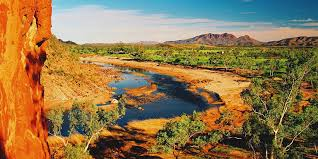
Alice Springs is famous for its unique location in the heart of Australia, its strong Aboriginal culture and art scene, and its stunning natural landscapes, including the MacDonnell Ranges. It’s also known as a hub for exploring the broader Red Centre region and for its outback character.
Alice Springs faces a complex combination of social and crime-related issues that contribute to a perception of danger. These include high rates of alcohol-related violence, property crime, and domestic violence, along with concerns about youth crime and the impact of past policies. While the town has a diverse population and attracts tourists, these issues have led to increased fear and anxiety among residents.

While Alice Springs faces significant challenges, it’s important to acknowledge that it is also a place of cultural significance, with a diverse population and a strong community spirit. Efforts are underway to address the underlying issues and improve safety and well-being for all residents.

This week’s bear is the Asiatic Black Bear, these bears can be found in eastern Asia including Afghanistan, Bangladesh, Bhutan, Cambodia, China, India, Islamic Republic of Iran, Japan, Democratic People’s Republic of Korea, Lao People’s Democratic Republic, Malaysia, Mongolia, Myanmar, Nepal, Pakistan, Russian Federation, Taiwan and Vietnam.
They have long black fur with a distinct white patch on the ch

est that is often crescent-shaped. The fur around the shoulders and throat is particularly long, and their ears are relatively large. The tail is short and is barely visible under a long, coarse coat. The black pelage has a light beige to white “V” shape on the chest area, a small beige to white coloured crescent across the throat, and a small spot of white on the chin. The white fur on the muzzle seldom reaches the orbits of the bear.

The size differs between males and females. Males typically weigh 110 to 150 kg, while females weigh 65 to 90 kg. The head and body measure 120 to 180 cm in length, while the tail is an additional 6.5 to 10.6 cm. The head is large and rounded, and the eyes are small. The ears are large and are set farther apart than on an American black bear. The body is heavy, the legs are thick and strong, and the paws are broad.
They are more carnivorous than their American counterparts, although only a small part of their diet is made up of meat. This includes small mammals, birds, fish, molluscs and carcasses. They also feed on grasses, fruits, berries, seeds, insects and honey. In autumn they fatten up for the winter by feeding on nuts. In northern climates they hibernate. In southern climates they do not hibernate.
Little is known about Asiatic black bears in the wild; most of what is known about their social and reproductive behaviour has been collected by observing the bears in zoos and environments other than their natural habitat.
In captive environments, the mating pattern of Asiatic black bears is classified as promiscuous. The gestation period is typically 6 to 8 months. This period includes a period of delayed implantation, where the fertilized egg floats freely in the uterus for a time before attaching to the uterine wall and developing further.
In the wild, Asiatic black bears typically forage alone. However, during breeding season, pairs can be seen hunting and gathering together.

They have a lifespan on around 25yrs in the wild and around 35-40yrs in captive.
They are listed as “Vulnerable” by the IUCN, meaning they face a high risk of extinction in the wild. Their populations are decreasing due to habitat loss, poaching, and the illegal trade of bear parts, particularly bile for traditional medicine. Here are some regional estimates of numbers:
They are generally considered dangerous to humans, with documented cases of both unprovoked and provoked attacks. While they are not as frequently involved in attacks as some other bear species, they are known to raid crops, damage property, and injure or kill people. Attacks are more common during late summer, coinciding with mating season.


This week we are wrapping up Kazakhstan with these facts.

The national animal of Kazakhstan is the golden eagle. It’s a powerful symbol of the country, representing strength, independence, and freedom, and it also appears on the national flag.

The national flower of Kazakhstan is the lily. Specifically, it’s the Lilium genus, though a specific variety isn’t officially designated. Lilies are recognized as a symbol of purity, grace, and renewal in Kazakhstan.

The national tree of Kazakhstan is the Schrenk’s Spruce, this majestic evergreen is native to the mountainous regions of Kazakhstan and symbolizes resilience and endurance.

The national dish of Kazakhstan is beshbarmak. It’s a hearty dish consisting of boiled meat (traditionally horse or mutton, but also beef) served over wide, flat noodles, often with a flavourful broth and onions. The name “beshbarmak” translates to “five fingers” from the Turkic languages, referring to the traditional way it’s eaten with your hands.
When it came to finding the most popular sport, I received two different answers football and kokpar, so I looked a bit more and it seems that football is the most popular sport overall, while Kokpar is the most popular traditional Kazakh game.

So, it seems that football dominates as the most-watched and participated-in sport in the country, but Kokpar holds a special place as a key part of Kazakh national identity and is widely played during celebrations like Nauruz.

Now you may be wondering what the hell Kokpar is well it’s a traditional equestrian sport, similar to polo but using a goat carcass instead of a ball.
Kazakhstan offers a relatively low cost of living compared to many Western countries, with living expenses significantly lower than in Australia or America but do are wages. The minimum wage is 531.25KZT per hour which is around $1.09 USD or $1.55AUD. America’s minimum wage is between $7.25 and $15.00. In Australia it is $24.10 per hour.

My watch says I slept for only5 hrs and 12mins and I was awake for 31 mins. It was after midnight before I settled, when my alarm went off at 5am I got up went to the toilet and took my meds then went back to bed for another 30mins. When I got up, I had a shower and dressed.
Tim and I went over to Kmart and bought a garment steamer to do his shirts.
It has turned out a warm day.
I have been struggling to find motivation to do stuff today, I was fine first thing this morning but after we got home from shopping my motivation had drained.
BHL6.6
Steps: 8,088= 4.12Klm’s
My watch says I slept for only 9 hrs and 12mins and I didn’t wake at all. I also woke up with a headache. Jessica bought me a ham & cheese pocket and a hash brown for breakfast.
Tim took the car to have the light bar fitted to the car, he left at 7.30am and it was around 1.30pm when he got home but he said he is happy with it.
He has packed his stuff to go away for a few days with work, he is going to Sydney tomorrow and will be home Thursday night or Friday he isn’t sure just yet.
I am so over the dyskinesia I have had this problem the last few days and it is exhausting and frustrating and yes, it is depressing me.
Steps: 11,219=5.70Klm’s
I will add here that I don’t walk that far most of the so-called steps are to do with movement and some days my body moves a lot. This is something Tim said last night about my high steps and not walking I reminded him about how much my body moves some days, and he said yeah, he knows.
I had a good night my watch says I slept for only 9 hrs and 21mins and I didn’t wake at all.
Tim has left this morning he is working in Sydney for a few days and will be home either late Thursday night or Friday morning.
I rang Centrelink and the man I spoke to was very helpful and after some time he managed to arrange for a letter to be sent to me stating I get no payment from Centrelink.
Tim video called me tonight he is a room on his own which makes him happy, he said the room was very small, but they are at Ibis.
Steps: 7,872=4.00
Another good night my watch says I slept for only 9 hrs, and I was awake for 31mins.
I did a load of washing and hung it out this left me hot and exhausted.
While I was using the powerfit and doing my exercises I was surprised to see Sue turn up. Turned out the morning voice message I sent to Sue was staticky and not right, so she came to check on me.
It is a nice warm winter day.
Tim rang at 7.10pm just to check in and see how I was he said he should be home sometime tomorrow night. Although I suspect it will be the early hours of Friday morning.
Steps: 6,869=3.49Klm’s
BGL: 5.4
Another good night my watch says I slept for only 7 hrs and 13 mins and I was awake for 13 mins.
It is a cold and windy day. I went shopping with Sue and it felt good to get out of the house.
Sue’s birthday present for Jeannie arrived and it looks good. I have done my present to for her already to post, I see how much it will cost to post and if it’s too much I may get Sue to give it to her when she sees Jeannie, Sue’s present is too fragile to post.
BGL 6.5
StepsL8,553=4.33Klm’s
I slept well, 9hrs & 21mins and I was awake for 32 minutes. Tim is home he went to bed a I was getting up, as he is off today, I will let him sleep till whenever he gets up.
Tim got up at 9.30am, he is working out the back.
Sue took me to have thee Xray and Ultrasound done.
It is a warm day
Kathy came over around 3.45pm she was here for just over an hour, she brought back all dad’s genealogy stuff. She uploaded it all to ancestry dot com.
I went to bed at 8pm had about 40 Mins sleep then woke up and haven’t been able to settle so I got up and used the powerfit for 30Mins, updated this and now I am going back to bed. It is now 11.45pm
BGL:6.3
Steps: 9,724=4.97 Klm’s
What a night, after returning to bed I couldn’t settle I was tired but nope wasn’t happening, I had to get up and find the Vicks to rum under my nose as I felt like I was all blocked up and couldn’t breathe right. Then I found myself needing to pee often live every 45 mins. So, when the alarm went at first, I didn’t want to get up, but I needed to pee again and decided to stay up. I can close my eyes later if I need too. I have had only 3hrs & 52mins of sleep.
Tim and I went to the shops so I could get a new vapor stick thing that you run under your nose to clear it making it easier to breathe.
Tim thought he broke the new laminator as it was jammed, he was going to toss it, but I said just remove the jam he had to take it apart to do that but after he did it worked just fine, he should have done that with the last one instead of having a hissy fit and tossing it in the bin.
As I was getting up to go to bed, I had a moment when I found it hard to stand upright, thankfully Sam was nearby and helped by holding me while I straightened up without falling over after I was upright, I was fine.
BGL: 6.1
Steps: 8,290=4.25Klm’s or 2.64miles.

Hi everyone here in Australia it is Caturday and this week there are two videos for you all to see, they were taken while I was staying at Tasha’s while mum went to Queensland in one of these you will see Luca as well.

My post with links to other posts.
https://jamfn.blogspot.com/2025/07/tuesdays-four-on-tuesday-for-change.html
https://jamfn.blogspot.com/2025/07/australia-child-labour-laws-history.html
https://jamfn.blogspot.com/2025/07/freedom-hodgepodge.html
https://jamfn.blogspot.com/2025/07/tuesdays-four-on-wednesday.html

This week we are looking at the second largest city in Western Australia this city is Mandurah, it is located approximately 72 kilometres (45 miles) south of Perth. It is known for its coastal location, marine life, and as a popular tourist destination.
It is also known for the Peel-Harvey Estuary with its abundant wildlife and migratory waterbirds. The Mandurah Community Museum features exhibits on the Peel region’s history. Halls Head Beach has a large resident dolphin population. To the south, Yalgorup National Park is home to thrombolites, rare, rock-like microorganism formations, at Lake Clifton.

Mandurah was initially established as a townsite in 1831, following the arrival of Thomas Peel’s settlement in the area. While a townsite was laid out in 1831, the area remained largely undeveloped until the post-war boom of the 1950s and 60s, when it began to grow as a fishing village and later a popular resort and retirement destination. The area’s name, Mandurah, is derived from the local Aboriginal word “mandjar,” meaning “meeting place”.
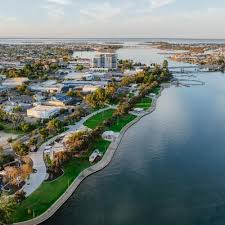
The traditional owners of Mandurah are the Bindjareb people of the Noongar Nation. The City of Mandurah acknowledges and respects the Bindjareb people as the first peoples of the land. They are also sometimes referred to as the Binjareb/Pinjarup people. The Noongar name for Mandurah is Mandjoogoordap, which means “meeting place of the heart”.
The City of Mandurah has a population of more than 99,000 residents as of June 30, 2023. This makes it the largest regional city in Western Australia. The city’s population has been steadily growing, with an increase of 3.82% in the year leading up to June 2023. Projections indicate further significant growth, with an expected increase of over 23,000 residents between 2021 and 2046


This week we are looking at a species of bear I have never heard of, that being the sun bear it is found in the tropical forests of Southeast Asia. It is the only species in the genus Helarctos and they are the smallest bear species and are only around half the size of an American black bear, measuring 4-5 feet tall when stood on their hind limbs, and weighing up to 68kg.
Sun bears are named for the bib of often sunshine-yellow fur adorning their chests. Each sun-bear bib is unique and can be used to distinguish one bear from another. Their fur is thick, short and generally jet-black, although some bears have a reddish or silvery hue.
Despite their name, recent research on wild sun bears suggests these animals are crepuscular, meaning their activity levels peak during the twilight hours of dawn and dusk.
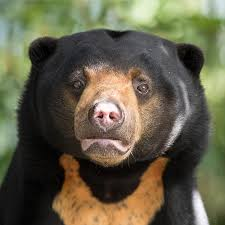
They are known to be very aggressive and may attack without apparent provocation. Except for females with cubs the bears are solitary although there is a suggestion that same may form long-term monogamous relationships. Litters are of from 1 to 3 cubs with no apparent set period for mating or birth.
Relative to their skull size, sun bears have the largest canine teeth of any bear species. For context, sun bear canines are the same size as those sported by polar bears, and species some 5 to 10 times larger.
Sun bears have long, curved claws, are well adapted for gripping bark and are the most arboreal of all the bear species. These bears will climb trees to forage for wild fruits and beehives and to evade predators such as tigers, leopards and dholes, an Asian canid. One of the characteristic signs of the presence of wild sun bears is claw marks on trees they have climbed.
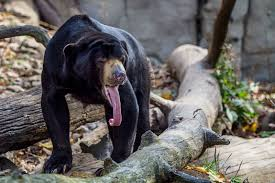
They have exceptionally long tongues, the longest among all bear species, reaching up to 25-30 centimetres (10-12 inches). These long, sticky tongues are essential for their diet, allowing them to extract insects and honey from hard-to-reach places like tree crevices and termite mounds.
Sun bears primarily inhabit dense tropical and subtropical rainforests throughout Southeast Asia. Their range includes areas in northeastern India, Bangladesh, Myanmar, Thailand, Peninsular Malaysia, Laos, Cambodia, Vietnam, southern China, and the Indonesian islands of Sumatra and Borneo. They are typically found at lower altitudes in these forests but can be seen at higher elevations in some regions like India.
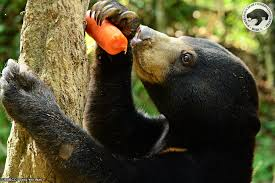
They are omnivorous, favouring fruits, insects, small animals and bee nests (for insects and honey). Large teeth and long claws enable sun bears to tear into logs and termite mounds in search of insects an important component of their diet. Their tropical habitat generally provides food resources year-round, so sun bears do not hibernate.
Sun bears face significant threats from habitat loss due to deforestation and conversion of forests for agriculture, particularly oil palm plantations. They are also targeted by commercial hunting for their bile, paws, and other body parts, and are affected by the illegal pet trade.

This week we are visiting Kazakhstan, a Central Asian country and former Soviet republic, it extends from the Caspian Sea in the west to the Altai Mountains at its eastern border with China and Russia.
It was once called the Kazakh Soviet Socialist Republic and was one of the constituent republics of the Soviet Union from 1936 until its dissolution in 1991.

Its largest metropolis, Almaty, is a long-standing trading hub whose landmarks include Ascension Cathedral, a tsarist-era Russian Orthodox church, and the Central State Museum of Kazakhstan, displaying thousands of Kazakh artifacts.
The capital is Astana although before 1997 the capital was Almaty, it has population of 1,423,726 it is the second largest city in the country. The population of the country is around 20 million.
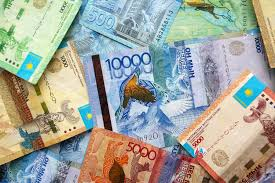
Kazakhstan is officially a bilingual country those languages are Kazakh and Russian. The currency is the Tenge.

The flag is a light blue field with a gold sun and soaring golden steppe eagle in the centre. Along the hoist side is a vertical band of national ornamentation in gold. The blue represents the endless sky and the unity of the Kazakh people, while the sun and eagle symbolize prosperity and freedom, respectively. The current flag was adopted in 1992, replacing the flag of the Kazakh Soviet Socialist Republic.

When it comes to religion the main ones are Islam and Christianity, the majority of Kazakhs, particularly ethnic Kazakhs, identify as Muslim. Most practice Sunni Islam of the Hanafi school. There are also smaller communities of Shia, Sufi, and Ahmadi Muslims.
A significant portion of the population, especially ethnic Russians, Ukrainians, and Belarusians, identify as Orthodox Christian. Other Christian denominations include Catholics, Lutherans, Presbyterians, Baptists, Pentecostals, and members of The Church of Jesus Christ of Latter-day Saints.
Smaller communities of Jews, Buddhists, and followers of other faiths like the Baha’i faith and Scientology also exist.
Kazakhstan is a presidential republic, where the President holds significant power. The President serves as both head of state and commander-in-chief, and also appoints the Prime Minister and other cabinet members. The country has a bicameral parliament, consisting of the Senate and the Majilis.
While the constitution outlines democratic principles like freedom of speech and religion, Kazakhstan’s political system is described as semi-presidential with a strong executive branch, and there are concerns about the fairness of elections and restrictions on freedoms.
That will do for now, part two next week.
 Jo-AnneRamplings