Elephants

Today we are looking at elephants which are the largest living land animals. Three living species are currently recognised: the African bush elephant, the African forest elephant, and the Asian elephant.

African elephants are the largest land animals, with males reaching up to 13 feet tall and weighing up to 14,000 pounds. 

The trunk is a multi-functional organ, used for breathing, smelling, touching, drinking, and even as a tool for digging and grabbing.

They have tusks, which are actually elongated incisor teeth that grow throughout their lives. 

While their skin is thick, it’s also sensitive and elephants often use mud and dust to protect themselves from the sun and insects. 

They are known to have an exceptional memory and are known to remember individuals and locations for years. 

They live in close-knit herds, primarily led by older females, and communicate through various vocalizations and body language. 

They communicate using a range of sounds, including trumpeting and infrasound, which can travel long distances.

African elephants are pregnant for an average of 22 months, whilst for Asian elephants it’s 18 to 22 months.1 You might think such a long pregnancy is because of what huge creatures they are – but you’d only be partly correct. Baby elephants do develop slowly in the womb because of their physical size but also because of the size of their intellect.

Baby elephants can stand and walk within minutes of birth, and they stay close to their mothers for support and protection. 

Both African and Asian elephants are facing threats from habitat loss and poaching, leading to conservation efforts to protect them. 

They can live almost as long as humans, African elephants have a maximum lifespan of about 74 years, Asian elephants can live to about 80 and the oldest known elephant in the world is thought to be an Asian elephant who lived to be 89 in captivity. 

Giant Panda

This week we are looking at the giant panda, which is a bear, I never thought of them as being part of the bear family.

Giant pandas belong to the bear family, whereas red pandas are in their own family, and they are more closely related to raccoons. Interestingly, giant pandas are more closely related to polar bears than to red pandas.

Giant pandas are typically 4 to 6 feet long and stand 2 to 3 feet tall at the shoulder. They can weigh between 220 and 330 pounds, with males tending to be larger than females,  Newborn pandas are very small, about the size of a stick of butter. 

Giant pandas live in the mountain ranges of southwestern China, specifically in the provinces of Sichuan, Shaanxi, and Gansu. They inhabit bamboo forests at elevations between 5,000 and 10,000 feet. Their habitat is characterized by humid, wet conditions and is often shrouded in mist and clouds.

A panda’s daily diet consists almost entirely of the leaves, stems and shoots of various bamboo species. Bamboo contains very little nutritional value so pandas must eat 12-38kg every day to meet their energy needs.

Scientists are not sure how long giant pandas live in the wild, but they are sure it is shorter than lifespans in zoos. They estimate that lifespan is about 15-20 years for wild pandas and about 30 years for those in human care. Chinese scientists have reported zoo pandas as old as 35.

Pandas are dependent on their mothers for the first few months of their lives and are fully weaned at 8 to 9 months. Most pandas leave their mothers when she becomes pregnant again, usually at about 18 months. Gestation takes from 95-160 days. Pandas normally give birth to single young. Twins seem to be born more frequently in captivity, when artificial insemination is used. The reproductive rate is about 1 cub every 2 years.

They are friendly and cheerful, Pandas have bundles of energy and warmth. They are confident and love trying out new things. Sociable and party-loving, they enjoy seeing friends and often put their friends’ feelings ahead of their own.

While pandas are known for their clumsy and lazy behaviour often observed in captivity or during feeding, they are actually proficient tree climbers and swimmers. 

There are the only two panda species found the giant and the red.. Despite their similarity in name, the two are not scientifically connected. They share the same geographical area and similar food.

Andean or Spectacled Bear

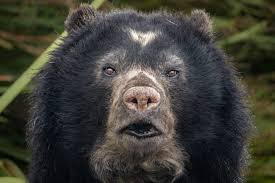
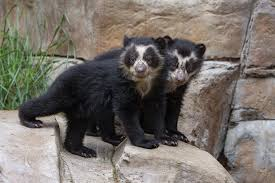
This week we are looking at the Andean Bear also known as the Spectacled Bear, this is a species of bear native to the Andes Mountains in northern and western South America. It is the only living species of bear native to South America, and the last remaining short-faced bear.

The bears are an endangered species, listed as Vulnerable, and it is illegal to kill them. The Andean bear is the last remaining short-faced bear spectacled bears are the only surviving species of bear native to South America, and the only surviving member of the subfamily Tremarctinae.

They are technically the largest land carnivore on that continent, although as little as 5% of its diet is composed of meat. South America’s largest obligate carnivore is the jaguar. Among South America’s extant, native land animals, only the Baird’s and South American Tapirs are heavier than this species. They are a mid-sized species of bear.

Overall, its fur is blackish in colour, though bears may vary from jet black to dark brown and to even a reddish hue. The species typically has distinctive, beige-coloured marking across its face and upper chest, though not all Spectacled bears have “spectacle” markings. The pattern and extent of pale markings are slightly different on each individual bear and bears can be readily distinguished by this.

They are relatively small compared to other bear species. 

Males typically weigh between 220-440 pounds and are 5.5 to 6.5 feet long, while females weigh between 80-180 pounds and are slightly smaller. They stand 2 to 3 feet tall at the shoulder. 

They have relatively large heads compared to their body size, as well as powerful claws and paws that help them climb trees and build nests.  Despite their size, they are known for their adaptability to different environments within the Andes, from cloud forests to coastal deserts. 

They inhabit mountainous regions of South America, primarily the Andes Mountains, from Venezuela to Bolivia. They are found in a variety of habitats including rainforests, cloud forests, grasslands, and even scrublands. They are known to build platform nests in trees for eating and sleeping and are generally active year-round.

They feed on fruits and bromeliads being there favored foods, but also eat berries, grasses, bulbs, cactus flowers and small animals such as rodents, rabbits and birds. Near settlements, bears sometimes raid cornfields. Andean bears climb trees and forage on the ground.

They have a lifespan of around 20yrs in the wild but up to about 38yrs under human care they have a gestation of between 160 to 255 days and can have between 1 and 4 cubs they are considered mature between 4 and 7 years.

They are the only bears are the only known to eat bromeliads. Has rings of white or light fur around its eyes. The rest of the bear’s fur is black or dark brown.

Andean bears, also known as spectacled bears, are generally considered one of the least aggressive bear species towards humans. While they are capable of defending themselves if threatened, they typically avoid encounters with people and are known for their shy and elusive nature. Attacks on humans are rare, with only one confirmed human death attributed to a spectacled bear. They can run up to 30 mph.

Asiatic Black Bear

This week’s bear is the Asiatic Black Bear, these bears can be found in eastern Asia including Afghanistan, Bangladesh, Bhutan, Cambodia, China, India, Islamic Republic of Iran, Japan, Democratic People’s Republic of Korea, Lao People’s Democratic Republic, Malaysia, Mongolia, Myanmar, Nepal, Pakistan, Russian Federation, Taiwan and Vietnam.

They have long black fur with a distinct white patch on the ch

est that is often crescent-shaped. The fur around the shoulders and throat is particularly long, and their ears are relatively large. The tail is short and is barely visible under a long, coarse coat. The black pelage has a light beige to white “V” shape on the chest area, a small beige to white coloured crescent across the throat, and a small spot of white on the chin. The white fur on the muzzle seldom reaches the orbits of the bear. 

The size differs between males and females. Males typically weigh 110 to 150 kg, while females weigh 65 to 90 kg. The head and body measure 120 to 180 cm in length, while the tail is an additional 6.5 to 10.6 cm. The head is large and rounded, and the eyes are small. The ears are large and are set farther apart than on an American black bear. The body is heavy, the legs are thick and strong, and the paws are broad.

They are more carnivorous than their American counterparts, although only a small part of their diet is made up of meat. This includes small mammals, birds, fish, molluscs and carcasses. They also feed on grasses, fruits, berries, seeds, insects and honey. In autumn they fatten up for the winter by feeding on nuts. In northern climates they hibernate. In southern climates they do not hibernate.

Little is known about Asiatic black bears in the wild; most of what is known about their social and reproductive behaviour has been collected by observing the bears in zoos and environments other than their natural habitat.

In captive environments, the mating pattern of Asiatic black bears is classified as promiscuous. The gestation period is typically 6 to 8 months. This period includes a period of delayed implantation, where the fertilized egg floats freely in the uterus for a time before attaching to the uterine wall and developing further. 

In the wild, Asiatic black bears typically forage alone. However, during breeding season, pairs can be seen hunting and gathering together.

They have a lifespan on around 25yrs in the wild and around 35-40yrs in captive.

They are listed as “Vulnerable” by the IUCN, meaning they face a high risk of extinction in the wild. Their populations are decreasing due to habitat loss, poaching, and the illegal trade of bear parts, particularly bile for traditional medicine. Here are some regional estimates of numbers:

  • China: Estimates range from 16,000 to 50,000. 
  • Japan: Estimates range from 12,000 to 20,000. 
  • India: Estimates range from 5,000 to 7,000. 
  • Russia: Estimates range from 5,000 to 7,000. 
  • Iran: Around 100-200. 
  • South Korea: Approximately 40, following reintroduction efforts

They are generally considered dangerous to humans, with documented cases of both unprovoked and provoked attacks. While they are not as frequently involved in attacks as some other bear species, they are known to raid crops, damage property, and injure or kill people. Attacks are more common during late summer, coinciding with mating season. 

Polar Bear

This week we are looking at the polar bear, the polar bear is a large bear native to the Arctic and nearby areas. It is closely related to the brown bear, and the two species can interbreed. The polar bear is the largest extant species of bear and land carnivore, with adult males weighing 300–800 kg.

They are a powerful symbol of the strength and endurance of the Arctic. The polar bear’s Latin name, Ursus maritimus, means “sea bear.” It’s an apt name for this majestic species, which spends much of its life in, around, or on the ocean–predominantly on the sea ice. In the United States, Alaska is home to two polar bear subpopulations.

They are good swimmers and can sustain a pace of six miles per hour by paddling with their front paws and holding their hind legs flat like a rudder. They have a thick layer of body fat and a water-repellent coat that insulates them from the cold air and water.

These bears spend over 50% of their time hunting for food. A polar bear might catch only one or two out of 10 seals it hunts, depending on the time of year as well as other things. Their diet mainly consists of ringed and bearded seals because they need large amounts of fat to survive.

They rely heavily on sea ice for traveling, hunting, resting, mating and, in some areas, maternal dens. But because of ongoing and potential loss of their sea ice habitat resulting from climate change–the primary threat to polar bears Arctic-wide–polar bears were listed as a threatened species in the US under the Endangered Species Act in May 2008. As their sea ice habitat recedes earlier in the spring and forms later in the fall, polar bears are increasingly spending longer periods on land, where they are often attracted to areas where humans live.

 They can run as fast as 40 kilometres per hour—but only for short distances. Younger, leaner bears are the best runners and are able to cover two kilometres’ without stopping. Older and larger bears, on the other hand, quickly overheat. However, they can only swim up to 10 kilometres per hour.

They have 42 razor sharp teeth: With jagged back teeth and canines larger than grizzly teeth, that would be quite the bite. Their paws are 30 cm wide which is big which act as a natural snowshoe that helps the bear trek across treacherous ice and deep snow. They also have 3 eyelids: The third helps protect the bear’s eyes from the elements and they have 4 inches of fat under their skin to keep it warm. Their skin is black, and their fur is transparent, and they have a blue tongue.

During autumn pregnant polar bears make dens in earth and snowbanks, where they’ll stay through the winter and give birth to one to three cubs. In spring the mother emerges from her den followed by her cubs. During that time, she will protect them and teach them how to hunt. They have a gestation period of between 195 and 265 days. They can live 20 to 30 years, but only a small percentage live past 15 to 18 years.

The oldest known polar bear in the Arctic lived 32 years. The oldest known polar bear in a zoological park lived 45 years.

When it comes to predator’s adult polar bears have no natural predators except other polar bears. Cubs less than one year old sometimes are prey to wolves and other carnivores.

Newborn cubs may be cannibalized by malnourished mothers or adult male polar bears.

American Black Bear

This week we are looking at the American black bear, or simply black bear, it is a species of medium-sized bear which is endemic to North America. It is the continent’s smallest and most widely

They vary in size, with males typically weighing between 56 to 226 kilos (125 to 500) pounds and females between 40 to 136kilos (90 to 300) pounds. They generally measure 1.5 to 2.1 metres (5 to 7 feet) in length and stand less than1 metre (2 to 3 feet) tall at the shoulder on all fours. When standing upright, they can reach a height of 5 to 6 feet

Most of their diet consists of berries, fruit, sedges, and insects. They will also occasionally consume fish, honeycomb, and human food and garbage, so it is important to make sure to keep your items locked up with bear-proof equipment! In the spring, black bears may prey on young elk and deer.

They are typically shy and secretive towards humans, generally avoiding encounters. They are known for their intelligence and curiosity, exhibiting problem-solving skills and a tendency to explore. While they can be active at any time of day, they are often crepuscular, meaning they are most active during dawn and dusk. Black bears are also solitary animals for most of the year, except during mating season and when females are raising cubs. 

They inhabit a wide range of environments across North America, primarily favouring forested areas. They are commonly found in mountainous regions, woodlands, and swamps, often seeking out areas with ample food, water, and shelter. 

They may become prey to mountain lions, wolves, coyotes, bobcats, grizzly bears, humans, or other black bears. Cubs are especially vulnerable to predation by these other animals.

While they are generally not known to be aggressive towards humans and often try to avoid encounters, they can be dangerous in certain situations. They may act defensively if they feel threatened or cornered, or if they are protecting food or their young. However, fatal black bear attacks are rare, with only a small number occurring each year in North America. 

Black bear cubs are typically born in January or February, weighing less than a pound and hairless, inside their mother’s den. They are usually born in litters of one to three, and emerge from the den with their mother in the spring, weighing around five pounds. Cubs stay with their mother for about 18 months, learning essential survival skills

Brown Bears

The brown bear is a large bear native to Eurasia and North America. Of the land carnivorans, it is rivalled in size only by its closest relative, the polar bear, which is much less variable in size and slightly bigger on average.

Grizzly bears and brown bears are the same species, although currently grizzly bears are considered to be a separate subspecies.

Brown bears are omnivorous, eating a mixed diet of plants, berries, fish, and small mammals, with almost 80 percent of their diet being tree bark, leaves, roots, mushrooms, nuts, fruit and berries. They are not averse to meat and will eat small rodents, birds, frogs or snakes, fish and carrion.

Unlike black bears, brown bears have long, strong claws that they use to dig for food, pick fruits, and catch prey.

The average life span for a wild brown bear is about 20 years, although many bears typically live longer than this. The oldest wild brown bears known lived for about 35 years.

Bear cubs are born after a gestation period of around 180-270 days. The newborn bears are naked, blind and toothless and are completely dependent on the mother. A litter usually consists of one to three cubs that weigh only 300 to 400 grammes at birth and are around 30 centimetres long.

The cubs typically stay with their mother for 2 to 3 years, learning essential survival skills. This period allows them to grow strong, learn to find food, and navigate their environment under their mother’s guidance. In some regions, like Katmai, cubs might stay with their mothers for around 2.5 years. 

Cubs are born in dens and rely on their mother’s milk for nourishment and protection. 

During their time with their mother, cubs learn crucial skills like foraging for food, recognizing and avoiding predators, and navigating different terrains. 

While some cubs might become more independent in their second year, they often continue to den with their mother for at least one more winter. 

Mothers are very protective of their cubs and may chase away or threaten other bears, including males, to keep their young safe. 

By the time they are around 2 to 3 years old, cubs are generally ready to venture out on their own and start their independent lives. 

They can climb trees, although their ability to do so diminishes as they grow older and larger. While young brown bears are excellent climbers, their size and weight can make it more challenging as they mature. However, they are still capable of climbing trees, even as adults. 

Why do they climb trees, well for various reasons, including escaping predators, accessing food (like fruit), or even just for fun or exploration.

They have an exceptionally acute sense of smell, exceeding that of dogs. Contrary to popular belief, bears are not nearsighted. Their eyesight and hearing are comparable to humans. They can run in short bursts up to 40 mph (64 kph) and are excellent swimmers

They use rocks as a tool to scratch an itchy spot and they know when they are being hunted.

Brown bear attacks on humans are relatively rare, with an average of about 40 attacks per year globally. While most encounters with bears do not result in attacks, and the vast majority of bears are not interested in attacking humans, defensive reactions can occur if a bear feels threatened or surprised, especially if it has cubs.

Rhinoceros

This week’s hooved animal is the rhinoceros or rhino the word rhinoceros is a combination of two Greek words – rhino (nose) and ceros (horn).

There are five living species of rhinoceros – white, black, greater one-horned, Javan and Sumatran. In addition, a number of other animals have rhinoceros as part of their names, including the rhinoceros auklet, rhinoceros beetle, rhinoceros chameleon, rhinoceros cockroach, rhinoceros fish, rhinoceros hornbill, rhinoceros iguana, rhinoceros rat snake, rhino shrimp, and rhinoceros viper. All of them have horn-like appendages on their noses.

They can be found in several countries across both Africa and Asia. In Africa, you can find them in Angola, Botswana, Kenya, Malawi, Mozambique, Namibia, South Africa, Tanzania, Uganda, Zambia, and Zimbabwe. In Asia, they can be found in India, Indonesia, Nepal, and Vietnam. 

The two main species of rhino in Africa are the black rhino and the white rhino. Black rhinos are found in 12 African countries, with the largest populations in Namibia, South Africa, Kenya, and Zimbabwe. White rhinos are found in 11 African countries. 

Asia is home to the greater one-horned rhino, Javan rhino, and Sumatran rhino. You can find them in India, Indonesia, Nepal, and Vietnam. 

A rhino’s horn is not attached to its skull. It is actually a compacted mass of hairs that continues to grow throughout the animal’s lifetime, just like our own hair and nails. The longest horn on record belonged to a white rhino and measured just under 152cm or 60 inches, which is five feet, and I am only four foot eleven inches tall.

The rhinoceros’s closest living relative is the tapir. Horses and zebras are also related, but less closely than tapirs. All three belong to the group of odd-toed ungulates, known as Perissodactyla. Really horses and zebras that sounds weird.

The white rhino’s name comes from the Afrikaans word “wyd,” which means “wide” and describes its mouth. Early English settlers in South Africa misinterpreted the “wyd” for “white”. Black rhinos may have received their name from the dark wet mud in their wallows that made them appear black in colour. Both species are gray in colour, the famous Blue Rhino, corporate logo for the well-known propane tank company, is entirely a figment of its founder’s imagination.

After mating, adult male and female rhinos typically go their separate ways. After the calf is born, it will spend a couple of years or more in the company of its mother, and perhaps associate with other females and their calves, but the father rhino is not part of the standard social group.

They are not generally considered friendly to humans, although they are not inherently aggressive. They prefer to be just left alone and will only charge if they feel threatened or are protecting their young. Female rhinos, especially those with calves, can be particularly dangerous in the wild. While they may not intentionally seek to harm humans, their size and power make them a serious threat if they do charge. 

The live anywhere between 35 and 50yrs depending on the breed.

All five species of rhinos are herbivores, eating mainly vegetation. They spend most of their time browsing and grazing through their natural habitat in search of plants and grasses to eat.

Bat-Eared Fox

This week we are look at the bat-eared fox, another fox I hadn’t heard of.

The bat-eared fox is a species of fox found on the African savanna. It is the only extant species of the genus Otocyon and a basal species of canid. Fossil records indicate this canid first appeared during the middle Pleistocene.

As the name indicates, this fox has unusually enormous ears in proportion to its head, like those of many bats. Their bodies are generally yellow-brown with a pale throat and under parts. The outsides of the ears, the racoon-like “face-mask,” lower legs, feet, and tail tip are all black. 

They can be found living in groups of mating pairs and their young. They are a very social species and spend lots of time grooming each other, as well as playing and sleeping together.

Their hearing is remarkable, but bat-eared foxes are also known for their social nature. They often live in family groups of up to 15 animals. They do not mark or defend territories aggressively against other packs.

They seldom drink water as they obtain most of the moisture they need from their food; 3. Unlike other canids, the male undertakes most parental care duties, while the female forages for food that maintains her milk production

Termites and dung beetles make up about 80 percent of their diets. In addition to termites and dung beetles, they also eat other insects and arthropods, small rodents, lizards, the eggs and chicks of other birds, and plant matter. They obtain much of their water from the body fluid of the insects they consume.

Predators include cheetahs, jackals, spotted hyenas, rock pythons, African wild dogs, and leopards. Bat-eared foxes are named for their large ears, which are also used for thermoregulation. To escape from predators, bat-eared foxes rely on speed and their incredible dodging ability.

They typically live for 6 years in the wild but can be up to 13 years in captivity. 

They reach sexual maturity at 8–9 months old, both male and female. They usually leave their family groups at 5–6 months old. 

They breed annually, producing litters of 3–6 pups, with a gestation period of 60–75 days. 

Grey Fox

The gray fox, or grey fox, is an omnivorous mammal of the family Canidae, widespread throughout North America and Central America.

They live in a wide variety of places. They prefer to live in places they can blend in, like canyons and ridges. Though they will also live in wooded areas, open desert and grasslands. They can be found from Quebec to Northern Columbia and Venezuela.

They are common, but very elusive and rare to spot in the wild. They are primarily nocturnal but may forage during the day.

They are smaller than red foxes. They weigh between 7 and 13 pounds and average 3 to 4 feet in length including the tail. They are stockier and have shorter legs than the red fox. Their color is grizzled gray with a distinctive black streak along the top to the black tip of the tail.

They have a white throat and belly. Their chest and lower sides of the body, undersurface of the tail, backs of the ears, parts of the legs, feet and neck are reddish or yellowish brown. The claws are sharp, and on the forefeet recurved.

Due to their more aggressive behavior, they prefer to hunt thicker cover than the more timid red fox. The gray fox’s preference for thicker cover, aggressive behavior, and the ability to climb trees minimizes the effect that eastern coyotes have on their population.

It often lines the den with shredded bark or leaves and will return to the same one year after year. The gray fox is nocturnal and crepuscular, which means it is most active at dusk and dawn. During the day, it remains in the den.

The gray fox is a solitary hunter and eats a wide variety of foods. A large part of its diet is made up of small mammals like mice, voles and eastern cottontail rabbits. It also eats birds; insects; and plants like corn, apples, nuts, berries and grass.

The gray fox has few natural predators. Bobcats, coyotes, great horned owls, and golden eagles may occasionally prey upon young gray foxes.