This week we are still in Japan, and I am going to share a bit about the Geisha.
Geisha originated in Japan during the Edo period as highly trained entertainers skilled in traditional arts—not prostitutes, as often misunderstood. The first geisha were men, but women soon became the dominant figures in the profession.
The earliest geisha-like figures were saburuko, female entertainers during the 7th century. Some performed dances and music, while others offered companionship or sexual services.
The modern concept of geisha emerged in Kyoto’s pleasure quarters. Initially, male performers entertained guests with music and storytelling. By the mid-18th century, women took over the role, specializing in refined arts like shamisen (three-stringed instrument), nihon-buyo (classical dance), and sadō (tea ceremony).
The Geisha culture thrived in Kyoto and Osaka, between 1688 and 1704, these women became cultural icons, versed in literature, poetry, and etiquette. They were distinct from courtesans, focusing solely on artistic performance.
Aspiring geisha trained in okiya (boarding houses) under senior geisha. Young apprentices, called maiko, learned through observation and practice before debuting as full geisha.
Between 1868 & 1912 Western influence challenged traditional roles, but geisha adapted by blending modern elements with heritage. Their popularity persisted, especially in Kyoto.
After WW11 during Allied Occupation abolished state-sanctioned prostitution, leading to confusion about geisha roles. Geisha reaffirmed their identity as artists, not sex workers.
Today’s Geisha are mostly found in Kyoto’s hanamachi (geisha districts), they continue to perform at private banquets (ozashiki) and public festivals. Their appearance—white makeup, elaborate kimono, and traditional hairstyles—remains iconic.
They are now seen as custodians of Japanese performing arts. Some schools, like the Inoue school in Kyoto, teach exclusive dance styles such as kyo-mai, passed down only within the geisha community.
Good morning, all another Monday has arrived, Sam is off to Tafe and I am now going to write some more about Japan.
The population is 126 million, the country has the longest life expectancy with many over the age of 100.
The country is known for its cleanliness with the culture emphasizes personal responsibility for littering. A person can be fined anything between $45 and $4,500USD, and repeat offenders may find themselves in jail. People often take their trash home as public bins and often scarce, they can be found near convenience stores, train stations, and vending machines.
Speaking of vending machines, the country has more vending machines then any other country with a large variety of products.
In Japan bowing is deeply ingrained in cultural practices and is used to express gratitude, apology as well as social hierarchy. The angle, duration, and context of the bow all convey different meanings, and mastering this etiquette is key to navigating Japanese society gracefully.
Men typically bow with arms straight at their sides, women often place hands together in front of their legs. Eyes should be cast downward—not making eye contact during the bow is considered polite.
Bowing is used for the following, greetings and farewells, apologies and expressions of thanks, ceremonies, religious rituals, and martial arts. Even in customer service interactions, even train staff bow to passengers!
Japanese people may even bow during phone calls, out of habit.
While bowing is standard, handshakes may be offered to foreigners in business or casual settings.
If unsure, follow your host’s lead. A slight bow is always appreciated and shows cultural awareness.
Now for a bit about the Japanese flag, known as the Hinomaru features a red circle on a white background symbolizing the sun. It reflects Japan’s identity as “The Land of the Rising Sun.”
The red circle represents the sun, a sacred symbol in Japanese mythology and the white background symbolizes purity, honesty, and peace. The current design was formally adopted in 1999 under Japan’s National Flag Law.
Hi everyone, this week we are looking at Japan, known as the Land of the Rising Sun, it is a country with a mixture of cultural heritage as well as advanced technology and has some unique traditions.
Japan isn’t just one island but has as many as 4,000 small islands and 4 main islands, which are Honshu, Hokkaido, Kyushu and Shikoku. It stretches approximately 2,400klm’s or 1,500 miles.
It is a mountainous place with about 80% of the land covered in mountains, including Mount Fuji.
Mount Fuji is not only Japan’s highest mountain; it has been a sacred site for the Shinto religion since the seventh century. The cool thing is that Princess Konohanasakuya is the Kami (divine person) of Mount Fuji in the Shinto religion. The cherry blossom is her symbol.
It is located on the Pacific Ring of Fire which makes it prone to earthquakes and volcanic eruptions, and it has around 1,000 earthquakes each year. Most of these earthquakes are minor and unnoticeable, but large and destructive earthquakes do occur from time to time.
The capital is Tokyo and is considered the largest city in the world, with around 374 million people living there.
It is one of the most technologically advanced counties and is well known for its innovations in robotics.
They give a great deal of attention to education and is one of the most literate in the world. A distinctive awareness of natural beauty and interest in shape and balance are obvious.
The country is 98.5% Japanese and yes this may seem absurd, but the modern world is becoming increasingly multicultural. However, this is not the case in Japan. That is largely due to stringent visa requirements and a cultural mindset keeping its distinctive and ancient culture steeped in old traditions.
I expect when you think of Japan, you’re probably thinking of the country’s numerous cities or its main islands. You may be Surprised that 67% is covered in forest. It is not uncommon to see signs on forest trails warning to look out for black bears.
Hello everyone, this week we are looking at the country of Indonesia which is in Asia. It is a vast and fascinating country with a wealth of unique facts.
The current capital is Jakarta, located on the island of Java. However, the government is in the process of relocating the capital to a new city, Nusantara, on the island of Borneo (East Kalimantan), due to overcrowding and environmental issues in Jakarta.
It has a population of around 284.7 to 285.7 million people making it the world’s fourth most populous country. It has the largest Muslim population in the world, though the country is officially secular and recognizes six major religions.
Indonesia is the world’s largest archipelagic state, comprising over 17,000 islands (though the exact number is debated). Due to its numerous islands, it has the second-longest coastline in the world, after Canada.
It stretches over a distance equivalent to about one-eighth of Earth’s circumference and straddles the equator.
Located on the Pacific Ring of Fire, Indonesia is one of the most volcanic countries in the world, home to 139 volcanoes, with many still active. It also has the world’s largest volcanic lake, that being Lake Toba, on Sumatra.
The national motto is “Bhinneka Tunggal Ika” (Unity in Diversity), there are more than 300 ethnic groups with over 700 languages and dialects spoken. The official national language is Bahasa Indonesia, which serves as a unifying force across the archipelago.
The island of Java is the most populous island in the world, home to more than half of Indonesia’s total population. It is where the capital is located.
The flag of Indonesia, known as Sang Saka Merah Putih (The Lofty Red and White), is a simple yet powerful design.
It is a horizontal bicolour of two equal bands, with red on top and white on the bottom. The red symbolises courage (keberanian), and the white symbolises purity (kesucian).
It was officially adopted on August 17, 1945, the day the nation proclaimed its independence.
However, the red and white colours and the bicolour design have a much longer history, tracing back to the Majapahit Empire in the 13th century. This flag was also used by Indonesian nationalist movements as early as 1928.
Today I am looking a bit more at the town of Beijing, the capital of China.
Beijing is a city with a rich and extensive history, with evidence of human habitation dating back hundreds of thousands of years. It has served as the capital of various Chinese dynasties for most of the past eight centuries and has played a central role in the country’s political and cultural development.
The area around modern-day Beijing has been inhabited since prehistoric times. The discovery of “Peking Man” fossils in Zhoukoudian, dating back 230,000 to 250,000 years, provides evidence of early human ancestors.
Beijing’s rise to a major imperial capital began in the 10th to 13th centuries, when nomadic peoples from beyond the Great Wall made the city their capital.
In 1215, the Mongol armies of Genghis Khan captured and destroyed the city. However, Kublai Khan, a successor of Genghis Khan and founder of the Yuan dynasty (1271–1368), decided to rebuild the city and make it his capital, renaming it Dadu (“Great Capital”). It was during this time that the city first became the political centre of a unified China. The Venetian merchant Marco Polo visited Dadu and was astonished by its grandeur.
In 1644, the Manchu people conquered China and established the Qing dynasty (1644–1912), with Beijing as their capital. The city’s layout and many of its iconic landmarks, such as the Forbidden City and the Temple of Heaven, remained largely the same, though new palaces and gardens were added outside the city walls, including the Old Summer Palace and the Summer Palace. The Old Summer Palace was famously destroyed by British and French troops during the Second Opium War in 1860.
The Qing dynasty was overthrown in 1912, and the Republic of China was established. Beijing remained the political centre for a time but was renamed Beiping (“Northern Peace”) in 1928 when the capital was moved to Nanjing.
On October 1, 1949, Mao Zedong proclaimed the founding of the People’s Republic of China from Tiananmen Gate, and Beijing was once again declared the nation’s capital. The city has undergone significant changes since then, with the development of modern infrastructure and the expansion of the urban area. Notable recent historical events include the Tiananmen Square protests in 1989 and the hosting of the 2008 Summer Olympics.
According to official data, the permanent population of Beijing was 21.832 million at the end of 2024. This marked a decrease of 26,000 from the previous year.
The housing market in Beijing is complex, with a mix of ownership and rental options. The government has played a significant role in housing policy, with a shift from subsidized public housing to a more commercialized market since 1978. This has led to a variety of housing tenures, including public rental, private market rental, and several types of home ownership (e.g., purchasing former public housing or market-rate homes). Residence status and income are major factors that determine the type of housing a person can access.
The majority of Beijing’s population lives in multi-story apartment buildings, a trend driven by rapid urbanization and the need to house a massive population in a limited space.
The most common form of housing is apartment buildings, these range from older, multi-story buildings (typically 4-7 stories) to modern high-rise towers with over seven floors and elevators. They are found throughout the city, with prices and quality varying significantly depending on the location. Modern, high-end apartments are common in the central business district and upscale neighbourhoods, while more functional and affordable apartments are found in the suburbs.
There are also siheyuans which are courtyard houses, these are Beijing’s traditional and iconic residential dwellings. A siheyuan consists of buildings arranged around a central courtyard. While they were once the dominant housing style, many have been demolished to make way for modern apartment buildings. Today, the remaining siheyuans are highly sought after and expensive, often found in the historic “hutong” (narrow alley) areas of central Beijing. Some have been converted into boutique hotels, restaurants, or shared by multiple families.
Found predominantly in the city’s suburbs are villas, which are Western-style, single-family homes or townhouses. They are a much rarer and more expensive housing option compared to apartments.
A significant portion of the migrant worker population and some state employees live in dormitories or other forms of collective housing provided by their employers. These are often located near factories or construction sites and are generally considered a more temporary or basic form of accommodation.
Time to move into another part of the world, we are now in Asia, which is the worlds largest and most diverse continent, it has both the highest and lowest points on Earth as well as the longest coastline of any continent.
It is subject overall to the world’s widest climatic extremes, and, consequently, produces the most varied forms of vegetation and animal life on Earth.
The name Asia is ancient, and its origin has been variously explained. The Greeks used it to designate the lands situated to the east of their homeland. It is believed that the name may be derived from the Assyrian word asu, meaning “east.” Another possible explanation is that it was originally a local name given to the plains of Ephesus.
Asia has the Arctic Ocean to its north, the Pacific Ocean to the east, the Indian Ocean to the south.
Asia is separated from North America to the northeast by the Bering Strait and from Australia to the southeast by the seas and straits connecting the Indian and Pacific oceans. The Isthmus of Suez unites Asia with Africa.
Asia is the birthplace of all the world’s major religions—Buddhism, Christianity, Hinduism, Islam and Judaism. Of those, only Christianity developed primarily outside of Asia and has little influence on the continent, though many Asian countries have Christian minorities. Buddhism has had a greater impact outside its birthplace in India and is prevalent in various forms in China, South Korea, Japan, the Southeast Asian countries, and Sri Lanka.
There are 48 countries in Asia, this number does not include dependent territories or areas of special sovereignty.
Over 2,300 languages are thought to be spoken in Asia, sssthis linguistic diversity is due to the continent’s vast size and diverse geography, which has allowed languages to develop in relative isolation. Asia is home to a wide array of language families, including Indo-European, Sino-Tibetan, Dravidian, and many others.
This week we are looking at the giant panda, which is a bear, I never thought of them as being part of the bear family.
Giant pandas belong to the bear family, whereas red pandas are in their own family, and they are more closely related to raccoons. Interestingly, giant pandas are more closely related to polar bears than to red pandas.
Giant pandas are typically 4 to 6 feet long and stand 2 to 3 feet tall at the shoulder. They can weigh between 220 and 330 pounds, with males tending to be larger than females, Newborn pandas are very small, about the size of a stick of butter.
Giant pandas live in the mountain ranges of southwestern China, specifically in the provinces of Sichuan, Shaanxi, and Gansu. They inhabit bamboo forests at elevations between 5,000 and 10,000 feet. Their habitat is characterized by humid, wet conditions and is often shrouded in mist and clouds.
A panda’s daily diet consists almost entirely of the leaves, stems and shoots of various bamboo species. Bamboo contains very little nutritional value so pandas must eat 12-38kg every day to meet their energy needs.
Scientists are not sure how long giant pandas live in the wild, but they are sure it is shorter than lifespans in zoos. They estimate that lifespan is about 15-20 years for wild pandas and about 30 years for those in human care. Chinese scientists have reported zoo pandas as old as 35.
Pandas are dependent on their mothers for the first few months of their lives and are fully weaned at 8 to 9 months. Most pandas leave their mothers when she becomes pregnant again, usually at about 18 months. Gestation takes from 95-160 days. Pandas normally give birth to single young. Twins seem to be born more frequently in captivity, when artificial insemination is used. The reproductive rate is about 1 cub every 2 years.
They are friendly and cheerful, Pandas have bundles of energy and warmth. They are confident and love trying out new things. Sociable and party-loving, they enjoy seeing friends and often put their friends’ feelings ahead of their own.
While pandas are known for their clumsy and lazy behaviour often observed in captivity or during feeding, they are actually proficient tree climbers and swimmers.
There are the only two panda species found the giant and the red.. Despite their similarity in name, the two are not scientifically connected. They share the same geographical area and similar food.
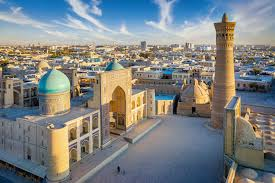
Here we are at another Monday, I wasn’t sure I would do a post today due to feeling tired and worn out and not having a lot of motivation but here I am writing about the country of Uzbekistan, not a country I have heard of but I do like doing posts about places and other stuff I know little or nothing about. This country has a population of around 36 million.
Uzbekistan is a Central Asian nation and former Soviet republic. It’s known for its mosques, mausoleums and other sites linked to the Silk Road, the ancient trade route between China and the Mediterranean. Samarkand, a major city on the route, contains a landmark of Islamic architecture: the Registan, a plaza bordered by 3 ornate, mosaic-covered religious schools dating to the 15th and 17th centuries
The capital city is Tashkent, it’s known for its many museums and its mix of modern and Soviet-era architecture. The Amir Timur Museum houses manuscripts, weapons and other relics from the Timurid dynasty. Nearby, the huge State Museum of History of Uzbekistan has centuries-old Buddhist artifacts. The city’s skyline is distinguished by Tashkent Tower, which offers city views from its observation deck.
The official currency is the Sum, the country replaced the ruble with the sum at par in on 16 July 1994. No subdivisions of this sum were initially issued and only banknotes were produced, in denominations of 1, 3, 5, 10, 25, 50, 100, 200, 500, 1,000, 5,000, and 10,000 sum. Further series, however, have introduced coins and a subunit, the tiyin. Because it was meant to be a transitional currency, the design was rather simplistic.
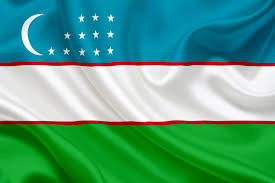
The flag of Uzbekistan is a horizontal triband with three equal bands of blue, white, and green, separated by two thin red stripes. In the upper left canton (hoist side), there’s a white crescent moon and twelve white stars. The blue band represents the sky and water and is also associated with the Turkic peoples. The white represents peace and purity. The green symbolizes nature and new life. The red stripes are a symbol of the power of life. The crescent moon is a traditional Uzbek symbol, and the twelve stars represent the twelve months of the Islamic calendar and the constellations.
Islam is the predominant religion, with the vast majority of the population identifying as Muslim. While Islam is dominant, there are also other officially recognized faiths, and the country has a diverse religious landscape.
Other faiths are also present, including Russian Orthodox Christianity, Judaism, Buddhism, there are also significant populations of Baha’is, Zoroastrians, and Roman Catholics.
Uzbekistan’s government acknowledges religious freedom, but it also maintains a system of state control over religious organizations, including registration requirements and oversight of religious literature. The Muslim Board of Uzbekistan (MBU) plays a significant role in managing Islamic affairs, and it works within a framework established by the government.
Uzbek is a Karluk Turkic language spoken by Uzbeks. It is the official and national language of Uzbekistan and formally succeeded Chagatai, an earlier Karluk language endonymically called Türki or Türkçe, as the literary language of Uzbekistan in the 1920s. However, many other native languages are spoken in the country. These include several other Turkic languages, Persian and Russian.
This week we are wrapping up Kazakhstan with these facts.
The national animal of Kazakhstan is the golden eagle. It’s a powerful symbol of the country, representing strength, independence, and freedom, and it also appears on the national flag.
The national flower of Kazakhstan is the lily. Specifically, it’s the Lilium genus, though a specific variety isn’t officially designated. Lilies are recognized as a symbol of purity, grace, and renewal in Kazakhstan.
The national tree of Kazakhstan is the Schrenk’s Spruce, this majestic evergreen is native to the mountainous regions of Kazakhstan and symbolizes resilience and endurance.
The national dish of Kazakhstan is beshbarmak. It’s a hearty dish consisting of boiled meat (traditionally horse or mutton, but also beef) served over wide, flat noodles, often with a flavourful broth and onions. The name “beshbarmak” translates to “five fingers” from the Turkic languages, referring to the traditional way it’s eaten with your hands.
When it came to finding the most popular sport, I received two different answers football and kokpar, so I looked a bit more and it seems that football is the most popular sport overall, while Kokpar is the most popular traditional Kazakh game.
So, it seems that football dominates as the most-watched and participated-in sport in the country, but Kokpar holds a special place as a key part of Kazakh national identity and is widely played during celebrations like Nauruz.
Now you may be wondering what the hell Kokpar is well it’s a traditional equestrian sport, similar to polo but using a goat carcass instead of a ball.
Kazakhstan offers a relatively low cost of living compared to many Western countries, with living expenses significantly lower than in Australia or America but do are wages. The minimum wage is 531.25KZT per hour which is around $1.09 USD or $1.55AUD. America’s minimum wage is between $7.25 and $15.00. In Australia it is $24.10 per hour.
Hi everyone before starting this year’s countries to learn about I thought we would star with some basic information most people may know but many will not.
Like there are seven continents on this planet, a continent is one of Earth’s seven main divisions of land. The continents are, from largest to smallest: Asia, Africa, North America, South America, Antarctica, Europe, and Australia.
According to the United Nations, there are 195 countries in the world, with 193 being part of the United Nations and two not being members, those two are the Holy See (Vatican City) and the State of Palestine.
However, other organizations may list a different number of countries. For example, the CIA lists 237 countries. Many other nations also consider themselves to be fully-fledged nations.
There are 54 countries in Africa, 44 in Europe, 48 in Asia, 23 in North America, 12 in South America, 14 in Oceania including Australia which is also considered a continent on its own and then there is Antarctica which of course has no countries.
Now you may be like me and think Oceania what the hell I wasn’t taught about this continent, I thought Australia was the sixth continent.
Well for some reason, those wise folks in geography academia decided we needed another way to identify them. And now we have Oceania. Oceania covers the whole area: All of Australia, all of New Zealand, PLUS the myriad of islands in the region that were orphaned without a continent home.
Also, Oceania is not considered a continent if you are using a geographical definition of continent. However, when dividing the world into 7 regions the islands of the Pacific are usually grouped with Australia and called Oceania, and sometimes these regions are called continents even though this is not technically correct.
When you think about it that makes sense since generally most people would say there is only one country in the continent of Australia. However, some say differently listing the following countries as part of the continent, Fiji, Kiribati, Marshall Islands, Micronesia, Nauru, New Zealand, Palau, Papua and New Guinea, Samoa, Solomons, Tonga, Tuvalu, Vanuatu. Australia is one country. There are no other sovereign nations in the Australian mainland.
I find all that confusing and now have a headache.









 Jo-AnneRamplings