Now days China is ruled as a unitary one-party state by the Chinese Communist Party (CCP). The CCP holds a monopoly on political power and its authority is embedded in all aspects of government and society.
The constitution of the People’s Republic of China explicitly states that the country is under the leadership of the CCP. The party’s institutions overlap with government bodies at every level, from the national government to local villages.
The General Secretary of the CCP, currently Xi Jinping, holds the ultimate power and authority over the state and the military. While he also holds the titles of President of China and Chairman of the Central Military Commission, his power is primarily derived from his position as head of the party.
The State Council is the chief administrative authority of the government. Led by the Premier, it is responsible for implementing the policies and directives set forth by the CCP. While it is the highest organ of state administration, it is subservient to the party’s leadership.
The National People’s Congress (NPC) is constitutionally the “highest organ of state power.” However, in practice, it functions as a rubber-stamp legislature that approves decisions already made by the CCP leadership. The CCP controls a two-thirds majority of the seats, and all elections are tightly controlled by the party.
Unlike many Western democracies, China’s political system does not have a separation of powers. The party’s authority is integrated into all state organs, including the government, military, and judicial system. The judiciary is not independent and serves to enforce the party’s will.
Or to put it simply, the Chinese Communist Party is the central and all-encompassing force that governs China, with all other state institutions operating under its control and direction. Like anyone didn’t already know this.
Today I am looking a bit more at the town of Beijing, the capital of China.
Beijing is a city with a rich and extensive history, with evidence of human habitation dating back hundreds of thousands of years. It has served as the capital of various Chinese dynasties for most of the past eight centuries and has played a central role in the country’s political and cultural development.
The area around modern-day Beijing has been inhabited since prehistoric times. The discovery of “Peking Man” fossils in Zhoukoudian, dating back 230,000 to 250,000 years, provides evidence of early human ancestors.
Beijing’s rise to a major imperial capital began in the 10th to 13th centuries, when nomadic peoples from beyond the Great Wall made the city their capital.
In 1215, the Mongol armies of Genghis Khan captured and destroyed the city. However, Kublai Khan, a successor of Genghis Khan and founder of the Yuan dynasty (1271–1368), decided to rebuild the city and make it his capital, renaming it Dadu (“Great Capital”). It was during this time that the city first became the political centre of a unified China. The Venetian merchant Marco Polo visited Dadu and was astonished by its grandeur.
In 1644, the Manchu people conquered China and established the Qing dynasty (1644–1912), with Beijing as their capital. The city’s layout and many of its iconic landmarks, such as the Forbidden City and the Temple of Heaven, remained largely the same, though new palaces and gardens were added outside the city walls, including the Old Summer Palace and the Summer Palace. The Old Summer Palace was famously destroyed by British and French troops during the Second Opium War in 1860.
The Qing dynasty was overthrown in 1912, and the Republic of China was established. Beijing remained the political centre for a time but was renamed Beiping (“Northern Peace”) in 1928 when the capital was moved to Nanjing.
On October 1, 1949, Mao Zedong proclaimed the founding of the People’s Republic of China from Tiananmen Gate, and Beijing was once again declared the nation’s capital. The city has undergone significant changes since then, with the development of modern infrastructure and the expansion of the urban area. Notable recent historical events include the Tiananmen Square protests in 1989 and the hosting of the 2008 Summer Olympics.
According to official data, the permanent population of Beijing was 21.832 million at the end of 2024. This marked a decrease of 26,000 from the previous year.
The housing market in Beijing is complex, with a mix of ownership and rental options. The government has played a significant role in housing policy, with a shift from subsidized public housing to a more commercialized market since 1978. This has led to a variety of housing tenures, including public rental, private market rental, and several types of home ownership (e.g., purchasing former public housing or market-rate homes). Residence status and income are major factors that determine the type of housing a person can access.
The majority of Beijing’s population lives in multi-story apartment buildings, a trend driven by rapid urbanization and the need to house a massive population in a limited space.
The most common form of housing is apartment buildings, these range from older, multi-story buildings (typically 4-7 stories) to modern high-rise towers with over seven floors and elevators. They are found throughout the city, with prices and quality varying significantly depending on the location. Modern, high-end apartments are common in the central business district and upscale neighbourhoods, while more functional and affordable apartments are found in the suburbs.
There are also siheyuans which are courtyard houses, these are Beijing’s traditional and iconic residential dwellings. A siheyuan consists of buildings arranged around a central courtyard. While they were once the dominant housing style, many have been demolished to make way for modern apartment buildings. Today, the remaining siheyuans are highly sought after and expensive, often found in the historic “hutong” (narrow alley) areas of central Beijing. Some have been converted into boutique hotels, restaurants, or shared by multiple families.
Found predominantly in the city’s suburbs are villas, which are Western-style, single-family homes or townhouses. They are a much rarer and more expensive housing option compared to apartments.
A significant portion of the migrant worker population and some state employees live in dormitories or other forms of collective housing provided by their employers. These are often located near factories or construction sites and are generally considered a more temporary or basic form of accommodation.
Hi everyone, I am going to share a little more information about China, like how old the country is.
The age of China as a continuous civilization is often measured in different ways, leading to various figures.
China is widely considered one of the world’s oldest continuous civilizations, with a history spanning over 4,000 years. This is based on archaeological and historical records of early dynasties like the Shang.
The first unified Chinese state was established by the Qin Dynasty in 221BCE. This marked the beginning of imperial China, which lasted for over two millennia. This period of centralized rule is a key factor in the formation of the modern nation-state.
The country has had many dynasties, however the number of dynasties China has had is a bit complicated, as it depends on how you define a “dynasty.” Some periods saw multiple competing dynasties at the same time, while others were short-lived.
However, historians generally recognise 13 major dynastic periods in a long, continuous line of succession that ruled over a unified or semi-unified China: Here are what those 13 dynasties are.
Xia Dynasty (c. 2070–1600 BCE): The first dynasty in traditional Chinese history, though its existence is considered quasi-mythical by some scholars.
Shang Dynasty (c. 1600–1046 BCE): The first dynasty with solid archaeological evidence.
Zhou Dynasty (c. 1046–256 BCE): The longest-ruling dynasty, which developed the concept of the “Mandate of Heaven.”
Qin Dynasty (221–206 BCE): The first to unify China and establish a centralized, imperial system.
Han Dynasty (206 BCE–220 CE): A golden age for Chinese culture and technology.
Sui Dynasty (581–618): Briefly unified China after a long period of disunity.
Tang Dynasty (618–907): Another “golden age,” known for its flourishing arts and culture.
Song Dynasty (960–1279): A period of great economic and technological advancement.
Yuan Dynasty (1271–1368): Established by the Mongols under Kublai Khan.
Ming Dynasty (1368–1644): Known for its ambitious public works and extensive maritime exploration.
Qing Dynasty (1644–1912): China’s last imperial dynasty, ruled by the Manchu people.
In addition to these, there were many other smaller or regional dynasties and periods of fragmentation, such as the Three Kingdoms, the Sixteen Kingdoms, and the Five Dynasties and Ten Kingdoms periods. If you were to count every single one of these, the total number of Chinese dynasties could be as high as over 80.
This week we are looking at China which is in East Asia and is the largest of all the Asian countries, making up nearly the entire East Asian landmass. It’s also nearly as large as Europe.
There are 33 administrative units under the central government, these consist of 22 provinces, 5 autonomous regions, 4 municipalities and 2 special administrative regions.
It has a population of around 1,416,096,094 which is around 17.2% or the total world population, it is the second largest populated country.
The capital of China is Beijing and has been for around 8 centuries, it has a population of over 22 million.
The official language is Standard Mandarin which is mainly based on the Beijing dialect.
The flag is red with five golden stars, it has one large star and four smaller stars in a arc, it has been the national flag since the foundation of the People’s Republic of China on the 1 October 1949. It was designed by Zeng Liansong. The red represents the Communist Revolution, and the stars represent the unity of the four social classes of the Chinese people.
When we think of the Chinese currency, we think of the currency we think of the Yuan which is the basic unit however, the currency is the renminbi.
The People’s Bank of China has the exclusive authority to issue currency. Banknotes range in denomination from 1 fen to 100 renminbi. The obverse side of some banknotes contain images of communist leaders, such as Mao Zedong. The reverse side of most coins contains images of historic buildings and the country’s diverse landscape.
Buddhist Statues
China is a centre for world religious thought and practices. Although about half the population identifies as nonreligious or atheist, many belief systems have shaped Chinese society for centuries. The government officially recognizes five religions: Buddhism, Taoism, Protestantism, Catholicism, and Islam, though it keeps these under tight control.
Confucianism Temple
Also popular is Confucianism which is a worldview, social ethic, political ideology, and way of life that entails ancestor reverence and profound human-centered religiousness. It emphasizes the duty of the individual in society and government.
There is also Daoism, which is a, indigenous religious-philosophical tradition, Daoism emphasizes mystical experience and the individual’s harmony with nature.
Buddhism came to China possibly as early as the 3rd century BCE. China became an incubator for many of the great present-day Buddhist sects, including Zen and Pure Land, and, by its extension into Tibet, the source of Tibetan Buddhism.
Folk Religion Temples
Many Chinese embrace aspects and rituals of indigenous folk religions, which comprise the largest group of those professing a belief. Deities of the popular pantheon are intimately involved in everyday life as givers of blessings or bringers of calamities.
Christians are a small but significant and growing minority, many of them converts to Evangelical Protestant denominations.
Islam Members of non-Han minorities constitute the bulk of those following Islam.
This week we are looking at the giant panda, which is a bear, I never thought of them as being part of the bear family.
Giant pandas belong to the bear family, whereas red pandas are in their own family, and they are more closely related to raccoons. Interestingly, giant pandas are more closely related to polar bears than to red pandas.
Giant pandas are typically 4 to 6 feet long and stand 2 to 3 feet tall at the shoulder. They can weigh between 220 and 330 pounds, with males tending to be larger than females, Newborn pandas are very small, about the size of a stick of butter.
Giant pandas live in the mountain ranges of southwestern China, specifically in the provinces of Sichuan, Shaanxi, and Gansu. They inhabit bamboo forests at elevations between 5,000 and 10,000 feet. Their habitat is characterized by humid, wet conditions and is often shrouded in mist and clouds.
A panda’s daily diet consists almost entirely of the leaves, stems and shoots of various bamboo species. Bamboo contains very little nutritional value so pandas must eat 12-38kg every day to meet their energy needs.
Scientists are not sure how long giant pandas live in the wild, but they are sure it is shorter than lifespans in zoos. They estimate that lifespan is about 15-20 years for wild pandas and about 30 years for those in human care. Chinese scientists have reported zoo pandas as old as 35.
Pandas are dependent on their mothers for the first few months of their lives and are fully weaned at 8 to 9 months. Most pandas leave their mothers when she becomes pregnant again, usually at about 18 months. Gestation takes from 95-160 days. Pandas normally give birth to single young. Twins seem to be born more frequently in captivity, when artificial insemination is used. The reproductive rate is about 1 cub every 2 years.
They are friendly and cheerful, Pandas have bundles of energy and warmth. They are confident and love trying out new things. Sociable and party-loving, they enjoy seeing friends and often put their friends’ feelings ahead of their own.
While pandas are known for their clumsy and lazy behaviour often observed in captivity or during feeding, they are actually proficient tree climbers and swimmers.
There are the only two panda species found the giant and the red.. Despite their similarity in name, the two are not scientifically connected. They share the same geographical area and similar food.
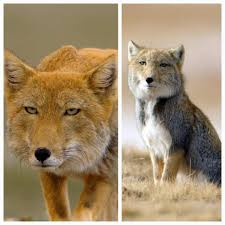
This week we are looking at The Tibetan fox, also known as the Tibetan sand fox, is a species of true fox endemic to the high Tibetan Plateau, Ladakh plateau, Nepal, China, Sikkim, and Bhutan, up to elevations of about 5,300 metres.
These foxes have a soft and dense rufous coloured coat from the crown, neck, back to the lower legs. Its muzzle is narrow, its cheeks, flanks, upper legs and rumps are grey, and its bushy tail has white tips.
They primarily prey on plateau pikas, followed by rodents, marmots, woolly hares, rabbits, small ground birds and lizards. It also scavenges on the carcasses of Tibetan antelopes, musk deer, blue sheep and livestock. Tibetan foxes are mostly solitary, daytime hunters as their main prey, pikas, are diurnal.
Like some foxes they are monogamous, and they won’t change their spouse unless one of them passes away.
They can live up to 10 years in ideal conditions. However, most foxes die from natural causes or are hunted by humans before they reach five years old.
There are no major threats to the species at present, although poisoning of pikas (a major prey item) in much of the Tibetan plateau poses a concern. Nonetheless, there is no evidence that the species is currently undergoing a decline that would warrant listing in a threatened category.
After a gestation period of 51 – 53 days, Tibetan Sand Foxes give birth to a litter of 3 – 6 young in a den.





 Jo-AnneRamplings