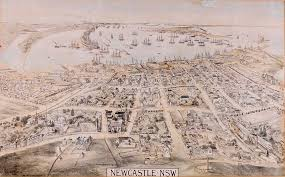
Today, we are looking at a bit of the history of Newcastle in New South Wales, the town was named after the famous coal port in England, Newcastle-upon-Tyne. The city was originally called Coal River and then Kingstown.
In 1797, Lieutenant John Shortland discovered the Hunter River estuary while searching for escaped convicts. Then in 1801, Governor King authorized a group of convicts and soldiers to settle in Newcastle to mine coal. This settlement was short-lived and closed in 1802 but was re-established in 1804.
After the settlement was re-established, it was named Newcastle to imitate the English coal port. The city’s link to Newcastle-upon-Tyne is still evident in some of its place names, such as Jesmond, Hexham, Wickham, Wallsend, and Gateshead.
The coal mined from the area was the colony of NSW first export. Newcastle gained a reputation as a “hellhole” as it was where the most dangerous convicts were sent to dig in the coal mines as punishment.
Newcastle remained a penal settlement until 1822, when the settlement was opened up to farming. Military rule ended in 1823, and prisoner numbers were reduced to 100 while the remaining 900 were sent to Port Macquarie. Port Macquarie is 245km or 153 miles.
After the town was freed from the influence of penal law it began to acquire the aspect of a typical pioneer settlement, and free settlers soon poured into the hinterland.
Today, the Port of Newcastle remains the economic and trade centre for the resource rich Hunter Valley. It is the world’s largest coal export port and Australia’s oldest and second largest tonnage throughput port.
The population of Newcastle, New South Wales in 2024 is around 174,529. This is based on a forecast prepared by population experts on behalf of the City of Newcastle.
Lake Macquarie’s estimated resident population is around 220,000 people, making it the third largest regional city in NSW.
Ok this week we are looking at Saudi Arabia, officially the Kingdom of Saudi Arabia, is a country in West Asia. Located in the centre of the Middle East, it covers the bulk of the Arabian Peninsula and has a land area of about.
The country was established in 1932 by King Abdulaziz Al-Saud, its transformation has been astonishing. In a few short decades, the Kingdom has turned itself from a desert nation to a modern, sophisticated state and a major player on the international stage.
In 1932, the two kingdoms of the Hejaz and Najd were united as the “Kingdom of Saudi Arabia”. Boundaries with Transjordan, Mandatory Iraq, and Kuwait were established by a series of treaties negotiated in the 1920s, with two “neutral zones” created, one with Iraq and the other with Kuwait.
The capital is Riyadh and is the main financial hub, it is on a desert plateau in the country’s centre. The business district landmarks include the 302m-high Kingdom Centre, with a sky bridge connecting 2 towers, and 267m-high Al Faisaliah Centre, with a glass-globe summit.
The currency is the Saudi Riyal and has been since the country was first established.
The flag is green with a white Arabic inscription and a sword. The inscription is the Islamic creed, or shahada, which translates to “There is no deity but God; Muhammad is the Messenger of God”. The current design has been used since 1973.
The colour of Islam is green, the sword represents the strictness in applying justice and the shahada is the central symbolic design of the flag. The flag must always be represented so that the inscription reads correctly on both sides. The flag is never to be flown vertically or at half-mast due to its religious symbolism.
The inscription is the Islamic creed, or shahada: “There is no deity but God; Muhammad is the Messenger of God”. The current design has been used by the government of Saudi Arabia since 15 March 1973.
As of February 2025, the population of Saudi Arabia is 37.47 million.
The official language is Arabic. The three main regional variants spoken by Saudis are: Najdi Arabic – about 14.6 million speakers. Hejazi Arabic – also known as Hijazi Arabic & West Arabian Arabic – about 10.3 million speakers.
The official religion of Saudi Arabia is Islam, and the country is considered an Islamic state. The majority of Saudi citizens are Sunni Muslim, with a Shia minority.
When it comes to religious freedom there isn’t any, the Saudi government does not provide for freedom of religion under the law. However, the government generally permits Shia religious gatherings and non-Muslim private religious practices.
The country’s constitution is the Quran and Sunna, which are traditions and practices based on the life of the Prophet Muhammad.
The legal system is based on sharia, which is Islamic law.
The government does not allow public worship of any religion other than Islam.
The government does not allow public display of non-Islamic religious symbols.
The government criminalizes proselytizing by non-Muslims.
Shia Muslims make up about 10–12% of the citizen population.
The majority of remaining Shia are Sulaimani Ismailis, also known as “Seveners”.
Pockets of Zaydis, another branch of Shia Islam, live in the provinces of Jizan and Najran.
Saudi Arabia has made progress in improving women’s rights, but discrimination still exists.
Recent improvements are the following, women can apply for passports, travel abroad, and register marriages and divorces without a male guardian’s permission.
Women can register as co-heads of households and live independently from their husbands
Women can join the senior ranks of the military
Women can change their personal data without a guardian’s permission
Women can register to perform the Hajj without being accompanied by a mahram
Women can vote and run in municipal elections
Female athletes can participate in the Olympics
There are still other challenges to overcome such as.
Women still face discrimination in law and practice, including in matters of marriage, divorce, child custody, and inheritance
The Personal Status Law (PSL) codifies male guardianship, which can prevent women from fully consenting to marriage
Many Saudi women still cover their faces or hair in public even though they are not required to wear a hijab or abaya in public. However, the government does encourage modest dress for both men and women.
When it comes to visiting the country both Australia and The States advise reconsidering travel to Saudi Arabia due to the threat of missile and drone attacks. Also, the country is a target for radical Islamic terror groups. There are also human rights abuses, cultural sensitivities, and government surveillance concerns.
This week we will look be looking when the USA invaded Australia during WW11. Kinda…
In my area of Australia there was the Joint Overseas Operations Training Services.
The Port Stephens area was the centre of much activity during 1943-44, 20,000 US servicemen and 2,000 Australian servicemen trained for beach landings.
A country club became headquarters for amphibious warfare training area know as JOOTS (Joint Overseas Operations Training Services).
Port Stephens an area in the Hunter Region of New South Wales, Australia, it is just north of Newcastle.
This came about due to Australia asking for help from the States to dissuade the Japanese from trying to invade and it worked.
For America, Australia was a natural springboard for a major counterattack against Japan and the Newcastle area saw plenty of evidence of the American commitment.
HMAS Assault was a naval training centre established by General Douglas MacArthur. The base was chosen because it was a safe haven from Japanese submarines and was a small, isolated fishing village. The HMAS Assault was used to train landing craft crews, beach parties, and signal teams.
Tomaree Head was a critical part of Australia’s defence of the east. It includes a curved concrete wall with a gun that protected Newcastle and the Williamtown airbase.
You can take a guided tour of the historic gun emplacements at Tomaree Head in Tomaree National Park.
In total nearly one million US troops passed through Australia during World War II. The first US troops arrived in Brisbane in December 1941.
By 1943, there were 250,000 Americans stationed in Melbourne, Sydney and Brisbane.
The US Army used Australia as a base of operations to support US forces in the Philippines.
Their main role in north Queensland was to provide services and supplies, and there was a large presence in Queensland mostly around Brisbane, Rockhampton, and Townsville.
The US Army also had a joint command with the British, Dutch, and Australian forces in the Pacific.
They had a substantial impact on the local economy and influenced fashion, consumerism, and domestic technology.
Of course, at times there were tensions with some Australians, which sometimes erupted into fighting.
There was also a large social impact on Australia, including many Australian women marrying US servicemen.
The US Army’s presence in Australia was part of a larger US deployment to combat zones overseas during World War II.
This week we have moved onto Iraq, officially known as the Republic of Iraq, is a country in West Asia, bordered by Saudi Arabia to the south, Turkey to the north, Iran to the east, the Persian Gulf and Kuwait to the southeast, Jordan to the southwest, and Syria to the west.
The country is dominated by two famous rivers: the Tigris and the Euphrates. They flow southeast from the highlands in the north across the plains toward the Persian Gulf. The fertile region between these rivers has had many names throughout history, including Al-Jazirah, or “the island,” in Arabic and Mesopotamia in Greek.
Many parts of Iraq are harsh places to live. Rocky deserts cover about 40 percent of the land. Another 30 percent is mountainous with bitterly cold winters. Much of the south is marshy and damp. Most Iraqis live along the fertile plains of the Tigris and Euphrates.
Baghdad is the capital and largest city of Iraq, located along the Tigris in the central part of the country. With a population exceeding 7 million, it ranks among the most populous cities in the Middle East and Arab World and forms.
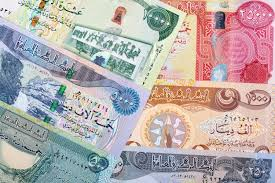
The Iraqi dinar is the currency of Iraq. The Iraqi dinar is issued by the Central Bank of Iraq. On 7 February 2023, the exchange rate with the US Dollar was US$1 = 1300 dinars.
The Iraqi flag has four horizontal stripes of red, white, green, and black. The colours are inspired by a poem by Safi al-Din al-Hilli. The flag also has an Arabic inscription that means “Allah is the Greatest”.
The current version of the Iraqi flag has been in use since 2008.
The flag was modified in 1991 by President Saddam Hussein.
In 2004, the Iraqi Governing Council proposed a new flag, but it was almost universally rejected by Iraqis.
The colours of the Iraqi flag are inspired by a poem by Safi al-Din al-Hilli.
The poem refers to red as willingness to shed blood, green for Arab fields, black for battles, and white for purity of motives and deeds.
The three green stars on the flag represent a desire to unite with Egypt and Syria.
It is one of the most culturally diverse nations in the Middle East. Arabs, Kurds, Turkmen, Assyrians, Mandaeans, and Armenians, among others, speak their own languages and retain their cultural and religious identities.
Iraqis once had some of the best schools and colleges in the Arab world. That changed after the Gulf War in 1991 and the United Nations sanctions that followed. Today only about 40 percent of Iraqis can read or write.
The country is a federal constitutional democracy. The Head of State is the President. The Head of Government is the Prime Minister, who appoints the Council of Ministers (Cabinet). The Council of Representatives (CoR) is the unicameral legislature. The Iraqi people elect the 329 members of the CoR through an open-list, proportional representation electoral process. Nine seats are set aside for representation of Iraqi minorities. The Constitution sets a quota of 25 per cent of CoR seats to be held by women. Members serve four-year terms. The Prime Minister and Cabinet Ministers do not have to be elected members of the CoR but the CoR must approve their nominations. Ministers must forgo their CoR seats to serve in Cabinet.
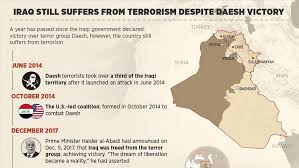
During late 2013 and 2014, the terrorist organisation Da’esh seized territory in west and northwest Iraq, including the city of Mosul. Da’esh systematically persecuted ethnic and religious minorities and committed abuses against vulnerable groups including women and children. On 9 December 2017, then-Prime Minister Haider al-Abadi announced the defeat of Da’esh in Iraq.
Despite the territorial defeat of Da’esh in Iraq and Syria (announced by the Syrian Democratic Forces in March 2019), Da’esh remains a very real threat to the region. At the request of the Government of Iraq, the Global Coalition to Defeat Da’esh continues to support the Iraqi Security Forces to combat the threat posed by remnants of Da’esh.
Iraqi women today suffer from insufficient educational opportunities and healthcare and limited access to the labor market, as well as high levels of violence and inequality.
The status of women has been affected by wars, Islamic law and the Constitution of Iraq as well as Cultural traditions. Abusive practices such as honour killings and forced marriages still persist.
The security situation in Iraq is volatile and could deteriorate with little warning. There’s a risk of violence, armed conflict, kidnapping and terrorist attacks.
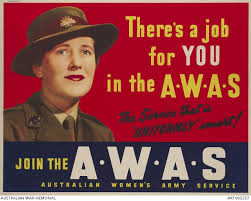
Ok this we are going to look at the brave and strong women who decided to join the military during the second world war. Three of the organisations that put these women into uniforms were The Land Army, The National Emergency Services (NES) and the Australian Women’s Army (AWAS).
The Land Army was voluntary group where women worked on farms, performing tasks like milking cows, harvesting crops, and tending livestock, to maintain food production while men were fighting overseas.
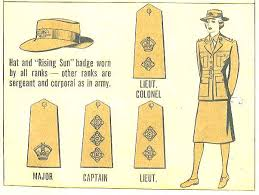
The AWAS was an official military unit within the Australian Army where women could enlist to serve in roles like driving, clerical work, communications, and even some combat support positions.
The Australian Women’s Army Service (AWAS) was formed in August 1941 to release men from some military duties to serve with fighting units. Women worked in traditional roles such as clerks, typists and cooks.
The NES was a general term for civilian volunteer organizations that provide support during emergencies like fire, flood, or medical crises, not specifically related to wartime service
There was a network of searchlights and listening posts that formed part of Newcastle’s defences were largely operated by women. These women were carefully selected for good eyesight and hearing as they would be on high alert lookout for the distant hum of aircraft engines.
They also had to maintain the searchlights in a high state of readiness, constantly polishing the lights and greasing their mechanisms. The searchlights batteries were connected by telephone to headquarters and each battery had a command post with a plotting board to track the positions and courses of aircraft.
Some of the hardships the women had to deal with things like having to bunk down in unlined shed in the bush, they were given hessians bags and a pile of straw to make their mattresses. They also had to shower under a modified kerosene tin full of water. Just because they were women didn’t mean they got an easy ride, they had route marches with full packs and training with live ammunition on .303 rifles, bren and Thompson guns.
The Australian Women’s Army Service served in New Guinea during World War II, making it the only non-medical women’s service to serve overseas during the war.
The Land Army and the AWAS were both disbanded shortly after the end of World War II, between 1945 and 1947.
The Royal National Anthem is the national anthem of the Hashemite Kingdom of Jordan. The translated name literally means “Peace be upon the King of Jordan”. As-salamu alaykum is the greeting in Arabic, therefore the name of the anthem can also be regarded as a Royal Salute.
In 1946, the National Anthem was written by the late Abdul Munim Rifai, a renowned Jordanian poet who later served as prime minister. Abdul Qader Tannir composed the music.
The first version of the lyrics was very short, as it only contained the first stanza of the current version. Since then, the anthem has been expanded. The abridged version of the anthem is usually used, while the full version is reserved for special occasions.
This week we are looking at Fort Scratchley which is where the big guns of Newcastle are located. It was built in 1882 to defend the city against a possible Russian attack.
However, its guns were not fired in anger until 8 June 1942, when the Japanese attacked Newcastle. Although they were only part of the defence of Newcastle, which included heavy guns at Fort Wallace and Shepherds Hill along with searchlights, radar stations and observation post.
At the time there were some Novocastrians who had mixed feelings about the guns, although during live firing exercises they would crowd the hill to watch the gunner’s blast away at make-shift targets towed behind tugs or other boats.
Because the vibration of the guns would break windows and shake crockery from the shelves residents were given noticed of exercises so they could put fragile goods in safe places.
After World War II the fort was home to 13 Medium Coast Battery RAA, a unit of the National Service Scheme, which was renamed 113 Coast Battery RAA in the 1960s. The army left the site in November 1972.
The 6-in guns were relocated to King Edward Park, 1.3 km (0.8 mi) away, as a memorial. However, after extensive lobbying, they were returned to Fort Scratchley in 1978.
In the first decade of the 21st century the site underwent a multimillion-dollar renovation and reopened as a museum.
In 2014, History show TV presenter Sir Tony Robinson visited the Fort to produce a segment for his show Tour of Duty which was aired in 2015.
In 2015, the Fort’s sole Nordenfelt gun was restored to fully functional condition and is fired on special occasions from its position in the underground casemate
Fort Scratchley is owned by the City of Newcastle (CN) and managed by volunteers from the Fort Scratchley Historical Society.
There is a guide at the gates who can give you a map to explore the Fort.
Visit the Parade and Ceremony Grounds, galleries and museum collections, learn about our historic guns, however, you cannot tour the tunnel.
Guided tunnel tours are led by passionate Fort Scratchley Historical Society volunteers with a wealth of knowledge and provide unique insight into the history of the site.
Individuals, families and groups of less than 12 people can purchase tickets at the Fort Scratchley shop. Schools, clubs or other social groups of 12 or more people should email booking requests through our contact page.
Unfortunately, due to the narrow stairs and hallways, the tour is unsuitable for wheelchairs, walkers, prams and strollers.
There’s also a shop with ice creams and drinks, souvenirs and gifts.
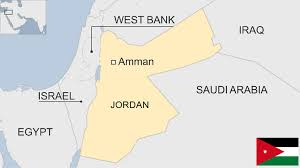
This week we are looking at Jordan an Arab nation on the east bank of the Jordan River, is defined by ancient monuments, nature reserves and seaside resorts. It’s home to the famed archaeological site of Petra, the Nabatean capital dating to around 300 B.C. Set in a narrow valley with tombs, temples and monuments carved into the surrounding pink sandstone cliffs, Petra earns its nickname, the “Rose City.”
The population is around 12 million.
The capital is Amman, which is a modern city with numerous ancient ruins. It is one of the region’s principal commercial and transportation centers as well as one of the Arab world’s major cultural capitals.
The Jordanian dinar has been the currency of Jordan since 1950. The dinar is divided into 100 qirsh or 1000 fulus. It is pegged to the US dollar. The Central Bank of Jordan commenced operations in 1964 and became the sole issuer of Jordanian currency, in place of the Jordan Currency Board.
The country’s official language is Arabic, everyone in the country, including the minority communities, speak Arabic in their day-to-day dealings.
In addition to the Arabic language, English has become a significant component in the school curriculum. While Arabic remains the official language in Jordan, English has been taught in Jordan’s schools and universities since the independence of Transjordan as a Kingdom.
The flag of Jordan is made up of three horizontal bands of black, white, and green, with a red chevron and a white seven-pointed star in the middle of the white band. The flag was adopted on April 16, 1928.
The colours and the star represent the following
Black: Represents the Abbasid Caliphate
White: Represents the Umayyad Caliphate
Green: Represents the Fatimid Caliphate
Red: Represents the Hashemite dynasty and the Arab Revolt
Star: The seven points of the star represent the seven verses of the opening chapter of the Quran, the Al-Fatiha. It also represents the unity of the Arab people, faith in one God, humility, national spirit, virtue, social justice, and aspiration.
More than 92% of the population are Muslims and approximately 8% are Christians. Most Christians belong to the Greek Orthodox Church; but there are also Greek Catholics, Roman Catholics, Syrian Orthodox, Coptic Orthodox, Armenian Orthodox, and a few Protestant denominations.
Jordan is a constitutional monarchy with a bicameral National Assembly. The king is the head of state and commander-in-chief of the armed forces. The prime minister is the head of government and is responsible for carrying out the day-to-day tasks of the executive branch. The judicial branch is independent of the other two branches. Which are the executive branch and the legislative branch.
The government operates comprehensive health facilities, including a national health insurance program. The government supervises and coordinates social and charitable organizations.
The government has the power to block and censor websites.
Although the constitution provides for the freedom to practise one’s religion in accordance with the customs that are observed in the Kingdom, unless they violate public order or morality.
However, such things as wanting to convert from Islam to another religion isn’t allowed and are not recognised as anything other than Islam and are still considered legally Muslims and face immense societal pressure.
There are many restrictions against religious minorities such as.
Jordan’s government may deny recognition to a religion.
Baháʼís are not permitted to establish schools, places of worship or cemeteries.
Aside from Christians, all other non-Muslim minorities do not have their own courts to adjudicate personal status and family matters.
Muslim women may not marry non-Muslim men, such as Christians, unless the men legally convert to Islam.
Since Muslims are prohibited from converting to other religions according to the Sharia law, converts from Islam cannot change their religion on governmental records. However, converts to Islam are required to change their religious identification to “Muslim” on governmental records and civil documents.
When it come to women’s rights, they suck, females over the age of 15 need a male guardian’s permission to marry for the first time. A marriage to a non-Muslim is not recognised.
They cannot travel abroad with their children without the consent of a male guardian or having judicial consent. They are subject to restrictions when it comes to employment and general prohibited from night work.
Hi everyone, Debby from My Shasta Home, she can be found here: https://myshastahome.blogspot.com/ asked to know more about the apology for the stolen generation.
On 13 February 2008, Prime Minister Kevin Rudd offered a formal apology to Australia’s Indigenous peoples, particularly the Stolen Generations, on behalf of the nation at Australian Parliament House.
The Apology was presented as a motion for voting to the Chamber. It acknowledged that ‘the laws and policies of successive Parliaments and governments had resulted in the forcible removal of Aboriginal and Torres Strait Islander children from their families and ‘inflicted profound grief, suffering and loss on these our fellow Australians’.
Between 1910 and 1970 thousands of Aboriginal and Torres Strait Islander children were forcibly removed from their families and communities by churches, welfare organisations and governments. The exact number is not known. However, is estimated that, anywhere from 1 in 10 to 1 in 3 Indigenous children were forcibly removed from their families and fostered or adopted by non-Indigenous families or raised in institutions. These children are known as the Stolen Generations. Many experienced neglect, physical and sexual abuse and exploitative labour, and were denied contact with their families.
Below are a couple of the statements given to the inquiry.
Lots of white kids do get taken away, but that’s for a reason – not like us. We just got taken away because we was black kids, I suppose – half-caste kids. If they wouldn’t like it, they shouldn’t do it to Aboriginal families.
Confidential evidence 357, South Australia Bringing Them Home, 1997
The Government has to explain why it happened. What was the intention? I have to know why I was taken. I have to know why I was given the life I was given and why I’m scarred today. Why was my Mum meant to suffer? Why was I made to suffer with no Aboriginality and no identity, no culture? Why did they think that the life they gave me was better than the one my Mum would give me? And an apology is important because I’ve never been apologised to. My mother’s never been apologised to, not once, and I would like to be apologised to.
Confidential evidence 139, Victoria: woman removed at 12 months in 1967 Bringing Them Home, 1997
On 26th May 1997 the Inquiry’s Bringing Them Home report was tabled in Parliament. The Report documented the grief and loss caused by the breaking of cultural, spiritual, and family ties, and the intergenerational impact on the lives and wellbeing of Aboriginal and Torres Strait Islander peoples, as well as their resilience and dignity:
For individuals, their removal as children and the abuse they experienced at the hands of the authorities, or their delegates, have permanently scarred their lives. The harm continues in later generations, affecting their children and grandchildren.
Bringing Them Home, 1997
A key recommendation of the report was the need for an official acknowledgement of and apology for the forcible removal of Aboriginal and Torres Strait Islander children.
Below is what the apology says.
I move:
That today we honour the Indigenous peoples of this land, the oldest continuing cultures in human history.
We reflect on their past mistreatment.
We reflect in particular on the mistreatment of those who were Stolen Generations—this blemished chapter in our nation’s history.
The time has now come for the nation to turn a new page in Australia’s history by righting the wrongs of the past and so moving forward with confidence to the future.
We apologise for the laws and policies of successive Parliaments and governments that have inflicted profound grief, suffering and loss on these our fellow Australians.
We apologise especially for the removal of Aboriginal and Torres Strait Islander children from their families, their communities and their country.
For the pain, suffering and hurt of these Stolen Generations, their descendants and for their families left behind, we say sorry.
To the mothers and the fathers, the brothers and the sisters, for the breaking up of families and communities, we say sorry.
And for the indignity and degradation thus inflicted on a proud people and a proud culture, we say sorry.
The Hon Kevin Rudd 13 February 2008
The National Apology is considered a milestone step toward reconciliation between Indigenous and non-Indigenous Australians.
The Prime Minister’s speech was met with applause, tears, and relief from many Aboriginal and Torres Strait Islander peoples, including members of the Stolen Generations, present in the House of Representatives. Thousands of people gathered throughout the country to watch a broadcast of the Apology, including hundreds watching from the Great Hall and thousands on the lawns outside Parliament House.
Following the speeches, Lorraine Peeters (Weilwun and Gamilaroi peoples), acting on behalf of the Stolen Generations present in the Parliament, presented a glass coolamon to the Prime Minister Kevin Rudd and the Leader of the Opposition, Brendan Nelson. The coolamon – made by Bai Bai Napangardi, an artist from the Balgo community in Western Australia – contained a message that said:
On behalf of our people, thank you for saying sorry.In return we give you this gift on behalf of us affected by being taken away from our families. This is our way of saying thank you. The gift is a glass coolamon, fragile yet strong. Coolamons have carried our children. The gift is a symbol of the hope we place in the new relationship you wish to forge with our people. A relationship that itself is fragile yet strong. We have a new covenant between our peoples, that we will do all we can to make sure our children are carried forward, loved and nurtured and able to live a full life.’
The Prime Minister and Leader of the Opposition then jointly presented the coolamon to the Speaker of the House of Representatives, who accepted it saying:
I gratefully receive this gift on behalf of the House. It will represent a very important point in the history of not only this chamber but our nation.
At the conclusion of the formal proceedings in the Chamber, an event was held in Members Hall, attended by many representatives of the Stolen Generations, Indigenous leaders, Indigenous and other organisations, and current and former parliamentarians. There, Tom Calma, then Aboriginal and Torres Strait Islander Social Justice Commissioner, responded to the Apology. Nominated by the National Stolen Generations Alliance and the National Sorry Day Committee, the two national bodies representing the Stolen Generations and their families, he declared that it was an ‘historic day’, one
… on which ‘our leaders – across the political spectrum – have chosen dignity, hope and respect as the guiding principles for the relationship with our first nations’ peoples’.
The National Apology and the Coolamon are on display at Parliament House.
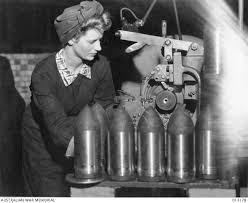
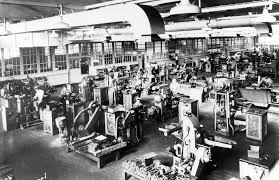
During the second world war saw many women working in wartime heavy industries in many countries including Australia, here in Newcastle hundreds of women were recruited to replace the men off fighting.
Around 500 men from Lysaght’s workshops alone were gone off fighting, the new spinner shop opened by Lysaght’s to make protective streamlined cowlings for aircraft propeller hubs, they were made of aluminum and had to be manufactured to extremely fine tolerances. This was a brand-new enterprise for Newcastle, those working there were taught by having to recondition 60 English made spinners for De Havilland Mosquito bombers, this work continued as a combination of local made and imported parts and by the time the plant finally wound up, they had made 900 spinners for the Mosquitoes, Beauforts and Lincoln aircraft.
The girls had to learn every job so that absences didn’t slow things down, they also had to wear scarves to keep their hair out of the machines, although there were accidents and if someone’s hair got caught in something like a drill chuck, the machine would have to be shut down and they would be lucky if they weren’t scalped.
In fact, women many countries worked in a variety of roles, including in the Australian Women’s Army Services (AWAS) and the Women’s Auxiliary Australian Air Force (WAAAF). They performed essential duties that were previously considered to be men’s work.
They operated anti-aircraft batteries, searchlights they also worked with range-finders. Women also worked in intelligence roles and defensive roles. They drove transports and plotted coordinates
Women’s contributions to the war effort helped to advance employment opportunities for women after the war, also their work during the war led to the establishment of the Women’s Employment Board in 1943.
Women’s work during the war led to women receiving 75% of the male wage for the same job.
















 Jo-AnneRamplings