The very sinkable Boambee

Ok this week I am going to share a bit about the steamer Boambee one unlucky vessel.

The 236-tonne wooden steamer was built in 1908 and by the time it ran aground and was dismantled forty years later it had sunk four times, including once at Newcastle’s wharf.
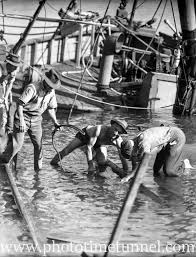
Records show that its first mishap happened at Tweed Heads on 20 December 1923 it was driven ashore by strong gale winds but was able to be refloated. Tweed Heads is a border town between New South Wales and Queensland.

Moving on, it is said to have sunk at Clarence Town Wharf in 1939 while loaded with gravel and wooden sleepers, again it was refloated only to sink again sometime during World War 11 at Hexham. Clarence Town is on the Williams River in New South Wales; the town of Hexham is also in NSW. Hexham is about a half hour drive from where I live.

Later on, it was hit by a ship in Newcastle Harbour and written off, however it would be bought by the Hunter River Steamship Company in 1947 to be used on the Newcastle to Sydney trade.

On its first trip it sprang a leak which was more than the pumps could handle so the captain decided to return to Newcastle while it slowly sank. By the time it reached Newcastle Harbour it was very low in the water and there were no tugs available to help. So, by the time she reached the wharf she began to list and sank ten minutes after reaching its berth.

It took five days, but she was able to be refloated, repaired and renamed.

Now called the Illalong it became the property of the Manning River Steamship Company. In March of 1948 while on route from Sydney to Newcastle with a cargo of brattice cloth for coalminers it went too close inshore during a thick fog and ran aground at Nine Mile Beach which is near Belmont.

This time it was written off again and quickly dismantled   

Romania

Good morning, all, it is time for another country this week it is Romania.

Romania can be found on the Black Sea coast of southeastern European it is divided into three major regions, Wallachia in the south, Moldavia in the northeast and Transylvania in the centre.

The country is known for the forested region of Transylvania, ringed by the Carpathian Mountains. Its preserved medieval towns include Sighişoara, and there are many fortified churches and castles, notably clifftop Bran Castle, long associated with the Dracula legend. Bucharest, the country’s capital, is the site of the gigantic, Communist-era Palatul Parlamentului government building. 

The country’s official language is Romanian, there is also some minority languages, including Hungarian and Romani.

It has a population of around 20 million but there’s also a large Romanian diaspora, meaning that a lot of Romanian people live abroad.

The Romanian leu is the currency of Romania. It is subdivided into 100 bani, a word that also means “money” in the Romanian language. The central bank is the National Bank of Romania.

The national flag of Romania is a tricolour featuring three equal vertical bands coloured blue, yellow and red. The flag used in the mid-19th century was a horizontal tricolor design of blue, yellow and red. This was later changed in 1862 to reverse the positioning of the red and blue bands. It was in 1866 when the vertical tricolor flag was introduced. This flag was used through 1948 until the communist era. The flag used in 1948 featured the same vertical tricolour bands as the previous flag with the addition of the country’s emblem. A total of four flags were used during the communist era, each with slight modifications to the emblem. Following the communist era, the flag first used in 1948 was adopted again in 1989 and has flown in the country ever since.

The Eurasian lynx is the national animal of Romania.

The Peony is the national flower.

The Great White Pelican is the national bird.

The coat of arms is a golden aquila that is holding a cross in its beak, at also shows a mace and a sword in its claws. It contains the three colours of the flag.

Undoubtedly one of the most famous people from Romania is Vlad Dracula (aka Vlad the Impaler or Vlad III), a 15th-century ruler of Wallachia. Vlad Dracula was a courageous and tenacious leader. During his rule he fought off Ottoman Turks who invaded parts of Wallachia (Southern Romania). He is often considered one of the most important rulers in Wallachian history and a national hero of Romania. 

Vlad the Impaler tortured thousands while he ate and drunk among the corpses. impaled 20,000 men, women and children and often ordered people to be skinned, boiled, decapitated, blinded, strangled, hanged, burned, roasted, hacked, nailed, buried alive or stabbed, I think he was evil.

Transport in Newcastle from way back when

                                                           Early Buses

This week will be looking at early public transport in Newcastle.

In 1940 transport in Newcastle was at a crossroads, many people relied on public transport in the form or trams, trains and buses due to the depression in the 1930’s private cars were rare.

Horse drawn vehicles were still pretty common and with the fuel shortages and rubber for tyres being in short supply during the second world war. Many businesses went back to using horse drawn vehicles, however, it became harder to get feed for the horses as the war dragged on.

A horse drawn ambulance

Prior to the construction of various road projects connecting the outer western suburbs of Newie crossing the Hunter River including the Stockton Bridge numerous ferry services, both privately run and publicly operated.

Early Stockton Ferry Warf 

Shuttling people and cars across the Hunter River to link the area of Stockton with the rest of Newcastle during the 19th and 20th centuries, the ferry runs from Market Street Wharf to Stockton.

                    People waiting for the ferry


Newcastle first had trams from 1887 until 1950, when the final line, the Waratah line, was replaced by buses. At its peak, the system ran to Speers Point and West Wallsend.

                        An early tram

The first railway in Australia was built by the Australian Agricultural Company in 1831. The railway was an inclined plane railway from the Company’s A pit in Church Street Newcastle to Newcastle Harbour.

                        Newcastle Station 

The first government operated bus route commenced on 22 September 1935 to Mayfield. On 10 June 1950, the final tram routes were withdrawn. On 2 February 1983, the Stockton ferry service was taken over from a private operator.

                        The first buses

                            Early Buses

Cars have been super important in Australia’s history. They first came to Australia in the early 1900s and back then not many people could afford them. In the 1950s, Australia started making its own cars, and that made a lot of jobs and made cars easier to get.

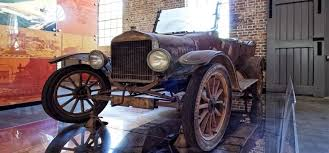
                A Model T on display at the Newcastle Museum 

I have not been able to find when the first cars arrived in Newcastle.