Uzbekistan

Here we are at another Monday, I wasn’t sure I would do a post today due to feeling tired and worn out and not having a lot of motivation but here I am writing about the country of Uzbekistan, not a country I have heard of but I do like doing posts about places and other stuff I know little or nothing about.  This country has a population of around 36 million.

Uzbekistan is a Central Asian nation and former Soviet republic. It’s known for its mosques, mausoleums and other sites linked to the Silk Road, the ancient trade route between China and the Mediterranean. Samarkand, a major city on the route, contains a landmark of Islamic architecture: the Registan, a plaza bordered by 3 ornate, mosaic-covered religious schools dating to the 15th and 17th centuries
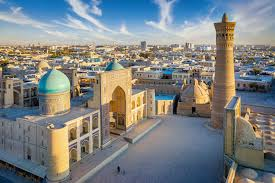
The capital city is Tashkent, it’s known for its many museums and its mix of modern and Soviet-era architecture. The Amir Timur Museum houses manuscripts, weapons and other relics from the Timurid dynasty. Nearby, the huge State Museum of History of Uzbekistan has centuries-old Buddhist artifacts. The city’s skyline is distinguished by Tashkent Tower, which offers city views from its observation deck.

The official currency is the Sum, the country replaced the ruble with the sum at par in on 16 July 1994. No subdivisions of this sum were initially issued and only banknotes were produced, in denominations of 1, 3, 5, 10, 25, 50, 100, 200, 500, 1,000, 5,000, and 10,000 sum. Further series, however, have introduced coins and a subunit, the tiyin. Because it was meant to be a transitional currency, the design was rather simplistic.
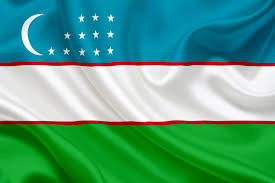
The flag of Uzbekistan is a horizontal triband with three equal bands of blue, white, and green, separated by two thin red stripes. In the upper left canton (hoist side), there’s a white crescent moon and twelve white stars. The blue band represents the sky and water and is also associated with the Turkic peoples. The white represents peace and purity. The green symbolizes nature and new life. The red stripes are a symbol of the power of life. The crescent moon is a traditional Uzbek symbol, and the twelve stars represent the twelve months of the Islamic calendar and the constellations. 

Islam is the predominant religion, with the vast majority of the population identifying as Muslim. While Islam is dominant, there are also other officially recognized faiths, and the country has a diverse religious landscape.

Other faiths are also present, including Russian Orthodox Christianity, Judaism, Buddhism, there are also significant populations of Baha’is, Zoroastrians, and Roman Catholics. 

Uzbekistan’s government acknowledges religious freedom, but it also maintains a system of state control over religious organizations, including registration requirements and oversight of religious literature. The Muslim Board of Uzbekistan (MBU) plays a significant role in managing Islamic affairs, and it works within a framework established by the government. 

Uzbek is a Karluk Turkic language spoken by Uzbeks. It is the official and national language of Uzbekistan and formally succeeded Chagatai, an earlier Karluk language endonymically called Türki or Türkçe, as the literary language of Uzbekistan in the 1920s.  However, many other native languages are spoken in the country. These include several other Turkic languages, Persian and Russian.

Saudi Arabia

Ok this week we are looking at Saudi Arabia, officially the Kingdom of Saudi Arabia, is a country in West Asia. Located in the centre of the Middle East, it covers the bulk of the Arabian Peninsula and has a land area of about.

The country was established in 1932 by King Abdulaziz Al-Saud, its transformation has been astonishing. In a few short decades, the Kingdom has turned itself from a desert nation to a modern, sophisticated state and a major player on the international stage.

In 1932, the two kingdoms of the Hejaz and Najd were united as the “Kingdom of Saudi Arabia”. Boundaries with Transjordan, Mandatory Iraq, and Kuwait were established by a series of treaties negotiated in the 1920s, with two “neutral zones” created, one with Iraq and the other with Kuwait.

The capital is Riyadh and is the main financial hub, it is on a desert plateau in the country’s centre. The business district landmarks include the 302m-high Kingdom Centre, with a sky bridge connecting 2 towers, and 267m-high Al Faisaliah Centre, with a glass-globe summit.

The currency is the Saudi Riyal and has been since the country was first established.

The flag is green with a white Arabic inscription and a sword. The inscription is the Islamic creed, or shahada, which translates to “There is no deity but God; Muhammad is the Messenger of God”. The current design has been used since 1973.

The colour of Islam is green, the sword represents the strictness in applying justice and the shahada is the central symbolic design of the flag. The flag must always be represented so that the inscription reads correctly on both sides. The flag is never to be flown vertically or at half-mast due to its religious symbolism.

The inscription is the Islamic creed, or shahada: “There is no deity but God; Muhammad is the Messenger of God”. The current design has been used by the government of Saudi Arabia since 15 March 1973.

As of February 2025, the population of Saudi Arabia is 37.47 million.

The official language is Arabic. The three main regional variants spoken by Saudis are: Najdi Arabic – about 14.6 million speakers. Hejazi Arabic – also known as Hijazi Arabic & West Arabian Arabic – about 10.3 million speakers.

The official religion of Saudi Arabia is Islam, and the country is considered an Islamic state. The majority of Saudi citizens are Sunni Muslim, with a Shia minority. 

When it comes to religious freedom there isn’t any, the Saudi government does not provide for freedom of religion under the law. However, the government generally permits Shia religious gatherings and non-Muslim private religious practices. 

The country’s constitution is the Quran and Sunna, which are traditions and practices based on the life of the Prophet Muhammad. 

The legal system is based on sharia, which is Islamic law. 

The government does not allow public worship of any religion other than Islam. 

The government does not allow public display of non-Islamic religious symbols. 

The government criminalizes proselytizing by non-Muslims. 

Shia Muslims make up about 10–12% of the citizen population. 

The majority of remaining Shia are Sulaimani Ismailis, also known as “Seveners”. 

Pockets of Zaydis, another branch of Shia Islam, live in the provinces of Jizan and Najran. 

Saudi Arabia has made progress in improving women’s rights, but discrimination still exists. 

Recent improvements are the following, women can apply for passports, travel abroad, and register marriages and divorces without a male guardian’s permission. 

Women can register as co-heads of households and live independently from their husbands 

Women can join the senior ranks of the military 

Women can change their personal data without a guardian’s permission 

Women can register to perform the Hajj without being accompanied by a mahram 

Women can vote and run in municipal elections 

Female athletes can participate in the Olympics 

There are still other challenges to overcome such as.

Women still face discrimination in law and practice, including in matters of marriage, divorce, child custody, and inheritance 

The Personal Status Law (PSL) codifies male guardianship, which can prevent women from fully consenting to marriage 

Many Saudi women still cover their faces or hair in public even though they are not required to wear a hijab or abaya in public. However, the government does encourage modest dress for both men and women.

When it comes to visiting the country both Australia and The States advise reconsidering travel to Saudi Arabia due to the threat of missile and drone attacks. Also, the country is a target for radical Islamic terror groups. There are also human rights abuses, cultural sensitivities, and government surveillance concerns. 

Jordan

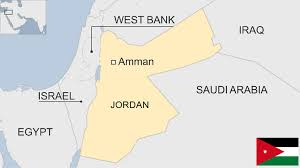
This week we are looking at Jordan an Arab nation on the east bank of the Jordan River, is defined by ancient monuments, nature reserves and seaside resorts. It’s home to the famed archaeological site of Petra, the Nabatean capital dating to around 300 B.C. Set in a narrow valley with tombs, temples and monuments carved into the surrounding pink sandstone cliffs, Petra earns its nickname, the “Rose City.”

The population is around 12 million.

The capital is Amman, which is a modern city with numerous ancient ruins. It is one of the region’s principal commercial and transportation centers as well as one of the Arab world’s major cultural capitals.

The Jordanian dinar has been the currency of Jordan since 1950. The dinar is divided into 100 qirsh or 1000 fulus. It is pegged to the US dollar. The Central Bank of Jordan commenced operations in 1964 and became the sole issuer of Jordanian currency, in place of the Jordan Currency Board.

The country’s official language is Arabic, everyone in the country, including the minority communities, speak Arabic in their day-to-day dealings.

In addition to the Arabic language, English has become a significant component in the school curriculum. While Arabic remains the official language in Jordan, English has been taught in Jordan’s schools and universities since the independence of Transjordan as a Kingdom.

The flag of Jordan is made up of three horizontal bands of black, white, and green, with a red chevron and a white seven-pointed star in the middle of the white band. The flag was adopted on April 16, 1928.

The colours and the star represent the following 

  • Black: Represents the Abbasid Caliphate
  • White: Represents the Umayyad Caliphate
  • Green: Represents the Fatimid Caliphate
  • Red: Represents the Hashemite dynasty and the Arab Revolt
  • Star: The seven points of the star represent the seven verses of the opening chapter of the Quran, the Al-Fatiha. It also represents the unity of the Arab people, faith in one God, humility, national spirit, virtue, social justice, and aspiration.

More than 92% of the population are Muslims and approximately 8% are Christians. Most Christians belong to the Greek Orthodox Church; but there are also Greek Catholics, Roman Catholics, Syrian Orthodox, Coptic Orthodox, Armenian Orthodox, and a few Protestant denominations.

Jordan is a constitutional monarchy with a bicameral National Assembly. The king is the head of state and commander-in-chief of the armed forces. The prime minister is the head of government and is responsible for carrying out the day-to-day tasks of the executive branch. The judicial branch is independent of the other two branches. Which are the executive branch and the legislative branch.

The government operates comprehensive health facilities, including a national health insurance program. The government supervises and coordinates social and charitable organizations. 

The government has the power to block and censor websites. 

Although the constitution provides for the freedom to practise one’s religion in accordance with the customs that are observed in the Kingdom, unless they violate public order or morality.

However, such things as wanting to convert from Islam to another religion isn’t allowed and are not recognised as anything other than Islam and are still considered legally Muslims and face immense societal pressure.

There are many restrictions against religious minorities such as.

  • Jordan’s government may deny recognition to a religion.
  • Baháʼís are not permitted to establish schools, places of worship or cemeteries.
  • Aside from Christians, all other non-Muslim minorities do not have their own courts to adjudicate personal status and family matters.
  • Muslim women may not marry non-Muslim men, such as Christians, unless the men legally convert to Islam.
  • Since Muslims are prohibited from converting to other religions according to the Sharia law, converts from Islam cannot change their religion on governmental records. However, converts to Islam are required to change their religious identification to “Muslim” on governmental records and civil documents.

When it come to women’s rights, they suck, females over the age of 15 need a male guardian’s permission to marry for the first time. A marriage to a non-Muslim is not recognised.

They cannot travel abroad with their children without the consent of a male guardian or having judicial consent. They are subject to restrictions when it comes to employment and general prohibited from night work.

The Middle East

Ok I am moving away from Africa and venturing into the Middle East, this is a geopolitical region encompassing the Arabian Peninsula, the Levant, Turkey, Egypt, Iran, and Iraq. The term came into widespread usage by the United Kingdom and western European nations in the early 20th century as a replacement of the term Near East.

The Middle East is considered to include countries like Egypt, Iran, Iraq, Israel, Jordan, Kuwait, Lebanon, Saudi Arabia, Turkey, United Arab Emirates, and others, totalling around 17 countries. Although the exact number depends on the definition used. Some sources include the Arabian Peninsula, the Levant, and parts of North Africa within the Middle East.

Egypt is traditionally considered to be part of the Middle East. It is a regional power in the Middle East, North Africa, and the Muslim world. I included it in the North African Countries.

However, when you consider that the official language of Egypt is Arabic. And the official religion of Egypt is Islam. As well as the fact that some say the majority of Egyptians today identify as Arabs linguistically, while others say that there is a growing minority reject this.

Roughly 60% of the population in the Middle East is under 25 years old. The term “Arab” generally refers to people who speak Arabic as their first language. The majority of Arabs are Muslims, but the majority of Muslims are not Arabs. The words Islam and Muslim are derived from the Arabic word salam, which means peace.

The Middle East is the birthplace of Christianity, Islam, and Judaism. It is, therefore, a region of great diversity. While Arabs compose the majority of the Middle East’s population, the region is also home to Berbers, Kurds, Jews, Persians, Turks, and a vast array of other ethnic and religious minorities.

The Middle East is about 3.82 million square miles or 9.9 million square kilometres It makes up about 6.2% of the Earth’s land.

The largest country is Saudi Arabia, which is about 800,000 square miles or 2.1 million square kilometres and the smallest country is Bahrain, which is about 295 square miles or 765 square kilometres.

The Middle East is known for its vast deserts, including the Sahara Desert and the Arabian Peninsula’s “Empty Quarter.

The highest point is Mount Damavand in Iran, which is 18,406 feet or 5,610 meters tall and the lowest point is the Dead Sea, which is 1,388 feet or 423 meters below sea level.

Next week we will start looking at different counties.