Bahrain

This week we are looking at Bahrain, officially the Kingdom of Bahrain, which is an island country of the Middle East, in West Asia. It is situated on the Persian Gulf, and comprises a small archipelago made up of 50 natural islands and an additional 33 artificial islands, centred on Bahrain Island which makes up around 83 percent of the country’s landmass.

The country has a population of only 1.6 million
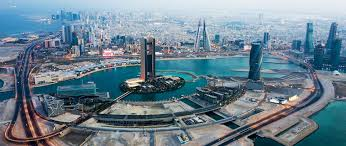
The modern capital of the gulf island nation of Bahrain, is Manama it has been at the centre of major trade routes since antiquity. Its acclaimed Bahrain National Museum showcases artifacts from the ancient Dilmun civilization that flourished in the region for millennia.

The city’s thriving Bab el-Bahrain Souq offers wares from colourful handwoven fabrics and spices to pearls. 
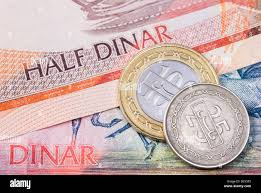
Their currency is the Bahraini dinar, the name is derived from the Roman denarius.

The Bahraini dinar was introduced in 1965, replacing the Gulf Rupee.

Arabic is the official language of Bahrain, although English is widely used.

Their flag consists of a white band on the left, separated from a red area on the right by five triangles that serve as a serrated line.

Alcohol is legal in Bahrain. However, drunken public behaviour is against the law. You could be fined, imprisoned or deported. Security officers and airline staff will not tolerate passengers believed to be drunk at the airport, including those who are in transit. The legal drinking age is 21.

The country recognises women’s equality in political, social, cultural, and economic spheres, granting them the right to vote and stand for office, and has taken steps to protect their rights through legislation and initiatives. 

The Bahraini Constitution ensures women are afforded public rights and freedoms, including the right to participate in public affairs, vote, and stand for office. 

Bahrain is a member of the Convention on the Elimination of All Forms of Discrimination against Women (CEDAW). 

In 2017, Bahrain adopted the unified Personal Status Law (PSL), a step towards protecting both Sunni and Shi’ite women under an inclusive legal framework. 
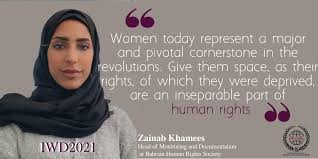
The Kingdom of Bahrain emphasizes that its legislation does not include discriminatory provisions against women. 

Achieving gender balance and prohibiting gender discrimination in all areas of life are fundamental principles enshrined in the Constitution of the Kingdom of Bahrain for both men and women. 

Women have the right to vote and stand in national elections, a right granted in 2002. 

Women are represented in the Legislative Authority, with 19% of participation in 2020, including 15% elected to the parliament and 23% appointed to the Shura Council.

Women also participate in the Municipal Council, with 23% representation. 

While there’s no strict dress code, it’s generally recommended that women dress modestly in public, covering shoulders and wearing skirts or trousers that fall below the knee.

Very tight or transparent clothing is considered inappropriate for both genders. 

While there is a majority of people that remain narrow-minded, there’s a larger number of people who accept that people are allowed to be different from each other. 

The youth of Bahrain and their parents are allowing room for more diversity. 
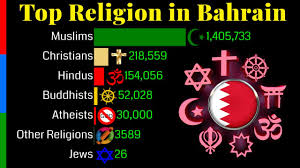
Bahrain’s official religion is Islam, with Sharia serving as a principal source for legislation, and the majority of Bahraini citizens are Muslims, including both Sunni and Shia sects, with the latter being in the majority. 

Besides Islam, Bahrain also has a small population of other religions, including Christians, Jews, Hindus, Baha’is, Buddhists, and Sikhs, among others. 

The country has an association that promotes religious coexistence and tolerance, aiming to foster respect for different faiths and advocate for peaceful coexistence. 

Iraq National Anthem

This week we are looking at Iraq’ national anthem it is titled Mawtini which in English mean My Homeland, it is a poem written by the Palestinian poet Ibrahim Tugan and is a popular patriotic song amongst the Arab people as well as being the official national anthem of Iraq.

It was adopted as the country’s anthem in 2004, the song formerly served as an unofficial anthem of Palestinians and other people of the Middle East during much of the 20th century. In 1996, Palestine formally adopted it as their official anthem. Even though it has since been superseded by something else, many Palestinians still identify strongly with it and consider it the unofficial national anthem of their country.

It has been described as a reflection of the shared experiences and struggles of Arab peoples, evoking strong emotions tied to national pride, hardship, and the aspiration for freedom. It is regarded as a symbol of resistance and a representation of the collective longing for liberation during periods of occupation and oppression. The anthem conveys emotions such as sorrow, anger, and hope, fostering a sense of renewal and solidarity among those who have endured similar adversities. Its lyrics express a deep love for the homeland, a commitment to its liberation, and a vision of a united and free nation. This message resonates widely across the Arab world, reflecting the shared struggles for independence, identity, and sovereignty.

The national anthem of Iraq between 2003 and 2004 was “Mawtini”, an instrumental composition composed by Iraqi Assyrian musician Louis Zanbaka. 

Also, the “Arḍu l-Furātayni”, also known as the “Land of The Two Rivers”, was the national anthem of Iraq from 1981 to 2003, during the Ba’athist regime of Saddam Hussein. 

My homeland, my homeland,
Glory and beauty, sublimity and splendour
Are in your hills, are in your hills.
Life and deliverance, pleasure and hope
Are in your air, are in your air.
Will I see you, will I see you?
Safely comforted and victoriously honoured.
Will I see you on your eminence?
Reaching to the stars, reaching to the stars
My homeland, my homeland.

My homeland, my homeland,
The youth will not tire
Their goal is your independence.
Or they die, or they die.
We will drink from death, and this will not be our enemies.
Like slaves, like slaves.
We do not want, we do not want
An eternal humiliation, or a miserable life.
We do not want to, but we will take it back.
Our storied glory, our storied glory.
My homeland, my homeland.

My homeland, my homeland,
The sword and the pen, not talk nor the quarrel
Are our symbols, are our symbols.
Our glory and our covenant, and a faithful duty
Moves us, moves us.
Our glory, our glory,
It is an honourable cause and a waving flag.
O, behold you, on your eminence,
Victorious over your enemies, victorious over your enemies.
My homeland, my homeland!

Iraq

This week we have moved onto Iraq, officially known as the Republic of Iraq, is a country in West Asia, bordered by Saudi Arabia to the south, Turkey to the north, Iran to the east, the Persian Gulf and Kuwait to the southeast, Jordan to the southwest, and Syria to the west. 

The country is dominated by two famous rivers: the Tigris and the Euphrates. They flow southeast from the highlands in the north across the plains toward the Persian Gulf. The fertile region between these rivers has had many names throughout history, including Al-Jazirah, or “the island,” in Arabic and Mesopotamia in Greek.

Many parts of Iraq are harsh places to live. Rocky deserts cover about 40 percent of the land. Another 30 percent is mountainous with bitterly cold winters. Much of the south is marshy and damp. Most Iraqis live along the fertile plains of the Tigris and Euphrates.

Baghdad is the capital and largest city of Iraq, located along the Tigris in the central part of the country. With a population exceeding 7 million, it ranks among the most populous cities in the Middle East and Arab World and forms.

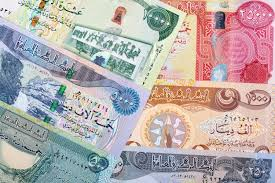
The Iraqi dinar is the currency of Iraq. The Iraqi dinar is issued by the Central Bank of Iraq. On 7 February 2023, the exchange rate with the US Dollar was US$1 = 1300 dinars.

The Iraqi flag has four horizontal stripes of red, white, green, and black. The colours are inspired by a poem by Safi al-Din al-Hilli. The flag also has an Arabic inscription that means “Allah is the Greatest”. 

The current version of the Iraqi flag has been in use since 2008. 

The flag was modified in 1991 by President Saddam Hussein.

In 2004, the Iraqi Governing Council proposed a new flag, but it was almost universally rejected by Iraqis. 

The colours of the Iraqi flag are inspired by a poem by Safi al-Din al-Hilli. 

The poem refers to red as willingness to shed blood, green for Arab fields, black for battles, and white for purity of motives and deeds. 

The three green stars on the flag represent a desire to unite with Egypt and Syria. 

It is one of the most culturally diverse nations in the Middle East. Arabs, Kurds, Turkmen, Assyrians, Mandaeans, and Armenians, among others, speak their own languages and retain their cultural and religious identities.

Iraqis once had some of the best schools and colleges in the Arab world. That changed after the Gulf War in 1991 and the United Nations sanctions that followed. Today only about 40 percent of Iraqis can read or write.

The country is a federal constitutional democracy. The Head of State is the President. The Head of Government is the Prime Minister, who appoints the Council of Ministers (Cabinet). The Council of Representatives (CoR) is the unicameral legislature. The Iraqi people elect the 329 members of the CoR through an open-list, proportional representation electoral process. Nine seats are set aside for representation of Iraqi minorities. The Constitution sets a quota of 25 per cent of CoR seats to be held by women. Members serve four-year terms. The Prime Minister and Cabinet Ministers do not have to be elected members of the CoR but the CoR must approve their nominations. Ministers must forgo their CoR seats to serve in Cabinet.

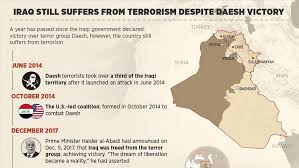
During late 2013 and 2014, the terrorist organisation Da’esh seized territory in west and northwest Iraq, including the city of Mosul. Da’esh systematically persecuted ethnic and religious minorities and committed abuses against vulnerable groups including women and children. On 9 December 2017, then-Prime Minister Haider al-Abadi announced the defeat of Da’esh in Iraq. 

Despite the territorial defeat of Da’esh in Iraq and Syria (announced by the Syrian Democratic Forces in March 2019), Da’esh remains a very real threat to the region. At the request of the Government of Iraq, the Global Coalition to Defeat Da’esh continues to support the Iraqi Security Forces to combat the threat posed by remnants of Da’esh.

Iraqi women today suffer from insufficient educational opportunities and healthcare and limited access to the labor market, as well as high levels of violence and inequality.

The status of women has been affected by wars, Islamic law and the Constitution of Iraq as well as Cultural traditions. Abusive practices such as honour killings and forced marriages still persist.

The security situation in Iraq is volatile and could deteriorate with little warning. There’s a risk of violence, armed conflict, kidnapping and terrorist attacks.

Jordan

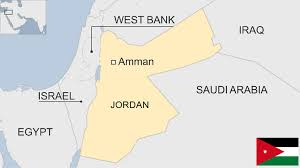
This week we are looking at Jordan an Arab nation on the east bank of the Jordan River, is defined by ancient monuments, nature reserves and seaside resorts. It’s home to the famed archaeological site of Petra, the Nabatean capital dating to around 300 B.C. Set in a narrow valley with tombs, temples and monuments carved into the surrounding pink sandstone cliffs, Petra earns its nickname, the “Rose City.”

The population is around 12 million.

The capital is Amman, which is a modern city with numerous ancient ruins. It is one of the region’s principal commercial and transportation centers as well as one of the Arab world’s major cultural capitals.

The Jordanian dinar has been the currency of Jordan since 1950. The dinar is divided into 100 qirsh or 1000 fulus. It is pegged to the US dollar. The Central Bank of Jordan commenced operations in 1964 and became the sole issuer of Jordanian currency, in place of the Jordan Currency Board.

The country’s official language is Arabic, everyone in the country, including the minority communities, speak Arabic in their day-to-day dealings.

In addition to the Arabic language, English has become a significant component in the school curriculum. While Arabic remains the official language in Jordan, English has been taught in Jordan’s schools and universities since the independence of Transjordan as a Kingdom.

The flag of Jordan is made up of three horizontal bands of black, white, and green, with a red chevron and a white seven-pointed star in the middle of the white band. The flag was adopted on April 16, 1928.

The colours and the star represent the following 

  • Black: Represents the Abbasid Caliphate
  • White: Represents the Umayyad Caliphate
  • Green: Represents the Fatimid Caliphate
  • Red: Represents the Hashemite dynasty and the Arab Revolt
  • Star: The seven points of the star represent the seven verses of the opening chapter of the Quran, the Al-Fatiha. It also represents the unity of the Arab people, faith in one God, humility, national spirit, virtue, social justice, and aspiration.

More than 92% of the population are Muslims and approximately 8% are Christians. Most Christians belong to the Greek Orthodox Church; but there are also Greek Catholics, Roman Catholics, Syrian Orthodox, Coptic Orthodox, Armenian Orthodox, and a few Protestant denominations.

Jordan is a constitutional monarchy with a bicameral National Assembly. The king is the head of state and commander-in-chief of the armed forces. The prime minister is the head of government and is responsible for carrying out the day-to-day tasks of the executive branch. The judicial branch is independent of the other two branches. Which are the executive branch and the legislative branch.

The government operates comprehensive health facilities, including a national health insurance program. The government supervises and coordinates social and charitable organizations. 

The government has the power to block and censor websites. 

Although the constitution provides for the freedom to practise one’s religion in accordance with the customs that are observed in the Kingdom, unless they violate public order or morality.

However, such things as wanting to convert from Islam to another religion isn’t allowed and are not recognised as anything other than Islam and are still considered legally Muslims and face immense societal pressure.

There are many restrictions against religious minorities such as.

  • Jordan’s government may deny recognition to a religion.
  • Baháʼís are not permitted to establish schools, places of worship or cemeteries.
  • Aside from Christians, all other non-Muslim minorities do not have their own courts to adjudicate personal status and family matters.
  • Muslim women may not marry non-Muslim men, such as Christians, unless the men legally convert to Islam.
  • Since Muslims are prohibited from converting to other religions according to the Sharia law, converts from Islam cannot change their religion on governmental records. However, converts to Islam are required to change their religious identification to “Muslim” on governmental records and civil documents.

When it come to women’s rights, they suck, females over the age of 15 need a male guardian’s permission to marry for the first time. A marriage to a non-Muslim is not recognised.

They cannot travel abroad with their children without the consent of a male guardian or having judicial consent. They are subject to restrictions when it comes to employment and general prohibited from night work.

Israel’s National Anthem

This week’s Hodgepodge is here: https://jamfn.blogspot.com/2025/02/hodgepodge-because-its-thursday.html

This week we are looking at the national anthem of the country Israel.

The anthem is a song called Hatikvah (The Hope, it was written in 1878 by Naftali Herz Imber, a Jewish poet. The theme of the song reflects the 2,000-year-old desire of the Jewish people to return to the Land of Israel which is not the country but refers to the traditional Jewish name for an area of the Southern Levant. As in a biblical reference, to the Land of Canaan, or the Promised Land also known as the Holy Land.

When the State of Israel was established in 1948, “Hatikvah” was unofficially proclaimed the national anthem. It did not officially become the national anthem until November 2004, when an abbreviated and edited version was sanctioned by the Knesset in an amendment to the Flag and Coat-of-Arms Law (now renamed the Flag, Coat-of-Arms, and National Anthem Law).

In its modern rendering, the official text of the anthem incorporates only the first stanza and refrain of the original poem. The predominant theme in the remaining stanzas is the establishment of a sovereign and free nation in the Land of Israel, a hope largely seen as fulfilled with the founding of the State of Israel.

The lyrics are below.

Kol od ba’le’vav p’nima,Nefesh yehudi ho’miyah.

U’lefa-atei mizrach kadimah,

Ayin le’Tziyyon tzofiyah.

Od lo avda tikva-teinu,

Ha’tikvah bat sh’not al-payim

Lih-yot am chofshi b’ar-tzeinu

Eretz Tziyyon v’Yerushalayim.

Translation:

As long as within our hearts

The Jewish soul sings,

As long as forward to the East

To Zion, looks the eye –

Our hope is not yet lost,

It is two thousand years old,

To be a free people in our land

The land of Zion and Jerusalem.

Israel

Ok after a bit of thought I am kicking of countries in the middle east with Israel.

Israel, officially the State of Israel, is a country in Western Asia. It is situated in the Southern Levant of the Middle East, and shares borders with Lebanon and Syria to the north, the West Bank and Jordan to the east, the Gaza Strip and Egypt to the southwest, and the Mediterranean Sea to the west.

The capital is Jerusalem, the population was 9.7 million in 2023. The official language is Hebrew.

It was called British Palestine in 1920 because that portion of the Ottoman Empire was given to the British to manage after World War I.

Both Jews and Arabs have claimed it as theirs alone. From a purely historical perspective, “Israel” predates “Palestine” by more than a millennium. But, with the Jewish people then dispersed from their homeland, “Palestine” became home to a substantial Arab population, again for more than a millennium

It is the homeland of the Jewish people, it is also the birthplace of Christianity, it also contains Islam’s third holiest site – the Dome of the Rock, and the Baha’i Gardens in Haifa.

Did you know voicemail technology was developed in Israel, or that there are more than 135 beaches.

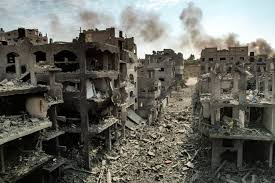
An armed conflict between Israel and Hamas-led Palestinian militant groups has been taking place in the Gaza Strip and Israel since 7 October 2023.

This is the fifth war since 2008 in the Gaza–Israel conflict, and the most significant military engagement in the region since the Yom Kippur War in 1973.

If like me, you don’t what or who HAMAS is well here is the answer. The Islamic Resistance Movement, abbreviated Hamas, is a Palestinian nationalist Sunni Islamist political organisation with a military wing known as the Al-Qassam Brigades. It has governed the Israeli-occupied Gaza Strip since 2007. 

The Israeli flag is white with a blue Star of David in the middle and two horizontal blue stripes. The flag was adopted on October 28, 1948, five months after Israel declared independence. The meaning goes beyond its visual elements. The Star of David at its center is a symbol of Jewish unity and connection to faith. The blue stripes represent the rivers of Babylon, evoking the longing for the Jewish homeland as described in the Bible.

The new Israeli shekel is Israel’s official currency. The value of one new shekel is equal to one hundred agorot. Since the year 1986, the Israeli Shekel has served as the country’s primary unit of currency.

The official religion is Orthodox Judaism, as I am sure most people would know, however, Israel’s laws protect the freedom of religion for all people, or so they say, how true that is I do not know.

The country’s basic laws define it as a Jewish democratic state. 

Judaism has been influential in Israel since the country’s founding. It plays a major role in the country’s political and state institutions. 

Each city and area of government has a religious council that regulates Jewish practices. 

Israel has religious courts that regulate personal status matters. 

Naturally everyone knows how dangerous it is to visit this country right now.

The Middle East

Ok I am moving away from Africa and venturing into the Middle East, this is a geopolitical region encompassing the Arabian Peninsula, the Levant, Turkey, Egypt, Iran, and Iraq. The term came into widespread usage by the United Kingdom and western European nations in the early 20th century as a replacement of the term Near East.

The Middle East is considered to include countries like Egypt, Iran, Iraq, Israel, Jordan, Kuwait, Lebanon, Saudi Arabia, Turkey, United Arab Emirates, and others, totalling around 17 countries. Although the exact number depends on the definition used. Some sources include the Arabian Peninsula, the Levant, and parts of North Africa within the Middle East.

Egypt is traditionally considered to be part of the Middle East. It is a regional power in the Middle East, North Africa, and the Muslim world. I included it in the North African Countries.

However, when you consider that the official language of Egypt is Arabic. And the official religion of Egypt is Islam. As well as the fact that some say the majority of Egyptians today identify as Arabs linguistically, while others say that there is a growing minority reject this.

Roughly 60% of the population in the Middle East is under 25 years old. The term “Arab” generally refers to people who speak Arabic as their first language. The majority of Arabs are Muslims, but the majority of Muslims are not Arabs. The words Islam and Muslim are derived from the Arabic word salam, which means peace.

The Middle East is the birthplace of Christianity, Islam, and Judaism. It is, therefore, a region of great diversity. While Arabs compose the majority of the Middle East’s population, the region is also home to Berbers, Kurds, Jews, Persians, Turks, and a vast array of other ethnic and religious minorities.

The Middle East is about 3.82 million square miles or 9.9 million square kilometres It makes up about 6.2% of the Earth’s land.

The largest country is Saudi Arabia, which is about 800,000 square miles or 2.1 million square kilometres and the smallest country is Bahrain, which is about 295 square miles or 765 square kilometres.

The Middle East is known for its vast deserts, including the Sahara Desert and the Arabian Peninsula’s “Empty Quarter.

The highest point is Mount Damavand in Iran, which is 18,406 feet or 5,610 meters tall and the lowest point is the Dead Sea, which is 1,388 feet or 423 meters below sea level.

Next week we will start looking at different counties. 

South Africa

Good morning all it is a much cooler day here in my part of the world, this week we are looking at another African country but this one you should all have heard of it is South Africa.

It is on the southernmost tip of the African continent, it is known for its great diversity in cultures, languages, religious beliefs and ethnic groups.

When we think of the capital most of us would say Cape Town but in fact, South Africa has three capitals as each branch of government has its own capital city. The administrative capital of South Africa is Pretoria, the legislative capital is Cape Town, and the judicial capital is Bloemfontein.

Why is this well in 1910, when the Union of South Africa was formed, there was a great dispute about the location of the new country’s capital city. A compromise was reached to spread a balance of power throughout the country, and this led to the three capitals of South Africa.

The population is around 63 million, with Black South Africans as the majority, with around 80% the rest is made up of coloured South Africans at around 8%, Indian or Asian South Africans at around 2.6% and  White South Africans being around 8%.

The country has nine provinces:

  • The Eastern Cape
  • The Free State
  • Gauteng
  • KwaZulu-Natal
  • Limpopo
  • Mpumalanga
  • The Northern Cape
  • North West
  • The Western Cape 

Each province has its own government, including a premier, legislature, and executive council. The provinces also have their own distinct landscapes, populations, economies, and climates. 

South Africa’s provinces were increased from four to nine in the lead-up to the 1994 general election.

This was done by reintegrating the country’s former homelands, known as Bantustans, into the country. 

The flag is a horizontal bicolour of red and blue with a green band in the middle that splits into a “Y” shape. The flag also features a black triangle on the hoist side, with narrow yellow or gold bands separating the triangle from the arms of the “Y”.

The flag was adopted in 1994 after the end of Apartheid to represent the country’s new democracy.

The country has a diverse religious population, with Christianity being the most widely practice with around 85% of the population being Christian. The largest group of Christian churches are the African Independent Churches, which include the Zion Christian Church and the Apostolic Church. 

Around 7% of the population practices Indigenous beliefs. Many Indigenous people combine Christian and Indigenous religious practices. 

It is believed that about 6% of the population is atheist or agnostic. 

There is also Hinduism, Islam, Buddhism, and Judaism practiced in the country.

South Africa is a secular state with a constitution that guarantees freedom of religion. The state’s relationship with religion is more moderate and tolerant, allowing for voluntary religious observances within state institutions.

Like many African countries South Africa isn’t considered a safe country to visit due to crime, civil unrest, and kidnapping. Violent crime is common and includes armed robbery, rape, carjacking, and mugging. There are also “smash-and-grab” attacks on vehicles. It is the 20th worst country in regards of safety and security.

Many would know of Apartheid which was in South Africa from 1948 to 1994 and was the racial segregation under the all-white government of South Africa which dictated that non-white South Africans (a majority of the population) were required to live in separate areas from whites and use separate public facilities and contact between the two groups would be limited. The different racial group were physically separated according to their location, public facilities and social life.

In 1948, after the National Party won that year’s elections, Apartheid became a social project of the government based on a series of laws which made it legal.

There are at least thirty-five languages are spoken in the country with twelve of them being regarded as official languages, they are Ndebele, Pedi, Sotho, Swazi, Tsonga, Tswana, Venda, Afrikaans, Xhosa, Zulu, English and South African Sign Language.

English is the primary language used in parliamentary and state discourse, though all official languages are equal in legal status.

The South African Rand  is the currency of South Africa and is issued by the South African Reserve Bank. The South African rand has the symbol R. It is subdivided into 100 cents. The name is derived from the word ‘Witwatersrand’, which means ‘ridge of white waters’.