Hunter Street, Newcastle NSW,Australia

When I was young it was considered to be a big deal to go into town to go the movies or to do some shopping and by in town I mean into Newcastle mainly Hunter Street.

So, this week I will write a bit about Hunter Street’s history and present.

Hunter Street is a major road in the Newcastle central business district, in New South Wales. The street, formerly three separate thoroughfares, extends from Pacific Street in the city’s east, to Selma Street in Newcastle West and since 2008 has been the focus of community-led creative enterprises and projects.

Hunter Street runs in the vicinity of an early nineteenth-century track known as Wellington Street that extended from Watt Street (formerly George Street) in the east to Perkins Street in the west. The strip was renamed Hunter Street by Henry Dangar in 1823 and by the mid nineteenth-century commercial and residential properties had been built on most addresses east of Perkins Street.

By 1900, Hunter Street had stretched a long way and had 26 hotels operating along the street. In 1887the first steam trams came into operation by 1898 the first restrictions on vehicular traffic drawn by animals were introduced

Drainage problems and raw sewerage necessitated the sealing of Hunter Street, first carried out with wooden blocks, concrete and asphalt.

After the opening of the Newcastle Steelworks in 1915, Newcastle became increasingly suburban, and Hunter Street developed as a destination for commerce and retail. The size and extravagance of Newcastle’s early twentieth-century department stores demonstrates the popularity of city shopping.

Established as the city’s main street for commercial and retail activity, Hunter Street entered a period of severe decline after World War II. However, it recovered over time.

Hunter Street developed as the commercial and civic hub of the region. Along its spine were the pubs, banks, insurance houses, shops, department stores, and cooperative societies that formed the civic and cultural life of Newcastle.

In 1989 an earthquake hit Newcastle and due to the damage making Hunter Street inaccessible for two weeks.

The in 1990 there was a recession which coupled with record youth unemployment, brought the emptying of Hunter Street to a terrible low in 2008, with the vacancy rate at 20% and chronically vacant properties beginning to deteriorate.

In recent years there have been efforts to clean up and bring life back into Hunter Street, as I haven’t been there myself I can’t say what it is like now.

Bulgaria

Good morning, time to visit another country this week we are visiting the Balkan region in Southeastern Europe which takes its name from the Balkan Mountains which run from Bulgaria into eastern Serbia.

So, the country will be Bulgaria a country with diverse terrain encompassing Black Sea coastline, a mountainous interior and rivers, including the Danube. A cultural melting pot with Greek, Slavic, Ottoman, and Persian influences, it has a rich heritage of traditional dance, music, costumes, and crafts.

At the foot of domed Vitosha mountain is its capital city, Sofia, dating to the 5th century B.C

The population is around 6.5 million and the language spoken is Bulgarian.

The lev is the currency of Bulgaria. Although Bulgaria is part of the EU, it is not part of the Eurozone. Eurozone is the group of counties that use the euro as their currency. Some prices are often published in euro, but this is simply to make things easier for visiting foreigners. Transactions are always done in Leva/BGN.

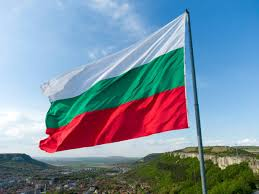
The national flag of Bulgaria is a tricolour consisting of three equal-sized horizontal bands of white, green, and red. The flag was first adopted after the 1877–1878 Russo-Turkish War, when Bulgaria gained de facto independence. After the downfall of the communist government, the old plain tricolour was reestablished on November 27, 1990. The white of the flag is said to stand for peace, love, and freedom, while green emphasizes the agricultural wealth of Bulgaria. Red is for the independence struggle and military courage.

Bulgaria is a parliamentary republic and conforms with the Constitution of the Republic passed by the Grand National Assembly in July 1991. The Constitution of the Republic of Bulgaria is the supreme law of the country and may not be contravened by any other law. All international treaties, which are ratified pursuant to the constitutional procedure, are considered part of domestic legislation.

The National Assembly is a unicameral parliament. It consists of 240 Members of Parliament, who are directly elected every four years. The National Assembly is a permanent acting body, directed by a board of Chairpersons, including the Speaker of the National Assembly. The Speaker of the National Assembly represents the National Assembly externally.

The head of the state is the President, who embodies the unity of the nation and represents the Republic of Bulgaria in international relations.

The Council of Ministers represents the executive branch and decides on the domestic and foreign policy of the country. The government manages the implementation of the state budget, governs state property and approves or rescinds certain categories of international treaties as postulated by the Constitution.

Some say Bulgaria is not dangerous for tourists if you stick to the rules and respect the culture. Crime is very low in Bulgaria; however, pickpocketing and petty theft have been recorded in the more touristy areas and main cities.

With the same colours as the flag, Shopska Salad is often proclaimed as Bulgaria’s national dish. It is often said to have been invented in the 1960s by the socialist party to showcase local ingredients to tourists and promote the theory that Bulgarian vegetables were among the tastiest in Europe.