Emu

This week we are looking at the Emu they are the second-largest living birds in the world, native only to Australia, and known for their speed, endurance, and unique breeding habits.

They stand up to 1.75–2 meters tall and weigh 50–55 kg (110–121 lbs), with brownish feathers with a shaggy texture; long legs adapted for running. They have three forward-facing toes, which help them sprint and manoeuvre quickly.

Some may know and some may not know but emus can run as fast as 50 km/h which is 31 mph, and they can jump up to 2 meters which is 7 feet and to that they are damn strong swimmer and move through water damn fast when they want to.

These birds are omnivorous with their diet consisting of seeds, fruits, flowers, shoots, and insects like beetles and grasshoppers. They will travel long distances to find food and water, often forming loose groups called “mobs.”

They will mate for life in the wild, the female will lay 7–10 large dark green eggs, each about 13 cm long, but it the male who incubates the eggs for ~60 days and raises the chicks, while the female often moves on to mate again.

Now are you wondering what they sound like, well the female makes a deep, low-pitched sounds that can sound like drumming and often described as a hollow and resonant sound. These calls can carry for long distances and are used for communication, especially during breeding season. Males tend to sound like a soft grunt.

These calls are used to attract mates, signal territory, or keep contact with other emus.

Have you heard of the Emu War of 1932 this was a war us humans lost, the Australian army tried to cull emus damaging crops, but the birds proved too elusive. Despite firing 10,000 rounds of ammunition, fewer than 1,000 were killed, and the “war” was considered a failure.

Cockatoo

Last week I wrote about birds in general, this week I am writing about the Cockatoo.

Cockatoos are intelligent, expressive parrot’s native to Australasia, known for their dramatic crests, powerful beaks, and deep emotional bonds with humans. They’re among the most affectionate and long-lived pet birds.

There are around 21 recognized species, including the Sulphur-crested, Galah, Palm, and Major Mitchell’s cockatoos

They are native to Australia, New Guinea, Indonesia, and the Solomon Islands.

Typically white, black, or pink with dramatic crests; less rainbow-coloured than other parrots

Their beak is strong, curved with a unique “three-way bite” for cracking nuts and gripping objects

They live in flocks and form lifelong pair bonds, they are loud and expressive, you wouldn’t want one if you lived I an apartment due to their volume.

They like to eat seeds, nuts, fruits, roots, and insects; use their beaks and strong tongues to forage.

They have a lifespan: 25–60 years, with some living over 70 years in captivity, in the wild they live in tree hollows and both parents care for their young.

They reproduce through internal fertilization, followed by egg-laying and a dedicated incubation period of about 28–30 days. The female lays 1–3 eggs per clutch, typically spaced a few days apart. Eggs are laid in a nest cavity or nesting box lined with wood shavings or soft material. The eggs are white and oval, and both parents may take turns incubating them.

Incubation lasts 28–30 days, during which the eggs must be kept at a stable temperature (~37.2°C) and humidity (55–60%).

Eggs are turned regularly to ensure even development and prevent the embryo from sticking to the shell. They are born blind and featherless, relying entirely on their parents. Their feathers start appearing in a few weeks and by 10 to 12 weeks they are ready to leave the nest.

They are highly social and attentive parents, often forming lifelong bonds. They teach their young vocalizations, foraging, and social behaviours essential for survival.

Birds

Hello everyone, this week we are looking at birds, did you know there are over 11,000 species of birds throughout the world and 800 different species in Australia.

Now I expect everyone knows that all birds have feathers, beaks and wings but not all can fly. I will talk about those that don’t fly next week.

The country with the largest number of different species in Colombia with about 1,917.

This remarkable avian diversity is due to Colombia’s unique geography and climate.

The country with the fewest bird species is Vatican City, due to its extremely small size and limited natural habitat. However, if you’re considering larger countries with more ecological context, Iceland is often cited as having notably low avian diversity.

Do you know the diet of birds, most eat plants and seeds but there are some that eat meat, meat eaters are considered birds of prey. However, there are some that are not like the Butcher bird and the Magpie both are native to Australia.

Birds that have musical voices are called songbirds; they have specially developed vocal cords which are called the syrinx which they use to produced sounds resembling songs. They also have a special section in their brain which helps them learn their songs.

The birds that fly do so to find food and avoid predators; birds have a very light skeleton and strong muscles and wings. The shape and size of their wings determine the distance between and type of flight they can do.

Birds have feathers for flight, insulation, communication, camouflage, and protection—making feathers one of the most versatile and essential adaptations in the animal kingdom.

However, their feathers are not just for flight, they have bright, patterned feathers are used in courtship rituals to attract mates. Males often display more vibrant colours than females. Birds fluff, spread, or raise feathers to signal aggression, readiness to mate, or submission.

Many birds have feather colours and patterns that match their surroundings, helping them avoid predators or sneak up on prey.

Some species molt into different plumage depending on the season for better camouflage.

Feathers protect birds from UV radiation, wind, rain, and physical injuries.

Dense feather layers help shield sensitive skin from harsh environments.

Rodents

Hello everyone, it is hot here and it is the type of day that I feel like doing stuff for an hour or so then I need to have a rest.

Anyway this week we are looking at rodents they are the largest order of mammals with hour many species there are. There are around 2,500 different species around the world.

Rodents are found everywhere except in Antarctica.

The character traits of rodents are incredibly diverse, as they are the largest order of mammals. However, they share several key physical and behavioural characteristics that define the group such as.

They have sharp incisor teeth which never stop growing and are kept short by gnawing.

They lack canine teeth and some premolars, leaving a distinct gap (diastema) between their incisors and their cheek teeth (molars/premolars).

While most are small (mice, hamsters), the order includes the largest living rodent, the capybara which weighs up to 70 kg.

They typically have robust bodies, short limbs, and a long tail although tails vary greatly—some are bushy like squirrels, others are nearly hairless like rats, and some are short or stubby.

They rely heavily on their long, sensitive whiskers to navigate and explore their environment, especially in the dark, as their vision is often less developed with many being colourblind or have poor eyesight.

Also they lack sweat glands and dissipate heat primarily through their tails and ears, making them susceptible to overheating.

They are one of the most successful mammalian groups, inhabiting nearly every environment on every continent except Antarctica. They are highly adaptable to new and human-disturbed environments.

The majority are herbivores, feeding on seeds, nuts, fruit, and plants, but many are omnivorous (like rats), and some are specialized predators (like grasshopper mice).

They are known for their high reproductive capacity, having large litters and short gestation periods, which helps compensate for high predation rates.

Sun Bear

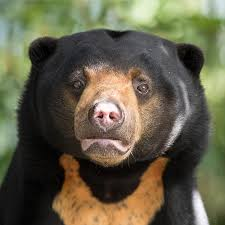
This week we are looking at a species of bear I have never heard of, that being the sun bear it is found in the tropical forests of Southeast Asia. It is the only species in the genus Helarctos and they are the smallest bear species and are only around half the size of an American black bear, measuring 4-5 feet tall when stood on their hind limbs, and weighing up to 68kg.

Sun bears are named for the bib of often sunshine-yellow fur adorning their chests. Each sun-bear bib is unique and can be used to distinguish one bear from another. Their fur is thick, short and generally jet-black, although some bears have a reddish or silvery hue.

Despite their name, recent research on wild sun bears suggests these animals are crepuscular, meaning their activity levels peak during the twilight hours of dawn and dusk.

They are known to be very aggressive and may attack without apparent provocation. Except for females with cubs the bears are solitary although there is a suggestion that same may form long-term monogamous relationships. Litters are of from 1 to 3 cubs with no apparent set period for mating or birth.

Relative to their skull size, sun bears have the largest canine teeth of any bear species. For context, sun bear canines are the same size as those sported by polar bears, and species some 5 to 10 times larger.

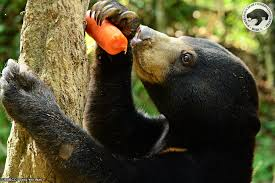
Sun bears have long, curved claws, are well adapted for gripping bark and are the most arboreal of all the bear species. These bears will climb trees to forage for wild fruits and beehives and to evade predators such as tigers, leopards and dholes, an Asian canid. One of the characteristic signs of the presence of wild sun bears is claw marks on trees they have climbed. 

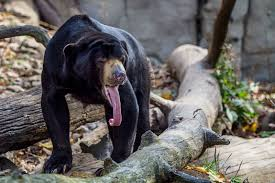
They have exceptionally long tongues, the longest among all bear species, reaching up to 25-30 centimetres (10-12 inches). These long, sticky tongues are essential for their diet, allowing them to extract insects and honey from hard-to-reach places like tree crevices and termite mounds.

Sun bears primarily inhabit dense tropical and subtropical rainforests throughout Southeast Asia. Their range includes areas in northeastern India, Bangladesh, Myanmar, Thailand, Peninsular Malaysia, Laos, Cambodia, Vietnam, southern China, and the Indonesian islands of Sumatra and Borneo. They are typically found at lower altitudes in these forests but can be seen at higher elevations in some regions like India. 

They are omnivorous, favouring fruits, insects, small animals and bee nests (for insects and honey). Large teeth and long claws enable sun bears to tear into logs and termite mounds in search of insects an important component of their diet. Their tropical habitat generally provides food resources year-round, so sun bears do not hibernate.

Sun bears face significant threats from habitat loss due to deforestation and conversion of forests for agriculture, particularly oil palm plantations. They are also targeted by commercial hunting for their bile, paws, and other body parts, and are affected by the illegal pet trade. 

England part 2

This week I am doing a little more about England with information such as, England’s national animal which is the lion.

In the Middle Ages there were lions kept at the Towel of London as part of a menagerie.

English medieval warrior rulers with a reputation for bravery attracted the nickname “the Lion”: the most famous being Richard 1 aka Richard the Lionhearthed.

Lions are frequently depicted on shields they also appear in sculpture, at sites of national importance. The lion is used as a symbol of English sporting teams, such as their national sporting teams.

The national tree is the oak tree, specifically the English oak, it represents strength and endurance.  In 1651 during the battle of Worcester King Charles 11 hid in an oak tree before making it safely into exile.

The national flower is the rose, a Tudor rose is officially used, it signifies the unification of the warring parties of during the War of the Roses under the Tudor dynasty, the red rose represented the House of Lancaster, and the white rose the House of York.

England doesn’t have a single official national dish, however there are some foods mostly connected to the country such as roast beef with Yorkshire pudding which has its roots dating back to the 18th century. The ballad “The Roast Beef of Old England” from 1731 highlights the dish’s cultural significance. 

Other dishes would be fish and chips, toad in the hold and bangers and mash.

Toad in the hole is a traditional British dish consisting of sausages in Yorkshire pudding batter, usually served with onion gravy and vegetables. Historically, the dish has also been prepared using other meats, such as rump steak and lamb’s kidney.

Bangers and mash are sausages, and mash is a traditional British dish consisting of sausages and mashed potato. The dish is usually served with onion gravy but may also include fried onions and peas.

England’s national drink is tea. While gin is also a strong contender, particularly in the south, tea’s widespread consumption across all social classes.

Many people say that England has two national sports being Association football (commonly known as soccer), as well as Cricket, which is often considered the national summer sport.

Also, England is known for being the home of some amazing authors such as William Shakespeare, Jane Austen and Charles Dickens to name a few.

There are two versions of the banknotes in circulation. One version featuring a portrait of King Charles III and one version featuring a portrait of Her late Majesty, Queen Elizabeth II. There are four denominations of the banknotes in circulation: £5, £10, £20 and £50. The £1 & £2 notes have been converted to coins during the 1980’s and 1990’s.

In England, women gained the right to vote in a phased approach. The Representation of the People Act of 1918 granted women over 30 the vote, provided they also met certain property qualifications. However, full equality with men was achieved in 1928 with the Equal Franchise Act of 1928, which lowered the voting age for women to 21.

The first woman to have a seat in parliament was Nancy Astor (Viscountess Astor), after a by-election, in December 1919. She was elected as a Conservative for the Plymouth Sutton constituency after her husband, Waldorf Astor, the former MP, was elevated to the peerage.

The English coat of arms, featuring three golden lions on a red field, dates back to the late 12th century, around 1198. While there are earlier uses of lions in English heraldry, the specific design of three lions passant-guardant was introduced by King Richard I and is the one that became established as the Royal Arms of England. 

The coat of arms of England, part of the wider Royal Arms of the United Kingdom, features three lions passant (walking) on a field of gold, representing the English royal lineage. This design, often described as “three lions on a field of gold,” has been a consistent symbol of England since its adoption by King Richard I in the 12th century. The lions, initially a single lion on a shield, were later expanded to three by his successor, King John, and have remained a defining feature of the English coat of arms ever since. 

At the center of the arms is a quartered shield, depicting the three passant guardant lions of England in the first and fourth quarters, the rampant lion and double tressure flory-counterflory of Scotland in the second quarter, and a harp for Ireland in the third quarter. 

Well I guess I will wrap this up hope people found the post interesting.


Sydney, New South Wales, Australia

This week we are looking at Sydney, which is the capital of New South Wales and one of Australia’s largest cities, is best known for its harbourfront Sydney Opera House, with a distinctive sail-like design. Massive Darling Harbour and the smaller Circular Quay port are hubs of waterside life, with the arched Harbour Bridge and esteemed Royal Botanic Garden nearby. Sydney Tower’s outdoor platform, the Skywalk, offers 360-degree views of the city and suburbs.

The estimated population of the Sydney metropolitan area in 2025 is around 5.248 million. 

Greater Sydney covers 12,368.7 sq km and is made up of 34 local councils. Over 650 suburbs make up the Greater Sydney region.

Sydney was founded 237yrs ago when in 1788, the First Fleet of convicts, led by Arthur Phillip, founded Sydney as a British penal colony, making it the first European settlement in Australia.

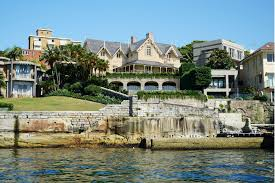
Sydney is also where Kirribilli House is, this is the secondary official residence of the prime minister of Australia. Located in the Northern Sydney suburb of Kirribilli, New South Wales, the cottage and its associated grounds are located at the far eastern end of Kirribilli Avenue. 

It commands impressive views across to the Sydney Harbour Bridge, Circular Quay and the Sydney Opera House and has been visited over the years by many important international dignitaries. Kirribilli House is open to the public on one day a year, courtesy of The Australiana Fund.

This year it will be open to the public for an open day on Saturday, June 3rd, 2025, from 10:00 am to 2:00 pm, along with Admiralty House, allowing visitors to explore the grounds and gardens.

There will be tours of both houses, and then lunch on the lawns. You can bring a packed lunch, or there will be food available to purchase. Entry is $15. 

Sydney has relatively low crime rates compared to many other major cities globally. Violent crime is uncommon, and the city is known for its safe streets.

Sydney’s public transportation system, including buses, trains, and ferries, is generally safe and mostly reliable all the services are well-monitored and have security measures in place. We also have transit officers that can tell people to leave stations and trains, demand full name and residential address when they suspect, on reasonable grounds that a person has committed a railway offence, Issue infringement notices (‘on-the-spot’ fines) for railway offences.

Island Fox

This will be the last post about foxes we are ending with the Island Fox.

The Island fox is native to six of the eight Channel Islands in California it is considered critically endangered by the IUCN, it is threaten by golden eagles, disease, and habitat destruction.

The Catalina Island Conservancy and Institute for Wildlife Studies have established a fox recovery program for the island fox. This program includes vaccination, relocation, and captive breeding. 

The island fox is a small fox species that is endemic to six of the eight Channel Islands of California. There are six subspecies, each unique to the island it lives on, reflecting its evolutionary history. They are generally docile, show little fear of humans, and are easily tamed.

The island fox has similar markings to the gray fox. They have gray colouring on the back, rust colouring on the sides, and white underneath. The face has a distinctive black, white, and rufous-coloured patterns.

In March 2004, four subspecies of the island fox were classified as a federally protected endangered species: the Santa Cruz Island fox, Santa Rosa Island fox, San Miguel Island fox and the Santa Catalina Island fox.

Island foxes reach sexual maturity at 10 months, and females usually breed within the first year. These foxes can live for up to 10 years in the wild, but four to six years is more typical.

They are generally docile, show little fear of humans, and are easily tamed. Island foxes played an important role in the spiritual lives of native Channel Islanders. They have been likely semi-domesticated as pets, used as pelts, or for other functions, like pest control.

They are omnivorous, eating both plants and other animals. They eat a large amount of insects, some island deer mice, reptiles, and fruit from native plants. New evidence is showing marine resources may be important for island foxes. Their diet also changes with the seasons.

 The primary threat to the island fox is predation by invasive golden eagles. The species is also very vulnerable to canine distemper transmitted by domestic dogs, habitat fragmentation due to development, and habitat loss to introduced livestock and game species.

Week 10 of 2025

I slept well woke only once to pee, a cool morning we are in for another hot day, with a top of 29C, it is currently 6am and 23C.

Tim took the car in for its first service, I noticed after he left that he forgot his phone, that would be annoying as who doesn’t scroll through Facebook while waiting. Those who left their phone at home that’s who.

I changed the sheets and by the time I was done I was dripping sweat and felt exhausted. So I turned the air con on.

I have answered 6 letters today.

Tim went and cashed in cans and bottles.

Steps:11,150s

It was midnight before I fully settle last night, at 5am I got up and took my meds then went back to bed for an hour.

Around 10am Tim and I went to Sue’s so he could change her flat tyre, however, he wasn’t able to get the lug nuts off as the tool he had was too big as was the one Sue had. Although the one Sue had, come with the car so you would have thought it would fit.

We called into the shops so I could get the scrips and some bread before coming home.

I have been tired on and off all day and it has been stinking hot.

Steps: 6,085

I had a much better night, last night, felt a little heavy headed when I first got up, but I am doing better now.

I made myself an egg and cheese roll for breakie but only managed to eat half of it.

Tim went to Sue’s after his morning school run to change her tyre, but he wasn’t able to do it as he couldn’t get the lug nuts off as they were on too tight.

This afternoon Dawson called in to see me and make sure I knew had another car.

Been raining this afternoon.

Steps: 9,822

Another good night, I can’t have my morning egg flip as we have no milk till the groceries are delivered and I have no bread, but I did have a stale bread roll which I have used to make a grilled cheese.

So, I managed to only eat half of the bread roll, nothing wrong with it just no appetite.

I had a wagon wheel hot cross bun for lunch, but it was too rich for me, in future I will only have half at a time.

It started out cool but warmed up by 11am.

By 5.45pm I was falling asleep, I will stay up till 7.30pm.

Steps:7,947

Another good night, I slept straight through waking only when my alarm went off.

I have both front and back sliding doors opened and it is nice just a slight breeze.

It started raining while I was wait for Sam this afternoon.

Tasha drove Blain’s girlfriend’s car to Tafe and on her way home the car stopped, and she couldn’t get it going and was in a state. Tim was able to go and help her turned out it was a flat battery.

Kathy rang Tim via Facebook as she does every Wednesday just to see him and have a short chat.

Steps:9,999

Another good night, I slept straight through waking only when my alarm went off.

I had a shower after Tim left for work, then I vacuumed before making breakie.

Sue rang the mobile tyre place, she had to buy a new tyre as they wouldn’t put the spare on in place of the flat one, well the guy turned up he was a friend of Ed and Les, she got the number of the mobile tyre mob from Sandy. Anyway, he told her for only $20 more she could have got two tyres as they would waive the call out fee.

It started to rain here around 1.45pm it didn’t last long maybe 10-minutes. It then started raining again at 3.30pm.

Steps:12,201

Had a reasonable night’s sleep, although when the alarm went off, I didn’t want to get up.

This morning I was sitting here reading blogs when I heard a loud squark and I jumped, when I turned round there was a cockatoo standing a foot away from me, I said what do you want, it walked over to bird seed and looked at me, so I feed it and all the others out the front.

It has been a nice day, haven’t done much not much motivation today. I started to feel real tied by 6pm.

It is 8.30pm and I am off to bed.

Steps: 5,945               

I had a good night, woke at 5am with the alarm but after taking my meds I went back to bed for another 40-minutes.

It is raining this morning; it looks like it will be a wet day.

I have been feel blah all day.

Bat-Eared Fox

This week we are look at the bat-eared fox, another fox I hadn’t heard of.

The bat-eared fox is a species of fox found on the African savanna. It is the only extant species of the genus Otocyon and a basal species of canid. Fossil records indicate this canid first appeared during the middle Pleistocene.

As the name indicates, this fox has unusually enormous ears in proportion to its head, like those of many bats. Their bodies are generally yellow-brown with a pale throat and under parts. The outsides of the ears, the racoon-like “face-mask,” lower legs, feet, and tail tip are all black. 

They can be found living in groups of mating pairs and their young. They are a very social species and spend lots of time grooming each other, as well as playing and sleeping together.

Their hearing is remarkable, but bat-eared foxes are also known for their social nature. They often live in family groups of up to 15 animals. They do not mark or defend territories aggressively against other packs.

They seldom drink water as they obtain most of the moisture they need from their food; 3. Unlike other canids, the male undertakes most parental care duties, while the female forages for food that maintains her milk production

Termites and dung beetles make up about 80 percent of their diets. In addition to termites and dung beetles, they also eat other insects and arthropods, small rodents, lizards, the eggs and chicks of other birds, and plant matter. They obtain much of their water from the body fluid of the insects they consume.

Predators include cheetahs, jackals, spotted hyenas, rock pythons, African wild dogs, and leopards. Bat-eared foxes are named for their large ears, which are also used for thermoregulation. To escape from predators, bat-eared foxes rely on speed and their incredible dodging ability.

They typically live for 6 years in the wild but can be up to 13 years in captivity. 

They reach sexual maturity at 8–9 months old, both male and female. They usually leave their family groups at 5–6 months old. 

They breed annually, producing litters of 3–6 pups, with a gestation period of 60–75 days.