
Grey Fox

The gray fox, or grey fox, is an omnivorous mammal of the family Canidae, widespread throughout North America and Central America.

They live in a wide variety of places. They prefer to live in places they can blend in, like canyons and ridges. Though they will also live in wooded areas, open desert and grasslands. They can be found from Quebec to Northern Columbia and Venezuela.

They are common, but very elusive and rare to spot in the wild. They are primarily nocturnal but may forage during the day.

They are smaller than red foxes. They weigh between 7 and 13 pounds and average 3 to 4 feet in length including the tail. They are stockier and have shorter legs than the red fox. Their color is grizzled gray with a distinctive black streak along the top to the black tip of the tail.

They have a white throat and belly. Their chest and lower sides of the body, undersurface of the tail, backs of the ears, parts of the legs, feet and neck are reddish or yellowish brown. The claws are sharp, and on the forefeet recurved.

Due to their more aggressive behavior, they prefer to hunt thicker cover than the more timid red fox. The gray fox’s preference for thicker cover, aggressive behavior, and the ability to climb trees minimizes the effect that eastern coyotes have on their population.

It often lines the den with shredded bark or leaves and will return to the same one year after year. The gray fox is nocturnal and crepuscular, which means it is most active at dusk and dawn. During the day, it remains in the den.

The gray fox is a solitary hunter and eats a wide variety of foods. A large part of its diet is made up of small mammals like mice, voles and eastern cottontail rabbits. It also eats birds; insects; and plants like corn, apples, nuts, berries and grass.

The gray fox has few natural predators. Bobcats, coyotes, great horned owls, and golden eagles may occasionally prey upon young gray foxes.
Red Fox

Ok let’s have a look at the red fox which I think may be the most well know of foxes it is in my opinion a handsome looking creature.

It is the largest of the true foxes and one of the most widely distributed members of the order Carnivora, being present across the entire Northern Hemisphere including most of North America, Europe and Asia, plus parts of North Africa. 

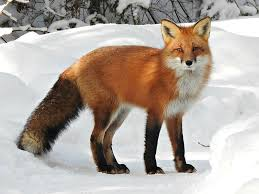
They have long snouts and red fur across the face, back, sides, and tail. Their throat, chin, and belly are grayish white. Red foxes have black feet and black-tipped ears that are large and pointy. One of the most noticeable characteristics of the red fox is the fluffy, white-tipped tail.

They have been called bold, cunning, and deceitful, particularly in children’s stories. In fact, they are shy, secretive, and nervous by disposition, and they appear to be very intelligent.

They are extraordinarily opportunistic, omnivorous predators. Nonetheless, most studies agree that they feed predominantly on small mammals, particularly rodents (rats, mice, voles and the occasional squirrel) and lagomorphs (rabbits and hares); in rural areas these groups together typically account for about 50% of the diet.

Red foxes are the most widespread wild canid and have the largest natural distribution of any non-human land mammal.

Red foxes can be found in many countries, including, most of Europe, Russia, Kazakhstan, Iraq, Iran, Pakistan, northern India, China, and Thailand. They can be found in the northern and eastern United States, north through Canada and Alaska to Baffin Island. In parts of North Africa as well as here in Australia they were introduced to Australia in the 1800s and have spread throughout much of the country. However, it wasn’t till the late 1990’s that they were introduced to Tasmania.

They are hunted for sport and for their pelts. Red foxes are also the primary carrier of rabies in much of their range

Both the male and female red fox, care for their pups, or kits. The mother, or vixen, spends a lot of time grooming and cleaning the cubs. The father brings food to the mother during the first few weeks. The parents take turns hunting and bringing food back to the kits. 

The vixen gives birth to 1–10 or more pups in a den, which is often a burrow abandoned by another animal. The pups are born brown or gray, but usually grow a new red coat by the end of the first month. 

Their dens are usually located on the edges of forests, near fields, or under porches. 

The pups start playing outside the den when they are about a month old. The mother feeds them regurgitated food at first, but eventually brings them live prey to play with and eat. 

The young remain with their parents at least until the fall of the year they were born in. They disperse in the fall once they are fully grown and independent.