Hi everyone, this week I thought I would wrap the posts about Russia with a bit about what it’s like now days.
So, the country is experiencing a period of significant transformation and challenges. While its economy has shown resilience, particularly in the face of Western sanctions, it remains heavily reliant on energy exports and faces persistent issues with corruption and human rights abuses. The ongoing war in Ukraine has also led to intensified repression of dissent and a decline in international relations.
Power is concentrated in the hands of President Vladimir Putin, with a system that suppresses genuine opposition and controls the media.
Life expectancy is lower than the OECD average, and there are issues with poverty and inequality. Life expectancy for women is 78 years, compared with 68 for men.
The war with the Ukraine has had a profound impact on Russia, leading to a decline in international relations and increased repression within the country. While overall confidence in the military remains high, there are signs that the war has eroded some support, particularly in comparison to pre-war levels.
The war is a significant factor in Russian life, with many citizens living in a “twilight zone” where the war is both ubiquitous and a backdrop to everyday life.
The Russian government has been using propaganda to portray the war as a struggle against the West, and this has been effective in uniting some segments of the population.
The war has led to a transfer of wealth from the government to the military and regions impacted by the conflict, creating a temporary consumer boom.
Russia’s international standing has been severely damaged by the war, and it faces increased isolation.
Many countries advise against all travel to Russia due to the ongoing war and associated risks. Also, there’s a high threat of terrorism. Terrorist groups, including al-Qaeda and Daesh-aligned groups, continue to call for attacks in Russia. Attacks can be indiscriminate and may occur on or around seasonal, festive, or religious events in public places, including popular tourist sites.
Next week we will move on to somewhere else as yet undecided
This week we will have a look at Russia during the twentieth century, this was a period of immense political, social, and economic upheaval, marked by revolution, civil war, and the rise of communism.
The century began with the Tsarist empire, ended with the collapse of the Soviet Union, and saw the country transform into a communist state. Key events include the Russian Revolution, World War I, the rise of Joseph Stalin, the Cold War, and the eventual disintegration of the Soviet Union.
St Petersburg early 20th Century
Russia’s participation in the war contributed to the social and political unrest that led to the February Revolution in 1917. This is when the monarchy was overthrown, and the Bolsheviks, led by Vladimir Lenin, seized power, establishing the world’s first communist society. This marked a shift from autocratic rule to a communist regime. This was known as the Russian Revolution’.
The country found themselves with a civil war which lasted between 1918-1922, this saw the Bolsheviks fighting against various anti-communist forces, ultimately solidifying their control over the country.
After the civil war Russia united with other republics to form the Union of Soviet Socialist Republics (USSR).
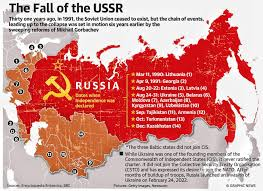
The Soviet Union was composed of 15 Soviet Socialist Republics (SSRs). These republics were: Russia, Ukraine, Belarus, Moldova, Lithuania, Latvia, Estonia, Georgia, Armenia, Azerbaijan, Kazakhstan, Uzbekistan, Kyrgyzstan, Tajikistan, and Turkmenistan.
It was at this time that Joseph Stalin became the dominant leader, implementing policies of industrialization, collectivization of agriculture, and widespread repression.
During the second world war The Soviet Union fought against Nazi Germany and the Axis powers, suffering immense casualties but ultimately contributing to the Allied victory.
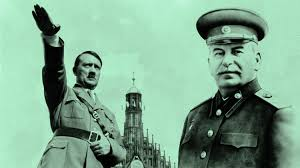
At first The Soviet Union officially maintained neutrality during WW2 but cooperated with and assisted Germany. However, after Nazi Germany attacked the USSR on June 22, 1941, the country allied with the United Kingdom and then the United States after the latter joined the war in December 1941.
On 22 June 1941, Adolf Hitler launched Operation Barbarossa, an invasion of the Soviet Union with the largest invasion force in history.
Hitler had always wanted to see Germany expand eastwards to gain Lebensraum or ‘living space’ for its people. After the fall of France Hitler ordered plans to be drawn up for an invasion of the Soviet Union. He intended to destroy what he saw as Stalin’s ‘Jewish Bolshevist’ regime and establish Nazi dominance.
Soviet forces launched a counteroffensive against the Germans arrayed at Stalingrad in mid-November 1942. They quickly encircled an entire German army, more than 220,000 soldiers. In February 1943, after months of fierce fighting and heavy casualties, the surviving German forces—only about 91,000 soldiers—surrendered.
After the second world war the country known as East Germany, officially the German Democratic Republic (GDR), was formed in October 1949 within the Soviet occupation zone of Germany following World War II. The Socialist Unity Party of Germany (SED), led by Walter Ulbricht, played a key role in its establishment and subsequent governance. The GDR was established as a communist state within the Soviet zone, marking the beginning of the Cold War division of Germany.
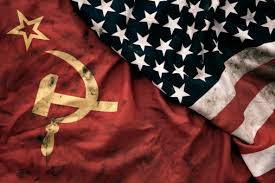
Between 1947-1991 saw what was known as the Cold War, this was the ideological and political rivalry between the Soviet Union and the United States shaped global politics and led to an arms race.
The Cold War was a period of geopolitical tension between the United States and the Soviet Union. It was characterized by an ideological struggle between capitalism and communism, a nuclear arms race, and proxy wars, but no direct military conflict between the two superpowers.
The Soviet Union collapsed in 1991 due to a combination of internal factors like economic stagnation, overextension of the military, and rising ethnic tensions, along with the influence of the Cold War and US policy of containment.
Mikhail Gorbachev’s reforms, including perestroika (economic restructuring) and glasnost (openness), while intended to revitalize the Soviet system, inadvertently accelerated its demise.
The Soviet economy was struggling with low productivity, inefficient planning, and a lack of innovation. They were heavily invested in a large military, especially during the Cold War, which strained its economy.
As the USSR was a vast empire with numerous ethnic groups, it was natural that many would feel oppressed and sought greater autonomy or independence.
Gorbachev’s reforms, while intended to address the economic problems, also opened the door for more political and cultural freedom. This led to increased criticism of the government, rising nationalist sentiments, and the weakening of the Communist Party’s grip on power.
In 1991, hardliners attempted to overthrow Gorbachev, but the coup failed due to a lack of support from the military.
After the failed coup, the Soviet Union’s republics began declaring their independence, and Gorbachev resigned as president. The Soviet Union was formally dissolved on December 26, 1991.
The collapse of the Soviet Union had a profound impact on the world, leading to the end of the Cold War, the emergence of new nations in Eastern Europe and Central Asia, and a shift in global power dynamics.
That will do it for this post more about Russia next Monday.
This week we are having a look at Russia’s history which can be divided into four parts the pre- Slavic era/ Kievan Rus’ period, the time of the Russian Empire and the time of the Soviet Union followed by the post-Soviet era.
The first East Slavic state, Kievan Rus’, emerged in the 9th century, adopting Orthodox Christianity from the Byzantine Empire in 988.
Over time, the Grand Duchy of Moscow unified Russian lands, leading to the proclamation of the Tsardom of Russia in 1547.
The Russian Empire expanded through conquest and exploration, becoming the world’s largest country by the early 18th century.
The Russian Revolution in 1917 led to the abolition of the monarchy and the establishment of the Soviet Union. The Soviet Union dissolved in 1991, leading to Russia becoming an independent country.
Russia started more or less with Mongol invasions, through to ages of enlightenment and industrialization to revolutions and wars, Russia is known not just for its political rises of world power and upheaval, but for its cultural contributions like ballet, Tolstoy, Tchaikovsky, caviar and vodka.
The first czar of Russia was Ivan IV aka Ivan the Terrible he ruled from 1547 to 1584, he was the grandson of Ivan the Great he expands the Muscovite territory into Siberia while instituting a reign of terror against nobility using military rule. He died of a stroke in 1584.
Now for a little about the Romanov Dynasty, which rule for around three hundred years. In 1613 after several years of unrest, famine, civil war and invasions, Mikhail Romanov is coronated as czar at age 16, ending a long period of instability.
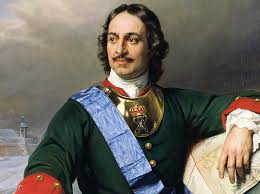
Between 1689-1725 Russia was ruled by Peter the Great it was under his rein that saw the building a new capital in St. Petersburg, modernizing the military (and founding the Russian navy) and reorganizing the government. With his introduction of Western European culture, Russia becomes a world power.
In 1762 Russia’s longest-ruling female leader, Catherine II, aka Catherine the Great, takes power in a bloodless coup and her reign marks Russia’s era of enlightenment. A champion of the arts, her 30-plus-year rule also extends Russia’s borders.
When Czar Alexander III came to power in 1861 he issues his Emancipation Reform, abolishing serfdom and allowing peasants to purchase land. His other notable reforms include universal military service, strengthening Russia’s borders and promoting self-government. In 1867, he sells Alaska and the Aleutian Islands to the United States, gilding the St. Isaac Cathedral domes in St. Petersburg with the proceeds. He was assassinated in 1881.
This week we are looking at Russia’s national anthem.
The “State Anthem of the Russian Federation” is the national anthem of Russia. It uses the same melody as the “State Anthem of the Union of Soviet Socialist Republics”, composed by Alexander Alexandrov, and new lyrics by Sergey Mikhalkov, who had collaborated with Gabriel El-Registan on the original anthem.
In 1944, that earliest version replaced ” The Internationale” as a new, more Soviet-centric and Russia-centric Soviet anthem. The same melody, but without any lyrics, was used after 1956. A second version of the lyrics was written by Mikhalkov in 1970 and adopted in 1977, placing less emphasis on WWII and more on the victory of communism, and without mentioning Joseph Stalin by name.
Glinka’s anthem was replaced soon after Yeltsin’s successor, Vladimir Putin, first took office on 7 May 2000. The federal legislature established and approved the music of the national anthem of the Soviet Union, with newly written lyrics, in December 2000, and it became the second anthem used by Russia after the dissolution of the Soviet Union.
The government sponsored a contest to find lyrics, eventually settling upon a new composition by Mikhalkov; according to the government, the lyrics were selected to evoke and eulogize the history and traditions of Russia. Yeltsin criticized Putin for supporting the reintroduction of the Soviet-era national anthem even though opinion polls showed that many Russians favoured this decision.
Public perception of the anthem is positive among Russians. A 2009 poll showed that 56% of respondents felt proud when hearing the national anthem, and that 25% liked it.
Below are then lyrics in English.
Russia is our sacred state, Russia is our beloved country. A mighty will, great glory – Your dignity for all time!
Be glorified, our free Fatherland, The age-old union of fraternal peoples, Ancestor-given wisdom of the people! Be glorified, country! We are proud of you!
From the southern seas to the polar edge Our forests and fields are spread out. You are the only one in the world! You are the only one – the native land so kept by God!
Be glorified, our free Fatherland, The age-old union of fraternal peoples, Ancestor-given wisdom of the people! Be glorified, country! We are proud of you!
A wide scope for dreams and for life The coming years open to us. We are given strength by our fidelity to the Fatherland. So it was, so it is and it will always be so!
Be glorified, our free Fatherland, The age-old union of fraternal peoples, Ancestor-given wisdom of the people! Be glorified, country! We are proud of you!
This week we will look be looking when the USA invaded Australia during WW11. Kinda…
In my area of Australia there was the Joint Overseas Operations Training Services.
The Port Stephens area was the centre of much activity during 1943-44, 20,000 US servicemen and 2,000 Australian servicemen trained for beach landings.
A country club became headquarters for amphibious warfare training area know as JOOTS (Joint Overseas Operations Training Services).
Port Stephens an area in the Hunter Region of New South Wales, Australia, it is just north of Newcastle.
This came about due to Australia asking for help from the States to dissuade the Japanese from trying to invade and it worked.
For America, Australia was a natural springboard for a major counterattack against Japan and the Newcastle area saw plenty of evidence of the American commitment.
HMAS Assault was a naval training centre established by General Douglas MacArthur. The base was chosen because it was a safe haven from Japanese submarines and was a small, isolated fishing village. The HMAS Assault was used to train landing craft crews, beach parties, and signal teams.
Tomaree Head was a critical part of Australia’s defence of the east. It includes a curved concrete wall with a gun that protected Newcastle and the Williamtown airbase.
You can take a guided tour of the historic gun emplacements at Tomaree Head in Tomaree National Park.
In total nearly one million US troops passed through Australia during World War II. The first US troops arrived in Brisbane in December 1941.
By 1943, there were 250,000 Americans stationed in Melbourne, Sydney and Brisbane.
The US Army used Australia as a base of operations to support US forces in the Philippines.
Their main role in north Queensland was to provide services and supplies, and there was a large presence in Queensland mostly around Brisbane, Rockhampton, and Townsville.
The US Army also had a joint command with the British, Dutch, and Australian forces in the Pacific.
They had a substantial impact on the local economy and influenced fashion, consumerism, and domestic technology.
Of course, at times there were tensions with some Australians, which sometimes erupted into fighting.
There was also a large social impact on Australia, including many Australian women marrying US servicemen.
The US Army’s presence in Australia was part of a larger US deployment to combat zones overseas during World War II.
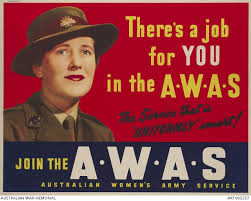
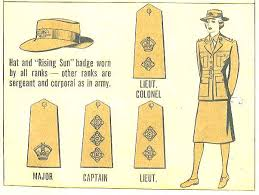
Ok this we are going to look at the brave and strong women who decided to join the military during the second world war. Three of the organisations that put these women into uniforms were The Land Army, The National Emergency Services (NES) and the Australian Women’s Army (AWAS).
The Land Army was voluntary group where women worked on farms, performing tasks like milking cows, harvesting crops, and tending livestock, to maintain food production while men were fighting overseas.
The AWAS was an official military unit within the Australian Army where women could enlist to serve in roles like driving, clerical work, communications, and even some combat support positions.
The Australian Women’s Army Service (AWAS) was formed in August 1941 to release men from some military duties to serve with fighting units. Women worked in traditional roles such as clerks, typists and cooks.
The NES was a general term for civilian volunteer organizations that provide support during emergencies like fire, flood, or medical crises, not specifically related to wartime service
There was a network of searchlights and listening posts that formed part of Newcastle’s defences were largely operated by women. These women were carefully selected for good eyesight and hearing as they would be on high alert lookout for the distant hum of aircraft engines.
They also had to maintain the searchlights in a high state of readiness, constantly polishing the lights and greasing their mechanisms. The searchlights batteries were connected by telephone to headquarters and each battery had a command post with a plotting board to track the positions and courses of aircraft.
Some of the hardships the women had to deal with things like having to bunk down in unlined shed in the bush, they were given hessians bags and a pile of straw to make their mattresses. They also had to shower under a modified kerosene tin full of water. Just because they were women didn’t mean they got an easy ride, they had route marches with full packs and training with live ammunition on .303 rifles, bren and Thompson guns.
The Australian Women’s Army Service served in New Guinea during World War II, making it the only non-medical women’s service to serve overseas during the war.
The Land Army and the AWAS were both disbanded shortly after the end of World War II, between 1945 and 1947.
This week we are going to look at shortages and rationing during WW11. Naturally Australia wasn’t the only country to have shortages and rationing.
After blackout rules became more enforced due to the submarine attacks found and increase in the demand for torches and batteries. However, it was next to impossible finding them.
At other times during the war there was shortages of a wide variety of goods, including some items most people don’t think of such as flannel underwear and woollen trousers, considered vital for men working in heavy industries.
A chronic worldwide shortage of shipping meant many goods generally imported were no longer available, substitutes could be found for some things but often people just had to do without.
Petrol was rationed and tyres were hard to find as rubber was diverted to the war effort. Many cars were converted to run on charcoal gas, these cars were hard to miss due to the big gas bags on their roofs. Petrol rationing was introduced in 1940.
Also is short supply were coins and by the end of 1942 pennies and half-pennies were almost unprocurable.
During 1942 rationing was introduced for food and clothing this meant having a ration book and coupons and in 1943 you needed a coupon for household furnishings.
Naturally this resulted in a thriving black market especially in waterfront places like Newcastle.
Here in Newcastle, there was a housing problem as the house building was placed on hold during the war. Public transport was also in short supply due to funding and rationing of petrol.
As a result of the fuel issues horse were brought back into service although fodder was also in short supply and Newcastle businesses lobbied the government to provide rail wagons to carry stock feed from country areas to keep freight moving.















 Jo-AnneRamplings