Red Wolf

This week we are looking at the red wolf this is a canine native to the southeastern United States. Its size is intermediate between the coyote and gray wolf.

They have wide heads with broad muzzles, tall, pointed ears and long, slender legs with large feet. Red wolves stand about 26 inches at their shoulder and are about 4 feet long from the tip of the nose to the tip of the tail. Adult red wolves range in weight from about 45 to 80 pounds.

American red wolves are critically endangered and the most endangered wolf in the world due to poaching, trapping and habitat loss. According to the USFWS, there are less than 20 American red wolves living in the wild in North Carolina. 

They are shy and elusive, however, they top predators. Potential danger lies in their becoming habituated to humans, particularly if people provide them with food.

Their home territory can stretch about 200 miles in diameter.

They live in packs which are family groups that typically have five to eight members, including a breeding pair and their offspring. 
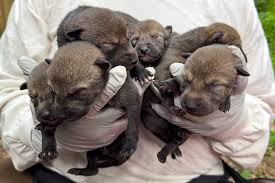
The young stay with the pack until they reach adulthood, when they leave to form their own packs. They are highly social animals that mate for life. They are also great parents and will sometimes care for other wolves’ pups.

The packs travel up to 20 miles per day to hunt for small mammals like rabbits and raccoons, and sometimes deer. Although pack animals the do not hunt in packs.
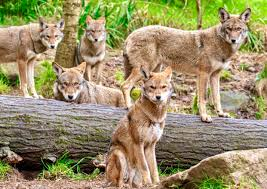
Wolves howl for many reasons, including to assemble the pack, find a mate, protect their pups, and identify each other. 

As they are considered a top predator, also called an apex predator, and has no known predators except humans. Some competition between coyotes and gray wolves can lead to killing of the red wolf but it is not due to predation.

Grey Wolf

This week we are looking at the wolf, also known as the gray wolf or grey wolf, is a canine native to Eurasia and North America. This is the most common wolf in the world.

A Grey wolve is about twice the size of a coyote. They measure up to 6 feet(183cm) in length, including tail, and about 30 inches (80-85cm) in height at the shoulder. Female wolves weigh around 70 – 80 pounds (31-36kg), while males weigh around 95 – 100 pounds, (43-45kg)

The life spans of wild wolves vary dramatically. Although the average lifespan is between 6 and 8 years, many will die sooner, and some can reach 13. Wolves in captivity can live up to 17 years.

Wolves rarely act aggressively toward people, but there have been instances in Alaska and Canada where wolves have attacked people. The first case of wild healthy wolves killing a human in modern North America occurred in Saskatchewan in 2005; a second person was killed in 2010 in Alaska.

Wolves are carnivores—they prefer to eat large-hoofed mammals such as deer, elk, bison, and moose. They also hunt smaller mammals such as beavers, rodents, and hares. Adults can eat 20 pounds of meat in a single meal.

Pups are born in early spring and are cared for by the entire pack. They depend on their mother’s milk for the first month, and then they are gradually weaned and fed regurgitated meat by other pack members. By 7 to 8 months of age, when almost fully grown, the pups begin traveling with the adults.

In a grey wolf pack, it is usually only the male and female alpha who are allowed to breed, the pair mate for life as a way to cement their position as pack leaders, producing a new litter each year and ensuring the stability of the rest of the pack.

Wolves’ vocalizations can be separated into four categories: barking, whimpering, growling, and howling. Sounds created by the wolf may actually be a combination of sounds such as a bark-howl or growl-bark. Barking is used as a warning.

Next week we will look at the Red Wolf.

African Wild Dog

This week we are kicking of the series about wild dogs from around the world and we will start with the African wild dog, also known as the painted dog or Cape hunting dog.

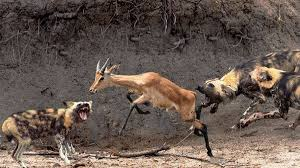
The African wild dog has a colourful, patchy coat. They have large bat-like ears and a bushy tail with a white tip, which may serve as a flag to keep the pack in contact while hunting. Their markings are as unique as a human fingerprint, making it easy to identify individuals.

This dog is native to sub-Saharan Africa

These wild dog packs have an 80% success rate when hunting, thanks to high levels of communication.

They generally live up to the age of 11 when living in the wild.

It can also run up to 70km or 44mph this is the same as a greyhound, over a long time. Of all large carnivores they are regarded as the most efficient hunters as their targeted prey rarely escapes. They hunt for a wide variety of prey, including gazelles and other antelopes, warthogs, wildebeest calves, rats, and birds.

They like to live in packs averaging from seven to 15 members and sometimes up to 40. Before the recent population decline, packs of up to 100 were recorded.  Within the pack, there is a unique social structure.

They cooperate in taking care of the wounded and sick members, there is a general lack of aggression exhibited between members of the pack, and there is little intimidation among the social hierarchy.

Every hunting pack has a dominant pair. They are usually the only pair that remains monogamous for life. Wild dogs also have a large range of vocalizations that include a short bark of alarm, a rallying howl, and a bell-like contact call that can be heard over long distances. Elaborate greeting rituals are accompanied by twittering and whining.

They are pack animals that are quick to defend themselves against any threatening animal. While they don’t prey on humans and typically approach them out of curiosity rather than aggression, it’s best not to go near them.