Cowra Breakout

Hi, everyone, this today’s post was inspired by the holiday taken back in December after visiting the site of the Cowra POW Camp.

Cowra may be the best-known camp due to the 1944 Cowra Breakout, which was the largest prison breakout in Australian history and of the largest of World War 11.

Over 1,000 Japanese prisoners attempted a mass escape leading to the deaths of over 200 people. The escape took place on the 5 August 1944.

In total about 235 Japanese prisoners died along with 4 Australian soldiers, it is one of the deadliest prison escape attempts in modern military history.

The soldiers who died were Privates Hardy, Jones, Shepherd, and Lieutenant Doncaster.

There was no single person in charge of the breakout but was driven by a group of non-commissioned who planned and initiated the escape.

This was because the prisoners were bound by the Bushido code, which viewed surrender as shameful. This created a shared determination among many prisoners to die honourably rather than be transferred to another camp. As a result, the breakout emerged from group consensus rather than top‑down command.

The escape was triggered by an unauthorised bugle call, sounded by a Japanese prisoner whose identity is not definitively recorded in official sources.

The event is widely studied in military history and commemorated in Japan and Australia. The Japanese Garden and War Cemetery were established as symbols of peace and reconciliation, further cementing Cowra’s global recognition.

Cowra wasn’t the only POW camp in Australia; in fact, there was over 50 POW and internment camps across all states and territories. This includes major, purpose‑built POW camps as well as smaller labour detachments, hostels, and temporary internment facilities.

Other major camps could be found at Hay, Loveday, Tatura, and Marrinup.

There was one Over 12,000 people were interned or held as POWs in Australia at the peak of the war. When I read this, I wondered why so many well it seems that Australia became a major Allied holding country because of its location being so far from the front lines and we had available land for secure camps.

US Troops Down Under During WW11

This week we will look be looking when the USA invaded Australia during WW11. Kinda…

In my area of Australia there was the Joint Overseas Operations Training Services.

The Port Stephens area was the centre of much activity during 1943-44, 20,000 US servicemen and 2,000 Australian servicemen trained for beach landings. 

A country club became headquarters for amphibious warfare training area know as JOOTS (Joint Overseas Operations Training Services).

Port Stephens an area in the Hunter Region of New South Wales, Australia, it is just north of Newcastle.

This came about due to Australia asking for help from the States to dissuade the Japanese from trying to invade and it worked.

For America, Australia was a natural springboard for a major counterattack against Japan and the Newcastle area saw plenty of evidence of the American commitment.

HMAS Assault was a naval training centre established by General Douglas MacArthur. The base was chosen because it was a safe haven from Japanese submarines and was a small, isolated fishing village. The HMAS Assault was used to train landing craft crews, beach parties, and signal teams.

Tomaree Head was a critical part of Australia’s defence of the east. It includes a curved concrete wall with a gun that protected Newcastle and the Williamtown airbase. 

You can take a guided tour of the historic gun emplacements at Tomaree Head in Tomaree National Park.

In total nearly one million US troops passed through Australia during World War II. The first US troops arrived in Brisbane in December 1941. 

By 1943, there were 250,000 Americans stationed in Melbourne, Sydney and Brisbane.

The US Army used Australia as a base of operations to support US forces in the Philippines. 

Their main role in north Queensland was to provide services and supplies, and there was a large presence in Queensland mostly around Brisbane, Rockhampton, and Townsville. 

The US Army also had a joint command with the British, Dutch, and Australian forces in the Pacific. 

They had a substantial impact on the local economy and influenced fashion, consumerism, and domestic technology. 

Of course, at times there were tensions with some Australians, which sometimes erupted into fighting. 

There was also a large social impact on Australia, including many Australian women marrying US servicemen. 

The US Army’s presence in Australia was part of a larger US deployment to combat zones overseas during World War II. 

Women in uniform in WW11 Australia

Ok this we are going to look at the brave and strong women who decided to join the military during the second world war.  Three of the organisations that put these women into uniforms were The Land Army, The National Emergency Services (NES) and the Australian Women’s Army (AWAS).

The Land Army was voluntary group where women worked on farms, performing tasks like milking cows, harvesting crops, and tending livestock, to maintain food production while men were fighting overseas.

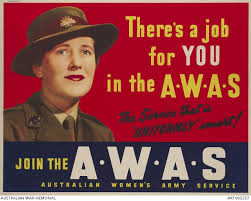
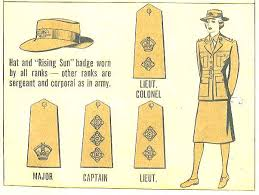
The AWAS was an official military unit within the Australian Army where women could enlist to serve in roles like driving, clerical work, communications, and even some combat support positions.  

The Australian Women’s Army Service (AWAS) was formed in August 1941 to release men from some military duties to serve with fighting units. Women worked in traditional roles such as clerks, typists and cooks.

The NES was a general term for civilian volunteer organizations that provide support during emergencies like fire, flood, or medical crises, not specifically related to wartime service

There was a network of searchlights and listening posts that formed part of Newcastle’s defences were largely operated by women. These women were carefully selected for good eyesight and hearing as they would be on high alert lookout for the distant hum of aircraft engines.

They also had to maintain the searchlights in a high state of readiness, constantly polishing the lights and greasing their mechanisms. The searchlights batteries were connected by telephone to headquarters and each battery had a command post with a plotting board to track the positions and courses of aircraft.

Some of the hardships the women had to deal with things like having to bunk down in unlined shed in the bush, they were given hessians bags and a pile of straw to make their mattresses. They also had to shower under a modified kerosene tin full of water. Just because they were women didn’t mean they got an easy ride, they had route marches with full packs and training with live ammunition on .303 rifles, bren and Thompson guns.

The Australian Women’s Army Service served in New Guinea during World War II, making it the only non-medical women’s service to serve overseas during the war. 

The Land Army and the AWAS were both disbanded shortly after the end of World War II, between 1945 and 1947.