

Hi, everyone let’s look at the celebrations of work because that is where I am up to in this book I am using for these posts.
It seems the union movement promoted the making and painting of banners to represent its organisations at grand processions proclaiming the dignity of labour. This practice dates back to the medieval time when craft guilds marched behind banners in church processions. These early British Trade Union banners were modest pieces of work made by a member of the branch.
However, by the 1830’s they were made by one company, George Tutill Limited and it was Tutill who was a former travelling showman who seems to have set the pattern of artwork that later appeared in Australian banners.
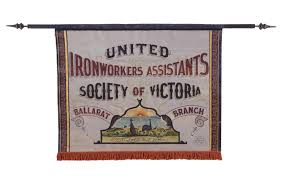
After making banners in Buckinghamshire for some time he set up business in East London in the late 1850’s. His banners were made from silk often with a woven patterned border, about 3 metres by 3 metres in size so not a small thing.
The banner would have a central square painted in oils depicting symbols of the craft union and scenes of the workplace. Outside the border a sign writer would paint the name of the union, its branch, and various slogans.

Tutill patented a method for treating materials for the manufacture of banners and flags. This involved a thin coating in India rubber to give flexibility and waterproofing to the banner.
Like the British which saw banners brought out for many occasions throughout a year, Australian banners would be brought out on days other than Eight Hour Day what we call Labour Day.
During the 1890’s these banners would be brought out during protest demonstrations, these bright banners were seen as a respectable face of unionism.


 Jo-AnneRamplings
Dearest Jo-Anne,
Guess they worked longer than eight–hour days back then!
Such banners were attention grabbers and conveyed a strong message.
Hugs,
Mariette
They are indeed attention grabbers and conveyed what they set out to do
🤗