
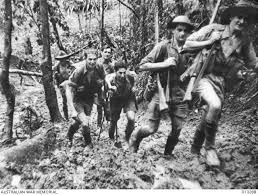
Time for some more about the Kokoda Trail in 1942 and the battle with the Japanese over it.
In July 1942 the Papuan Infantry Battalion was joined by recent conscripts who arrived with little military training, there average age was only eighteen and half.
It was these men that were expected to mount the defensive and at first, they were referred to as “chocos” or chocolate soldiers, a term taken from George Bernard Shaw’s play Arms and the Man about a man who would not fight. It was first used in WW1 about soldiers who arrived in Egypt after Gallipoli.
However, after their baptism of fire at Kokoda and Milne Bay these so called “Chocos” soon proved how bravely they could fight and how well.

The Japanese had first landed in New Guinea in March at Lae and Salamaua, then in July at Buna and Gona, less than 200 kilometres from Port Moresby as the crow flies. What stood in their way was the steep range pf the Owen Stanley Mountains, with the only way over the range being by foot.
As to why they didn’t invade by sea well the battles of the Coral Sea and Midway put an end to that idea. So, over the mountain they would go via the Kokoda track.
This as they soon found out was easier said than done.
Major-General Morris was ordered to secure the village of Kokoda, so he gathered the best of his untrained Australian and Papuan forces for the task. They left Port Moresby on 7 July and arrived on the15 July.
Even before they found themselves fighting the enemy they had to fight their way through horrific conditions of the jungle. As well as steepness of the track, they had to deal with a rainforest dripping with moss and leaches as well as mosquito infested swamps. Large numbers of men contracted malaria.
Despite being in the tropics, they were continually wet and cold in the rain and high altitudes. They of course were carrying their equipment weighing 27 kilos and their heavy boots and khaki summer uniforms were not suitable for the conditions.
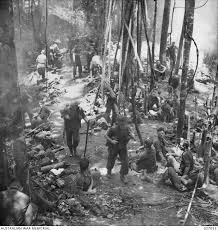
In fact, the khaki made them stand out against the green of the jungle. At some point camouflage and jungle green uniforms were issued.
That’s enough for this week.

 Jo-AnneRamplings
Dearest Jo-Anne,
Hate the names they gave those Austronesians—Chocos.
The Dutch also had part of Papua New Guinea and even part of the neighboring islands had Austronesian people. In fact, my favorite first cousin who served in the marine, did marry an exotic looking Austronesian woman. It did not last as the family and surrounding was not ready for it in the early 1970s. SAD!
My own sister when I took her and her significant other into the mountains of North Carolina, was mocking them as ‘blue’. Why a swear name or ridiculous nickname?! She was talking in the restaurant where we had a coffee with lunch and it hurt my feelings as Liz (Pieter’s adopted daughter) is partly First Nation and Scottish and Dutch. Anita our foster daughter is Indonesian and that is a mixture of all the countries that ever colonized them.
Even we may have traces of all sorts of tribes, due to wars or whatever!
No doubt were those chocos excellent fighters as they knew the territory and the climate with all its nasty side affects!
Hugs,
Mariette
It is sad your cousin’s marriage didn’t last due to a non supporting family but sadly that is the way it was back then and still is in some families.
The name “chocos” wasn’t just directed at the natives but mostly the Australians.
Hate any kind of mass generalizing!
“easier said than done” – not wrong there.
Such a complex time in history – well written and insightful as always – thank you!
Linda xx
Thanks for dropping by and I am pleased you liked the post
Always a pleasure xx