
Hi all, how is everyone doing, I hope all is good with and those you care about, this week we are still in Africia and the country is Ethiopia a county that many will have heard of in different commercials for UNICEF.
Ethiopia, in the Horn of Africa, is a rugged, landlocked country split by the Great Rift Valley. With archaeological finds dating back more than 3 million years, it’s a place of ancient culture. Among its important sites are Lalibela with its rock-cut Christian churches from the 12th–13th centuries. Aksum is the ruins of an ancient city with obelisks, tombs, castles and Our Lady Mary of Zion church.
In 1931, Emperor Haile Selassie formally requested that the international community use the name Ethiopia instead of the exonym Abyssinia, and the issuing Bank of Abyssinia also became the Bank of Ethiopia.

The capital is Addis Ababa, which is in the highlands bordering the Great Rift Valley, is the country’s commercial and cultural hub.
Located in the capital is a National Museum which exhibits Ethiopian art, traditional crafts and prehistoric fossils, including replicas of the famous early hominid, “Lucy.”

It has a population of around 126 million, this may be due to a very high fertility of 4.4 children per woman. The combination of a high birth rate and relatively low life expectancy means that Ethiopia is a young country. 41.5 percent of the population is below 15 years and only 3.3 percent is above 65.

The currency is the birr it is subdivided into 100 santims.

The national animal is the lion, and its national flower is the calla lily. The national bird is the Stresemann’s bush crow, also known as the Abyssinian pie, bush crow.

The Flag of Ethiopia consists of a green, yellow, and red tricolour with the national emblem, a golden pentagram on a blue disc, superimposed at the centre.
The star represents the unity of all Ethiopian nationalities, its rays the bright prospects for their future. Blue is for peace, yellow for hope, justice, and equality. Red represents sacrifice for freedom and equality, while green is equated with labour, development, and fertility.

Religion in Ethiopia consists of a number of faiths. Among these mainly Abrahamic religions, the most numerous is Christianity totalling at 67.3%, followed by Islam at 31.3%. There is also a longstanding but small Ethiopian Jewish community.
Christianity in Ethiopia dates back to the ancient Kingdom of Aksum, when the King Ezana first adopted the faith in the 4th century AD. This makes Ethiopia one of the first regions in the world to officially adopt Christianity. Various Christian denominations are now followed in the country.
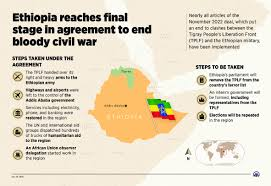
This is not a country you want to go visiting in face a search online will tell you to avoid non-essential travel to Ethiopia due to civil unrest, violence, armed conflict and crime. The security situation can deteriorate without warning. This advisory excludes Addis Ababa where you should exercise a high degree of caution.
The government of Ethiopia is the federal government of Ethiopia. It is structured in a framework of a federal parliamentary republic, whereby the prime minister is the head of government and the commander-in-chief of the Ethiopian Armed Forces. The prime minister is the most powerful political figure in Ethiopian politics. The official residence of the prime minister is the Menelik Palace in Addis Ababa.

 Jo-AnneRamplings
Good job
Dearest Jo-Anne,
Will rewrite this comment again without the link but so you know and can read: did email it instead!
Interesting country but not a ‘safe’ travel destination—as often for that region.
We all celebrate the Three Magi (or Three Kings—Epiphany) and Balthasar an elderly was from Ethiopia!
Guess it is an overall exotic country but no desire to ever visit there.
Hugs,
Mariette
I will check my email, there are many countries that are to dangerous to visit
Indeed!
Interesting article. BTW Happy Belated Birthday!
Pleased you liked it
Wonderful ♥️
I am pleased you liked it