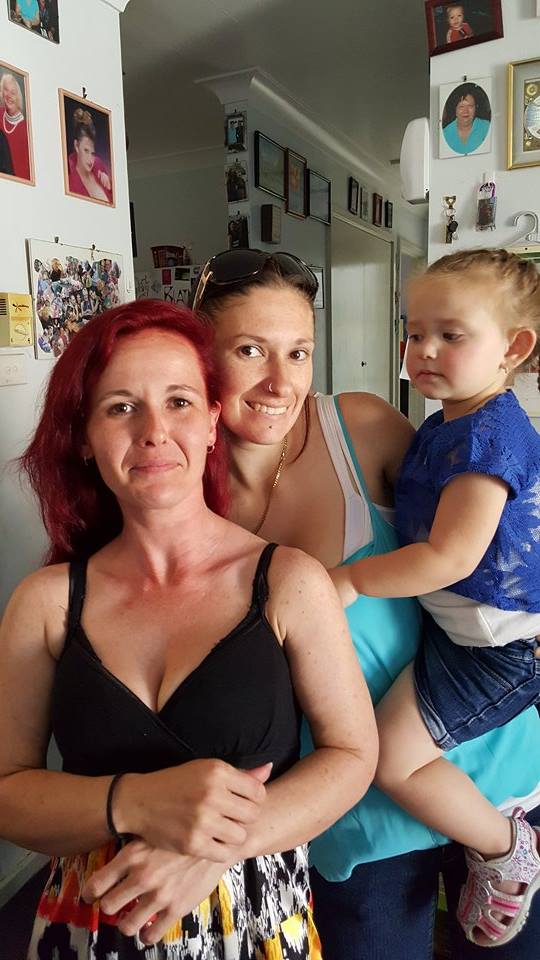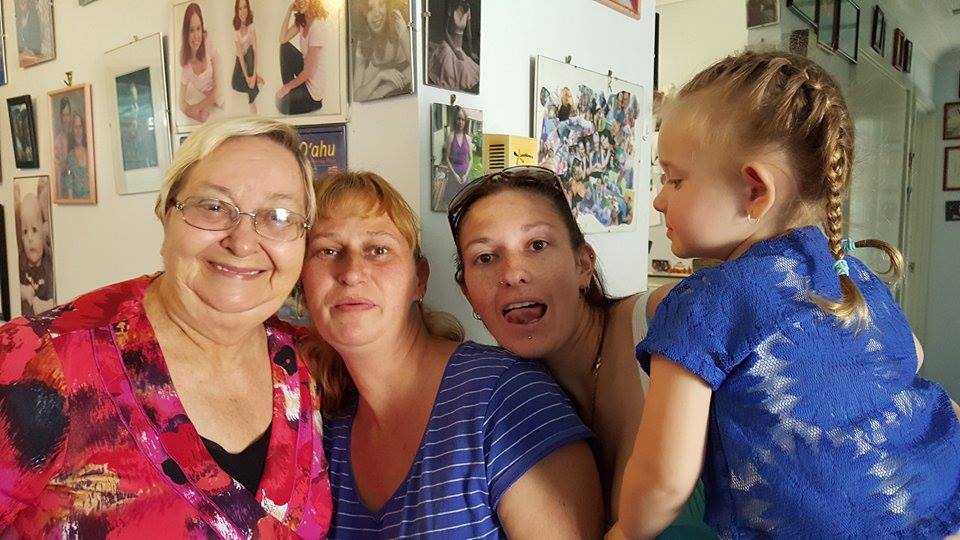

Good Afternoon, my special girl is out of hospital

Great tuesday

Good afternoon world, how is everyone on this fine Tuesday afternoon?

I had a somewhat busy morning, taking boys to school, driving Tasha to her job network provider so she could finish off her white card and then I had to go over to the hospital to pick up Jessica. Yes she is home at last but of course she will not be going back to her place for a little while as she is still in pain and finding it difficult to get around, she has been given the all clear to go back to work in a week or two depending on how she is feeling.

I have decided that since I will have to pick either Blain or Leo up early I will arrange with the school that one week Blain will got to the office when he gets out and wait for me and the next week Leo will do it this will start after Jessica goes back to work and that way I will only have to the one boy out only 10 minutes early.

Natasha’s car is now not running at all so Jono has asked a mate to look at it and tell her how much it will cost to get it repaired and if it is too much she is going to sell it as is to whoever wants it and save to get another car.

Blain with parents

So tonight I will have both Blain and Leo here again and Jessica as well so hopefully they will not fight, they do have a tendency to fight when together for any length of time.

Oh yeah I woke this morning at around 3.30am to go to the loo and when I got back to bed and checked the time I woke Tim and said don’t you have to get up, he looks at his clock and says no not yet, well I thought he said he had to get up at 3.30am but I was too tired to argue with him, well I get a text from him saying he overslept 45 minutes and I replied thought so.

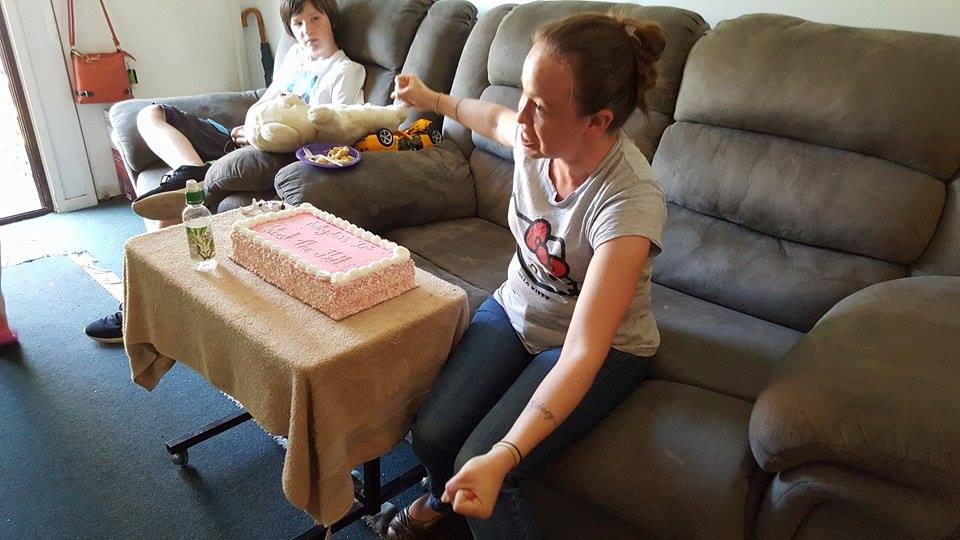
Jessica just went off at me because Leo still likes to sleep with nan & papa I do try to get him to sleep in the spare room and some nights he will go to sleep in there but still ends up with me and Tim at some point during the night.

Leo and JesI hope Jessica gets her car back soon it has been in the shop being repaired for over 2 weeks now closer to 3 weeks in fact.

Chocolate Soldiers

The ‘Chocolate Soldiers’ of New Guinea

By A. E. Lockrey

The heat and the haze of the jungle
Enshroud them on every side,
The dank and the damp so insistent
They contend with in youthful pride:
Dark terrors are there in the lurking,
In shady concealment they hide,
But the defiant Chocolate Soldiers
Have suffered and bled and died.

Through the trackless mountain passes,
Through the deadly swampland drear,
In the slush of endless mudlands
They plod; and the enemy near
Is crafty, and cunning and silent,
But the Chocos have no fear
As, shedding their blood in the jungle
They fight for their country so dear.

And who will dare with sneering
To say they cannot face,
All this, and more if needs be
For the honour of their race?
And how can mind forget it,
And how can time efface,
Such valour must be given
In history’s page a place.

100 Years on and still going strong

100 yrs on

Anzac Day goes beyond the anniversary of the landing on Gallipoli in 1915. It is the day on which we remember Australians who served and died in all wars, conflicts, and peacekeeping operations. The spirit of Anzac, with its human qualities of courage, mateship, and sacrifice, continues to have meaning and relevance for our sense of national identity.

In Canberra, the Memorial, in close cooperation with the Returned and Services League of Australia ACT, hosts the:

800px-Anzac_Cove

The Aboriginal and Torres Strait Islander Commemorative Ceremony will be held after the Anzac Day Dawn Service at the Aboriginal Memorial plaque on the side of Mount Ainslie.

What is Anzac Day?

Anzac Day – 25 April – is one of Australia’s most important national occasions. It marks the anniversary of the first major military action fought by Australian and New Zealand forces during the First World War.

What does ANZAC stand for?

Anaca stands for Australian and New Zealand Army Corps. The soldiers in those forces quickly became known as Anzacs, and the pride they took in that name endures to this day.

Why is this day special to Australians?

When war broke out in 1914 Australia had been a federated nation for only 13 years, and the new federal government was eager to establish its reputation among the nations of the world. When Britain declared war in August 1914 Australia was automatically placed on the side of the Commonwealth. In 1915 Australian and New Zealand soldiers formed part of the expedition that set out to capture the Gallipoli peninsula in order to open the Dardanelles to the allied navies. The ultimate objective was to capture Constantinople (now Istanbul), the capital of the Ottoman Empire, an ally of Germany.

The Australian and New Zealand forces landed on Gallipoli on 25 April, meeting fierce resistance from the Ottoman Turkish defenders. What had been planned as a bold stroke to knock Turkey out of the war quickly became a stalemate, and the campaign dragged on for eight months. At the end of 1915 the allied forces were evacuated from the peninsula, with both sides having suffered heavy casualties and endured great hardships. More than 8,000 Australian soldiers had been killed. The Gallipoli campaign had a profound impact on Australians at home, and 25 April soon became the day on which Australians remembered the sacrifice of those who died in the war.

Although the Gallipoli campaign failed in its military objectives, the Australian and New Zealand actions during the campaign left us all a powerful legacy. The creation of what became known as the “Anzac legend” became an important part of the identity of both nations, shaping the ways they viewed both their past and their future.

they who shal not grow old

Early commemorations

In 1916, Anzac Day was held on 25 April for the first time. It was marked by a wide variety of ceremonies and services in Australia, a march through London, and a sports day in the Australian camp in Egypt. In London more than 2,000 Australian and New Zealand troops marched through the streets; a London newspaper headline dubbed them “the knights of Gallipoli”. Marches were held all over Australia; in the Sydney march convoys of cars carried soldiers wounded on Gallipoli and their nurses. For the remaining years of the war Anzac Day was used as an occasion for patriotic rallies and recruiting campaigns, and parades of serving members of the AIF were held in most cities.

During the 1920s Anzac Day became established as a national day of commemoration for the more than 60,000 Australians who had died during the war. In 1927, for the first time, every state observed some form of public holiday on Anzac Day. By the mid-1930s all the rituals we now associate with the day – dawn vigils, marches, memorial services, reunions, two-up games – were firmly established as part of Anzac Day culture.

With the coming of the Second World War, Anzac Day also served to commemorate the lives of Australians who died in that war. In subsequent years the meaning of the day has been further broadened to include those who were killed in all the military operations in which Australia has been involved.

Anzac Day was first commemorated at the Memorial in 1942. At the time, government orders prohibited large public gatherings in case of a Japanese air attack, so it was a small occasion with neither a march nor a memorial service. Since then, Anzac Day has been commemorated at the Memorial every year.

What does it mean today?

Australians recognise 25 April as an occasion of national remembrance, which takes two forms. Commemorative services are held at dawn – the time of the original landing – across the nation. Later in the day, former servicemen and servicewomen meet to take part in marches through the major cities and in many smaller centres. Commemorative ceremonies are more formal and are held at war memorials around the country. In these ways, Anzac Day is a time at which Australians reflect on the many different meanings of war.

The Dawn Service

It is often suggested that the Dawn Service observed on Anzac Day has its origins in a military routine still followed by the Australian Army. The half-light of dawn was one of the times most favoured for launching an attack. Soldiers in defensive positions were woken in the dark before dawn, so by the time first light crept across the battlefield they were awake, alert, and manning their weapons; this is still known as the “stand-to”. As dusk is equally favourable for battle, the stand-to was repeated at sunset.

After the First World War, returned soldiers sought the comradeship they had felt in those quiet, peaceful moments before dawn. A dawn vigil became the basis for commemoration in several places after the war. It is difficult to say when the first dawn services were held, as many were instigated by veterans, clergymen, and civilians from all over the country. A dawn requiem mass was held at Albany as early as 1918, and a wreath laying and commemoration took place at dawn in Toowoomba the following year. In 1927 a group of returned men, returning from an Anzac Day function held the night before, came upon an elderly woman laying flowers at the as yet unfinished Sydney Cenotaph at dawn. Joining her in this private remembrance, the men later resolved to institute a dawn service the following year. Thus, 150 people gathered at the Cenotaph in 1928 for a wreath laying and two minutes’ silence. This is generally regarded as the beginning of organised dawn services. Over the years the ceremonies have developed into their modern form and have also seen an increased association with the dawn landings of 25 April 1915.

Today’s dawn services include the presence of a chaplain, but generally not of dignitaries such as the governor-general. Originally, the services were simple, and usually followed the military routine. Before dawn, those who had gathered would stand while two minutes’ silence was held. At the end of this time a lone bugler would play the Last Post and then conclude the service with Reveille, the bugler’s call to wake up.

In recent times more families and young people have taken part in dawn services. Reflecting this change, some services have become more elaborate, incorporating hymns, readings, pipers, and rifle volleys. Other services, though, have retained the simple format of the dawn stand-to, familiar to so many soldiers.

trenches

The Anzac Day National Ceremony

At the Australian War Memorial the National Ceremony takes place at 10.15 am in the presence of people such as the prime minister and the governor-general. Each year the ceremony follows a pattern that is familiar to generations of Australians.

A typical Anzac Day National Ceremony may include the following features: an introduction, hymn, prayer, an address, the laying of wreaths, a recitation, the Last Post, a period of silence, the playing of either the Rouse or the Reveille, and the national anthem. After the Memorial’s ceremony families often place red poppies on the Tomb of the Unknown Australian Soldier or beside the names of relatives on the Memorial’s Roll of Honour, as they do after Remembrance Day services.

Anzac Day 2

Lest we forget…………………………..

Updates

Jessica's house after storm (5)

Ok I have some news to share, my daughter Jessica was operated on yesterday afternoon, she is recovering ok still has drainage tube in her stomach but is off the pain-relieving drip but still not feeling that great, she doesn’t know when she will be home as yet. However, that is probably a good thing as this is what her front lawn looks like and her street is without electricity and the street is still cornered off due to fallen trees. Leo of course is here and he is fine not distressed in any way about his mum not being here and being in hospital.

Jessica's house after storm (14)

In other news some may have heard about the elderly lady who was killed in Maitland due to her car being swept away in flood waters. Well it turns out the woman is my sister in-laws grandmother, so her family are shocked and sadden by this, they were worried yesterday about her when they saw the car on the news and realised it looked like her car, so they tried to ring her and were unable to contact her.

https://www.facebook.com/hashtag/nbnnews?source=feed_text&story_id=362917457243869

Jessica's house after storm (4)

This is a photo from Facebook of Sydney harbour bridge, thought it was a wow photo so sharing it as well.

Sydney harbour bridge

Natasha is working five nights a week at her new cleaning job and either me or Jono have Blain while she is at work,he is suppose to be picked up by his dad this afternoon sometime I don’t know when though I was told between 4-5pm but it is now 5.10pm and he still isn’t here.

Jessica's house after storm (8)

Blain will be off school till Monday while they continue to clean up the school after the storm, Leo went back to school today but there are a number of school still closed till Monday.

Jessica's house after storm (11)

Wet, Windy, Cold and in hospital

storm

Here I am on a very wet, windy and cold Tuesday afternoon at last writing a post for the day, and what a day has it been, some of you might here on the news about the terrible storm that has it the Hunter Valley today and yes I live in the Hunter Valley, Newcastle is part of the Hunter Valley it is the lower part of the Hunter Valley.

Now let’s go back to last night, that is when the bad weather started and my daughter Jessica was yet again in a great deal of pain and I had no car so was unable to go to her, it got that bad that she managed to drive herself here, yes she had rung the ambo’s but the paramedic told her it was stress and muscle pain and did nothing. Well after about an hour my niece Kelli turned up to drop Blain off for the night while Tasha was at work, and because Jessica was in so much pain screaming and crying she decided to take her to the John Hunter Hospital (our main hospital).

This morning I woke up to a note from Kelli that said Jessica had been admitted to the hospital and would tell me more later. Seems Jessica has pancreatitis and will need her gallbladder removed, that hopefully will happen tomorrow. More about that later.

Power lines

Back to the weather it has been very bad here, Tasha went to Jessica’s place to meet some guy who was suppose to be picking up the work van, (he never turned up) and while there the tree next to the van was uprooted and the power lines came down. The tree missed Natasha by centimetres and gave her a terrible fright, all she could thing was that if it had hit her it would have killed her, she managed to get her car out of the driveway and came back here very shaken up and crying.

When Kelli went back to pick up some clothes for Jessica the road was closed and the SES would not let her pass.

Jes tree

Tim rode the motorbike to work this morning silly man, and wanted me to go and get him at 7.30 tonight but at 4pm he walked in the door, another driver drove him home as all the buses had been pulled off the road. I will have to drive him to work in the morning and he is hoping that by the time he knocks off it will be ok and he will be able to ride the bike home safely.

road closed

Albert Jacka, have you heard of him? No, didn’t think so

AlbertJacka

Today I am going to tell you a bit about a fella names Albert Jacka, let me guess you have no idea who he is well I also had no idea who he was till he was mentioned on a tv program I was watching recently.

Albert Jacka, VC, MC & Bar, was born on the 10th January 1893 and was the first Australian to be awarded the Victoria Cross during the first world war, the highest the highest decoration for gallantry “in the face of the enemy” that can be awarded to members of the British and Commonwealtharmed forces.

He received the medal for his actions during the Gallipoli Campaign. He later served on the Western Front and was twice further decorated for his bravery.

He was to receive his VC for his actions at Courtney’s Post, on the 19th May 1915 the Turks launched an assault against the Anzac line, capturing a section of the trench on end of which was guarded by Jacka for several minutes he fired warning shots into the trench wall until reinforcements arrived. He then attempted to enter the trench with three others; all but Jacka were either wounded or pinned.

It was then decided that while a feint attack was made from the same end, Jacka would attack from the rear. The party then proceeded to engage the Turks with rifle fire, throwing in two bombs as Jacka skirted around to attack from the flank. He climbed out onto “no man’s land“, entering the trench via theparapet. In the resulting conflict, Jacka shot five Turkish soldiers and bayoneted two others, forcing the remainder to flee the trench; he then held the trench alone for the remainder of the night. Jacka’s platoon commander, Lieutenant Crabbe, informed him the following morning that he would be recommended for his bravery.

Upon the conclusion of the war, Jacka returned to Australia and entered business; establishing the electrical goods importing and exporting business Roxburgh, Jacka & Co. Pty Ltd. He was later elected to the local council, where he became the mayor of the City of St Kilda. Jacka never fully recovered from the multiple wounds he sustained during his war service, and died at the age of 39.

Albert_Jacka_portrait_

Hey hey it’s Saturday, with Five things Friday and my grandchildren

250px-New_Hey_Hey_It's_Saturday_Logo

Hey hey it’s Saturday yes it is now Saturday morning around 11.15 in my part of the world and have to say yesterday was one hectic day. I did the usual Friday stuff but for some reason I forgot to get tomatoes and onions and frozen pizza for Tim this of course pissed him off, but you know what pissed me off, it was him saying that I never think of him ever. Yeah Tim that’s right I never think about you what a load of shit.

Anyway around 2pm Tasha dropped off Blain and Leo and around 3pm Michael dropped off Sydney-May and Summer, yes I had all four grandchildren last night and this morning. Although Natasha picked Blain up early around 8ish and Jessica is here now but Kathy will not be here to get the girls till around 1.30pm.

5things-300x218

Well are you wondering what my five things for Friday would have been, no, to bad going to tell you anyway.

Blain

Leo

Sydney-May

Summer

Chaotic house

Oh yeah before I go I will tell you that at 10pm last night I had to ring Kathy-Lee as Summer started to cry at 9.30pm and would not settle down she was working herself into a right state so I ended up ringing Kathy and Michael came straight out and picked her up and took her home, he brought her back this morning around 8.30ish.

All the little ones were pretty well behaved and this morning Sydney-May has been outside playing with the neighbours children and Summer has been going outside and coming back inside and out again watching telly on and off.

I will soon see if I can get Summer to have a nap.

My Family

Tablet taking

phenergan

Medication, how do you like to take it, do you prefer tablets or medicine?

If you are taking a heap of tablets such as between 10-20 tablets at a time do you like to take them one at a time or do you split them up into 3 or 4 at a time, or maybe you just split the amount in half or do you take all of them in one go.

Last week my sister Sandra was giving her daughter Temika a small 10mg phenergan tablet well poor Temika drank three glasses of water trying to get the tablet to go down and after each drink Sandy would say is it gone and Temika would poke her tongue out and the tablet was still there. After the third glass of water Sandy cracked up and said “that’s ok Jo” Temika replied “I’m not Aunty Jo” Sandy told her I know sweetheart but when Aunty Jo was little like you she was unable to swallow a little blue tablet either and just like has happened to you the tablet would dissolve on her tongue.

This is true I was unable to swallow tablets for many years I was in my late teens when I was able to swallow tablets without much drama, nowadays, however, I can throw back 15-20 tablets and swallow them in one go.

Pills

I have said jokingly that if I was to want to overdose on tablets I would be able to do it pretty easy as I have no trouble swallowing a heap of tablets and lets be honest here if I had a bottle of sleeping tablets and wanted to overdose on them I would just take the whole lot in one go. Don’t worry I have no interest in doing that, I also don’t take sleeping pills in fact my doctor wouldn’t give them to me even if I asked.

Leo takes his medication by us dissolving the tablet in a small amount of water, he is good at taking his medication thankfully.

Tim takes only 4 tablets a night and has to take them one by one, damn I would just take the whole lot in one go, I take a total of 20 tablets at night a mixture of prescribed medication and vitamin tablets and I take 10 at a time, I could take them all in one go but don’t like to take a few of the tablets too early as they make me very sleepy. Thankfully I only take between 8-10 tablets of a morning and I take all them in one go.

Oskar Schindler

oskar schindler

Many of us have seen or heard of the movie Schindler’s List which was based on the book Schindler’s Ark written by Thomas Keneally who for those who don’t know is an Australian author.

Anyway Oskar Schindler was a real person granted not a good looking as Liam Neeson played him in the movie but a real person none the less. There is a website about the man here:

http://www.oskarschindler.com/ However, I will tell you a little about the man here just because I can.

He was born in 1908 and grew up in Zwittau, Moravia wherever that is, I Goggled it and it is the Czech Republic. In 1936 he joined the Abwehr aka intelligence service of Nazi Germany and in 1939 he joined the Nazi Party. He was an industrialist a spy and in time a man who cared enough to save around 1,200 Jews during the Holocaust.

In 1938 he was arrested for espionage by the Czech government but was released under the terms of the Munich Agreement, although he continued to collect information for the Nazis in Poland in 1939.

Gas Chambers

It was in 1939 that he obtained an enamelware factory in Poland which employed around 1,750 workers about a thousand of those were Jews, his Abwehr connections helped him protect his Jewish workers from deportation and death in the Nazi concentration camps.

He started out wanting to make money this was his main goal but in later years he became more interested in shielding his workers without regard for the cost involved. As time went on he had to give Nazi officials larger and larger bribes and luxury gifts obtained on the black market to keep his workers safe.

His factories were located in occupied Poland and the Czech Republic by 1944 Germany was losing the war and the SS began closing down the easternmost concentration camps and evacuating the remaining prisoners westward. Schindler convinced SS-Hauptsturmfuhrer Amon Goth commandant of the nearby Krakow-Plaszow concentration camp, to allow him to move his factory to Brunnlitz, thus sparing his workers from certain death in the gas chambers.

Corpses stacked outside the Mauthausen barracks

Using names provided by Jewish Ghetto Police officer Marcel Goldberg, Göth’s secretary Mietek Pemper compiled and typed the list of 1,200 Jews who travelled to Brünnlitz in October 1944. Schindler continued to bribe SS officials to prevent the execution of his workers until the end of World War II in Europe in May 1945, by which time he had spent his entire fortune on bribes and black-market purchases of supplies for his workers.

On 15 October 1944 a train carrying 700 men on Schindler’s list was initially sent to the concentration camp at Gross-Rosen, where the men spent about a week before being re-routed to the factory in Brünnlitz. Three hundred female Schindlerjuden were similarly sent to Auschwitz, where they were in imminent danger of being sent to the gas chambers. Schindler’s usual connections and bribes failed to obtain their release. Finally after he sent his secretary, Hilde Albrecht, with bribes of black market goods, food and diamonds, the women were sent to Brünnlitz after several harrowing weeks in Auschwitz.

schindlers-list

In addition to workers, Schindler moved 250 wagon loads of machinery and raw materials to the new factory. Few if any useful artillery shells were produced at the plant. When officials from the Armaments Ministry questioned the factory’s low output, Schindler bought finished goods on the black market and resold them as his own. The rations provided by the SS were insufficient to meet the needs of the workers, so Schindler spent most of his time in Kraków, obtaining food, armaments, and other materials. His wife Emilie remained in Brünnlitz, surreptitiously obtaining additional rations and caring for the workers’ health and other basic needs. Schindler also arranged for the transfer of as many as 3,000 Jewish women out of Auschwitz to small textiles plants in the Sudetenland in an effort to increase their chances of surviving the war.

In January 1945 a trainload of 250 Jews who had been rejected as workers at a mine in Goleschau in Poland arrived at Brünnlitz. The boxcars were frozen shut when they arrived, and Emilie Schindler waited while an engineer from the factory opened the cars using a soldering iron. Twelve people were dead in the cars, and the remainder were too ill and feeble to work. Emilie took the survivors into the factory and cared for them in a makeshift hospital until the end of the war. Schindler continued to bribe SS officials to prevent the slaughter of his workers as the Red Army approached On 7 May 1945 he and his workers gathered on the factory floor to listen to British Prime Minister, announce on the radio Germany’s surrender.

GAs chambers1

Schindler moved to West Germany after the war, where he was supported by assistance payments from Jewish relief organisations. After receiving a partial reimbursement for his wartime expenses, he moved with his wife to Argentina, where they took up farming. When he went bankrupt in 1958, Schindler left his wife and returned to Germany, where he failed at several business ventures and relied on financial support from Schindlerjuden (“Schindler Jews”) – the people whose lives he had saved during the war. He was named Righteous Among the Nations by the Israeli government in 1963.

He died on 4 October 1974 in Hildesheim, Germany, and was buried in Jerusalem on Mount Zion, the only member of the Nazi party to be honoured in this way.