Bat-Eared Fox

This week we are look at the bat-eared fox, another fox I hadn’t heard of.

The bat-eared fox is a species of fox found on the African savanna. It is the only extant species of the genus Otocyon and a basal species of canid. Fossil records indicate this canid first appeared during the middle Pleistocene.

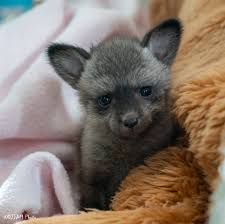
As the name indicates, this fox has unusually enormous ears in proportion to its head, like those of many bats. Their bodies are generally yellow-brown with a pale throat and under parts. The outsides of the ears, the racoon-like “face-mask,” lower legs, feet, and tail tip are all black. 

They can be found living in groups of mating pairs and their young. They are a very social species and spend lots of time grooming each other, as well as playing and sleeping together.

Their hearing is remarkable, but bat-eared foxes are also known for their social nature. They often live in family groups of up to 15 animals. They do not mark or defend territories aggressively against other packs.

They seldom drink water as they obtain most of the moisture they need from their food; 3. Unlike other canids, the male undertakes most parental care duties, while the female forages for food that maintains her milk production

Termites and dung beetles make up about 80 percent of their diets. In addition to termites and dung beetles, they also eat other insects and arthropods, small rodents, lizards, the eggs and chicks of other birds, and plant matter. They obtain much of their water from the body fluid of the insects they consume.

Predators include cheetahs, jackals, spotted hyenas, rock pythons, African wild dogs, and leopards. Bat-eared foxes are named for their large ears, which are also used for thermoregulation. To escape from predators, bat-eared foxes rely on speed and their incredible dodging ability.

They typically live for 6 years in the wild but can be up to 13 years in captivity. 
They reach sexual maturity at 8–9 months old, both male and female. They usually leave their family groups at 5–6 months old. 

They breed annually, producing litters of 3–6 pups, with a gestation period of 60–75 days. 

Grey Fox

The gray fox, or grey fox, is an omnivorous mammal of the family Canidae, widespread throughout North America and Central America.

They live in a wide variety of places. They prefer to live in places they can blend in, like canyons and ridges. Though they will also live in wooded areas, open desert and grasslands. They can be found from Quebec to Northern Columbia and Venezuela.

They are common, but very elusive and rare to spot in the wild. They are primarily nocturnal but may forage during the day.

They are smaller than red foxes. They weigh between 7 and 13 pounds and average 3 to 4 feet in length including the tail. They are stockier and have shorter legs than the red fox. Their color is grizzled gray with a distinctive black streak along the top to the black tip of the tail.

They have a white throat and belly. Their chest and lower sides of the body, undersurface of the tail, backs of the ears, parts of the legs, feet and neck are reddish or yellowish brown. The claws are sharp, and on the forefeet recurved.

Due to their more aggressive behavior, they prefer to hunt thicker cover than the more timid red fox. The gray fox’s preference for thicker cover, aggressive behavior, and the ability to climb trees minimizes the effect that eastern coyotes have on their population.

It often lines the den with shredded bark or leaves and will return to the same one year after year. The gray fox is nocturnal and crepuscular, which means it is most active at dusk and dawn. During the day, it remains in the den.

The gray fox is a solitary hunter and eats a wide variety of foods. A large part of its diet is made up of small mammals like mice, voles and eastern cottontail rabbits. It also eats birds; insects; and plants like corn, apples, nuts, berries and grass.

The gray fox has few natural predators. Bobcats, coyotes, great horned owls, and golden eagles may occasionally prey upon young gray foxes.

Kit Fox

Hello everyone, this week we are having a look at the Kit Fox, anyone heard of this fox before, I haven’t till now.

The kit fox is a fox species that inhabits arid and semi-arid regions of the southwestern United States and northern and central Mexico. These foxes are the smallest of the four species of Vulpes occurring in North America and are among the smallest of the vulpines worldwide.

It has a narrow nose and a small, slim body. The foot pads of kit foxes are small by comparison with other canids. They weigh only about three to six pounds, making them about the size of a full-grown jackrabbit, and ​​the smallest fox in North America​.

It is specially adapted for its desert habitat. Its large, close-set ears help dissipate heat, keeping it cool in the hot desert.

​They closely resemble swift foxes found on the eastern plains of Colorado but have larger ears and a more angular appearance.

They live for up to seven years in the wild, while captive animals can live up to 12 years.

Their primary food is kangaroo rats, but it also actively hunts white-footed mice, pocket mice, ground squirrels, rabbits and ground-nesting birds. During certain times of the year, kit foxes will also eat insects. They are nocturnal animals finding shelter in dens to avoid the heat of the day and hunt at night.

They rarely drink water since they get all the water and electrolyte they need from their diet. They also have a digestive tract that is super-efficient at absorbing every last millilitre of water from the food they eat.

Coyotes are the biggest predatory threat to kit foxes. Some estimates suggest that three out of four kit fox deaths can be associated with coyote attacks.

In September and October, the female will prepare a natal den, where the male will meet the female. Pair bonds last at least one breeding season. After birth, parents bring food to the dens for the pups. The pups emerge from the dens when they are about five weeks old then forage alongside the parents once they reach four months, by seven months they are ready to leave their parents. They mate for life and have intricate family situations where kits from previous years often stay with the family and help with the new pups.

Fennec Fox

First up there is a new post  over here:

http://jamfn.blogspot.com/2024/12/goodbye-2024.html

Hi everyone, how many of you have heard of the fennec fox?

I had noy heard of it till I was researching foxes for these posts. 

The fennec fox is a small fox native to the deserts of North Africa, ranging from Western Sahara and Mauritania to the Sinai Peninsula. Its most distinctive feature is its unusually large ears, which serve to dissipate heat and listen for underground prey.

The fennec is the smallest fox species, standing about 20cms or 8 inches tall and weighing up to 1.3kgs or 3 pounds.

In the wild, fennec foxes eat insects—particularly grasshoppers and locusts—as well as small rodents, lizards, birds and their eggs. They will also consume roots, fruits and leaves, which help them to hydrate.

In captivity should consist of a mix of meat and vegetables, and include supplements to ensure they get enough taurine, they should be eating 90% meat and insects, such as waxworms, morioworms, locusts and such. The meat should be low in retinol (vitamin A) and contain enough calcium and taurine. 

The other 10% should be vegetables and fruit, such as diced melons, berries, and leafy greens. Avoid fruits and vegetables that are high in carbohydrates or belong to the nightshade family, such as tomatoes and aubergines.

They can live up to 14 years in captivity and about 10 years in the wild. 

They typically give birth to one litter of pups per year, with between two and five young in a litter.

The female does not allow the male to interact with the kits until they are 5 to 6 weeks old. Parent-raised offspring are weaned by 8 to 10 weeks of age. Carrying, grooming, and nursing of the young continue until this time. Wild fennec foxes stay with their family until they are at least 1 year old.

In general, male fennec foxes tend to be slightly larger and heavier than females.

The primary threat to fennec foxes is human interference. They are commonly trapped for exhibition or sale to tourists, and there have been limited instances of human settlements encroaching on fennec populations. Native populations in the Sahara region also hunt fennec foxes. They are preyed upon by the Pharaoh eagle-owl; both adults and pups may possibly fall prey to jackals and striped hyenas.

They are currently listed as a species of least concern, according to the International Union for Conservation of Nature (IUCN) Red List of Threatened Species. While there are no major threats to the desert-dwelling wild populations, habitat loss still occurs in their native range.

Red Fox

Ok let’s have a look at the red fox which I think may be the most well know of foxes it is in my opinion a handsome looking creature.

It is the largest of the true foxes and one of the most widely distributed members of the order Carnivora, being present across the entire Northern Hemisphere including most of North America, Europe and Asia, plus parts of North Africa. 

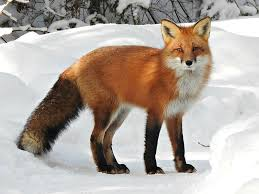
They have long snouts and red fur across the face, back, sides, and tail. Their throat, chin, and belly are grayish white. Red foxes have black feet and black-tipped ears that are large and pointy. One of the most noticeable characteristics of the red fox is the fluffy, white-tipped tail.

They have been called bold, cunning, and deceitful, particularly in children’s stories. In fact, they are shy, secretive, and nervous by disposition, and they appear to be very intelligent.

They are extraordinarily opportunistic, omnivorous predators. Nonetheless, most studies agree that they feed predominantly on small mammals, particularly rodents (rats, mice, voles and the occasional squirrel) and lagomorphs (rabbits and hares); in rural areas these groups together typically account for about 50% of the diet.

Red foxes are the most widespread wild canid and have the largest natural distribution of any non-human land mammal.

Red foxes can be found in many countries, including, most of Europe, Russia, Kazakhstan, Iraq, Iran, Pakistan, northern India, China, and Thailand. They can be found in the northern and eastern United States, north through Canada and Alaska to Baffin Island. In parts of North Africa as well as here in Australia they were introduced to Australia in the 1800s and have spread throughout much of the country. However, it wasn’t till the late 1990’s that they were introduced to Tasmania.

They are hunted for sport and for their pelts. Red foxes are also the primary carrier of rabies in much of their range

Both the male and female red fox, care for their pups, or kits. The mother, or vixen, spends a lot of time grooming and cleaning the cubs. The father brings food to the mother during the first few weeks. The parents take turns hunting and bringing food back to the kits. 

The vixen gives birth to 1–10 or more pups in a den, which is often a burrow abandoned by another animal. The pups are born brown or gray, but usually grow a new red coat by the end of the first month. 

Their dens are usually located on the edges of forests, near fields, or under porches. 

The pups start playing outside the den when they are about a month old. The mother feeds them regurgitated food at first, but eventually brings them live prey to play with and eat. 

The young remain with their parents at least until the fall of the year they were born in. They disperse in the fall once they are fully grown and independent. 

New Guinea Singing Dog

This week are looking at the New Guinea Singing Dog, not an animal I have heard of before, how about of you?

The New Guinea singing dog or New Guinea Highland dog is an ancient lineage of dog found in the New Guinea Highlands, on the island of New Guinea. Once considered to be a separate species in its own right, under the name Canis hallstromi, it is closely related to the Australian dingo.

They are thought to be one of the oldest breeds of canine, with some evidence suggesting that they may have been present on the island of New Guinea for over 5,000 years. It was thought that they went extinct in the wild in the 1970s, but in 2018, DNA evidence confirmed the presence of a wild group in New Guinea.

Does it really sing? Well, when it comes to sounds, they really have their own voice! Most of the singing dog’s vocalizations are like that of the wolf, dingo, and domestic dog, but their howl is incredibly unique. By using Sonograms, it is believed that their howl is like the song of the humpback whale.

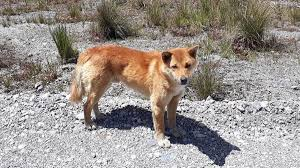
They are a small to medium size dog species. They have a wedge-shaped head and triangular, upright ears. These dogs have a soft, thick coat and a bushy tail. The eyes of the singing dog are reflective and glow bright green in low light conditions.

They have a distinctive appearance, which includes a dense, long coat that ranges in colour from red to black and brown. These dogs have a small, compact body and a wedge-shaped head with pointed ears. They have a high metabolism and require a diet rich in protein to maintain their energy levels. Their legs, joints, and spine are highly flexible making them skilled climbers.

They are known to live up to 15 years in captivity, but it is unknown how long they live in the wild.

They prey on small mammals, small reptiles, and birds; they even try to hunt 3.5-foot-tall (1-meter-tall) dwarf cassowaries! New Guinea singing dogs have a strong hunting drive and fearless nature, and they are highly curious.

They are not pack animals but are solitary animals but may forage in pairs. They are known to be shy and elusive and live in mountains and thick forests of New Guinea and Indonesia. They are also excellent climbers and can jump high like cats.

You can have a New Guinea Singing Dog as a pet, but they can be challenging to fully domesticate and may not be the best fit for most families.

They are intelligent, lively, and affectionate, but they can be difficult to housetrain and are not very socially active. They can also be fearful and unreliable off-leash. They do best with experienced pet parents who are familiar with the breed. 

It is estimated that only 200-300 of these animals are in existence today. 

Coyote

This week we are looking at the coyote, also known as the American jackal, prairie wolf, or brush wolf, is a species of canine native to North America. It is smaller than its close relative, the gray wolf, and slightly smaller than the closely related eastern wolf and red wolf.

An animal that many of my American friends would be familiar with.

Some people think that they are wolfs and in places where their range overlaps, it may be hard to tell the difference between a coyote and a wolf because of their somewhat similar appearances. But while they do look similar and are closely related, there are several ways to tell them apart. For starters, their size. Wolves are much bigger than coyotes.

In captivity, coyotes can live 13 to 15 years but in the wild, most die before they reach three years of age. The oldest confirmed wild coyote so far in this research was an eleven-year-old alpha female, Coyote.

Although coyotes have been known to attack humans (and pets) and as such are a potential danger to people, especially children, risks are minimal, and we feel that the majority of attack incidents could be reduced or prevented through modification of human behaviour.

Great horned owls, bald and golden eagles, wolves, and bears all have been known to prey on coyotes. Coyotes are quick to respond to increases or decreases in prey.

Coyotes are social animals that often live in family groups called packs. A pack is usually led by an alpha male and female pair and includes other coyotes such as young from the previous year, or coyotes that have been accepted into the pack. A pack usually consist of between 3 and 7 coyotes.

Coyotes are very vocal and use a variety of calls to communicate, including howls, barks, yips, growls, whines, and whimpers.

They have fewer pups when food is scarce, or they can have large litters when hares are abundant.

However, coyotes can also live alone or in loose pairs. Solitary coyotes are usually young coyotes (six months to two years old) or older individuals who have left packs. Coyotes also sometimes hunt cooperatively with other species, such as badgers or crows.

Red Wolf

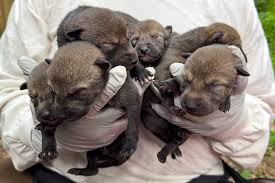
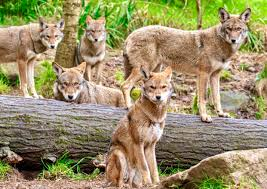
This week we are looking at the red wolf this is a canine native to the southeastern United States. Its size is intermediate between the coyote and gray wolf.

They have wide heads with broad muzzles, tall, pointed ears and long, slender legs with large feet. Red wolves stand about 26 inches at their shoulder and are about 4 feet long from the tip of the nose to the tip of the tail. Adult red wolves range in weight from about 45 to 80 pounds.

American red wolves are critically endangered and the most endangered wolf in the world due to poaching, trapping and habitat loss. According to the USFWS, there are less than 20 American red wolves living in the wild in North Carolina. 

They are shy and elusive, however, they top predators. Potential danger lies in their becoming habituated to humans, particularly if people provide them with food.

Their home territory can stretch about 200 miles in diameter.

They live in packs which are family groups that typically have five to eight members, including a breeding pair and their offspring. 

The young stay with the pack until they reach adulthood, when they leave to form their own packs. They are highly social animals that mate for life. They are also great parents and will sometimes care for other wolves’ pups.

The packs travel up to 20 miles per day to hunt for small mammals like rabbits and raccoons, and sometimes deer. Although pack animals the do not hunt in packs.

Wolves howl for many reasons, including to assemble the pack, find a mate, protect their pups, and identify each other. 

As they are considered a top predator, also called an apex predator, and has no known predators except humans. Some competition between coyotes and gray wolves can lead to killing of the red wolf but it is not due to predation.

Dingo

Well, here we are at another Monday and time to look at another wild dog, this week it is the Australian Dingo.

Dingoes have a lifespan from as few as 3yrs to usually around 16yrs but some have been known to live for 20yrs.

The dingo is an ancient lineage of dog found in Australia, however, compared with the skull of the dog, the dingo possesses a longer muzzle, longer carnassial teeth, longer and more slender canine teeth, larger auditory bullae, a flatter cranium with a larger sagittal crest, and larger nuchal lines.

The dingo’s three main coat colourations are light ginger or tan, black and tan, or creamy white. The skull is wedge-shaped and appears large in proportion to the body.

The dingo is closely related to the New Guinea singing dog. The oldest remains of dingoes in Australia are around 3,500 years old.

A dingo pack usually consists of a mated pair, their offspring from the current year, and sometimes offspring from the previous year.

Dingoes do not bark like a dog but howl, chortle, yelp, whine, growl, chatter, snort, cough and purr.

Dingoes are largely terrestrial carnivores they have a broad diet including fresh meat, fish, eggs and carrion they occasionally eat plants and fruits. They’re opportunistic hunters but will also scavenge food. The bulk of their diet is made up of meat: they eat kangaroos, wallabies, feral pigs, wombats, small mammals (rabbits, rodents), birds and lizards.

Their strong jaw and large canines permit the dingo to procure and machinate rather tough prey, allowing them to tear meat from carcasses and crush bones to obtain calcium and fat.

Dingoes have a strict social hierarchy and regularly mate for life. Female dingoes have one annual breeding cycle, March to June. The dingo pack helps with the rearing of pups which are weaned at about 2 months, at which time the pups may be abandoned or can stay with the parents for up to a year. Dingo pups are fully grown by 7 months.

They are primarily killed by humans, crocodiles, and sometimes by other canid species, such as jackals and domestic dogs. They are also killed by Dingoes from other packs. Pups may be taken by large birds of prey.

They are highly intelligent and intuitive animals that have a high capacity to solve problems and plan.

With this high intelligence and foresight comes a strong sense of self-awareness and independence.

African Wild Dog

This week we are kicking of the series about wild dogs from around the world and we will start with the African wild dog, also known as the painted dog or Cape hunting dog.

The African wild dog has a colourful, patchy coat. They have large bat-like ears and a bushy tail with a white tip, which may serve as a flag to keep the pack in contact while hunting. Their markings are as unique as a human fingerprint, making it easy to identify individuals.

This dog is native to sub-Saharan Africa

These wild dog packs have an 80% success rate when hunting, thanks to high levels of communication.

They generally live up to the age of 11 when living in the wild.

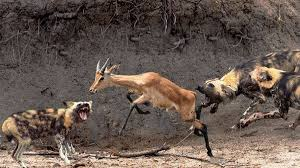
It can also run up to 70km or 44mph this is the same as a greyhound, over a long time. Of all large carnivores they are regarded as the most efficient hunters as their targeted prey rarely escapes. They hunt for a wide variety of prey, including gazelles and other antelopes, warthogs, wildebeest calves, rats, and birds.

They like to live in packs averaging from seven to 15 members and sometimes up to 40. Before the recent population decline, packs of up to 100 were recorded.  Within the pack, there is a unique social structure.

They cooperate in taking care of the wounded and sick members, there is a general lack of aggression exhibited between members of the pack, and there is little intimidation among the social hierarchy.

Every hunting pack has a dominant pair. They are usually the only pair that remains monogamous for life. Wild dogs also have a large range of vocalizations that include a short bark of alarm, a rallying howl, and a bell-like contact call that can be heard over long distances. Elaborate greeting rituals are accompanied by twittering and whining.

They are pack animals that are quick to defend themselves against any threatening animal. While they don’t prey on humans and typically approach them out of curiosity rather than aggression, it’s best not to go near them.