Grey Fox

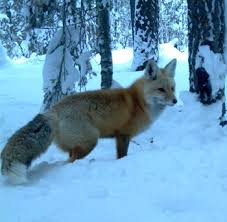
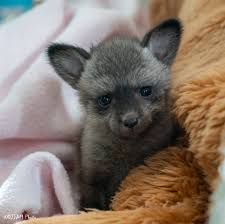
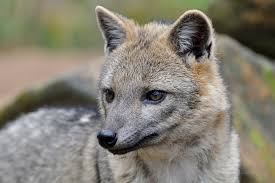
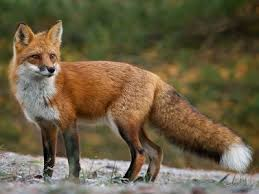
The gray fox, or grey fox, is an omnivorous mammal of the family Canidae, widespread throughout North America and Central America.

They live in a wide variety of places. They prefer to live in places they can blend in, like canyons and ridges. Though they will also live in wooded areas, open desert and grasslands. They can be found from Quebec to Northern Columbia and Venezuela.

They are common, but very elusive and rare to spot in the wild. They are primarily nocturnal but may forage during the day.

They are smaller than red foxes. They weigh between 7 and 13 pounds and average 3 to 4 feet in length including the tail. They are stockier and have shorter legs than the red fox. Their color is grizzled gray with a distinctive black streak along the top to the black tip of the tail.

They have a white throat and belly. Their chest and lower sides of the body, undersurface of the tail, backs of the ears, parts of the legs, feet and neck are reddish or yellowish brown. The claws are sharp, and on the forefeet recurved.

Due to their more aggressive behavior, they prefer to hunt thicker cover than the more timid red fox. The gray fox’s preference for thicker cover, aggressive behavior, and the ability to climb trees minimizes the effect that eastern coyotes have on their population.

It often lines the den with shredded bark or leaves and will return to the same one year after year. The gray fox is nocturnal and crepuscular, which means it is most active at dusk and dawn. During the day, it remains in the den.

The gray fox is a solitary hunter and eats a wide variety of foods. A large part of its diet is made up of small mammals like mice, voles and eastern cottontail rabbits. It also eats birds; insects; and plants like corn, apples, nuts, berries and grass.

The gray fox has few natural predators. Bobcats, coyotes, great horned owls, and golden eagles may occasionally prey upon young gray foxes.

Week 3 of 2025

Another good night and nice morning it’s 20 degrees, my BGL is 5.3

Tim and I went over to Lake Fair, he wanted to cash in empty bottles, and I wanted to go to the dollar store to see what cheap Christmas things they had.

I only found a couple of things but that’s ok.

By the time we got home it was stinking hot.

Steps:6,499

I had a decent enough sleep, up at 5, showered and dressed, I have to see the neurologist is Sydney at 12.40pm so we will leave here around 9.30am

It is currently 18 degrees, but it is expected to reach 30 degrees today. My BGL was 5.1

When I saw the neurologist, she was pleased with how I am doing and isn’t making any change to my medication. The only thing that annoyed me was that she was running 70 minutes late.

We arrived home around 5pm, to a stinking hot house, we should have asked one of the girls to come and turn the air con around 4.30, that was the first thing I did after walking into the house.

LIARNA’S BIRTHDAY SHE IS 15 TODAY

I had a good night didn’t wake at all, it is 21 degrees this morning and my BGL was 5.1, we are headed for a top temp of 29 degrees.

Kathy will be dropping Summer off for the day, Summer would rather stay home alone like she did yesterday, but her mum said no.

Ok in the last how the temp has dropped to 19 degrees.

Thankfully I remember this morning that the water will be cut off from 8am to 3pm and made sure the kettle was filled as well as a jug of water.

As it turned out we didn’t have the water cut off.

There was an incident out the front, Tim was walking over to Jess’s place and the woman in unit 14 was driving out and Tim said she made like she was going to run him over. I watched the video caught on the door-bell camera, but I didn’t notice anything. I am not saying she didn’t do something just that I couldn’t see it. Anyway, he rang the cops to report it, and they came out to talk to him at 10.30pm.

Another mostly good night.

The temp is 25 degrees and my GL is 5.1. We are in for another hot day it reached a top of 33 degrees.

So, I went and had my care plan reviewed and then I went and had an Xray of my elbow done as well as the CT scan done of my left knee. Sue drove me.

I was glad that Tim turned the air con on before he went to work, as that meant I came home to a cool house.

Tim is working today; he should be home around 3pm. 

I managed to walk up and check the mail without my cane or my walker, I felt exhausted by the time I got back inside the house.

I am having a very restless night; I just can’t settle.

Steps:8,346

After a restless start to the night, I ended up sleeping good enough, I got up at 5am, showered and dressed for the day.

It is a nice 20 degrees, only looking at a top of 22 degrees today.

Around 11am it started raining and has been raining on and off all day. It has also been very windy and cold.

Steps:6,502

Another good night woke twice to pee.

It is a coldish 18 degrees and have long pants on, so I can have the sliding doors open. My BGL was 5.1

Damn it is a cold day feels more like winter then summer today. In fact, after Tim left for work, I turned the heater on for about an hour to warm the room up.

This afternoon I started to feel off, headache and aching chest and back area and just not feeling right.

Steps:4,510

Another good night woke only once to pee, it is another cool and wet morning raining as I write this. I still don’t feel great but I’m ok. It is only 19 degrees and my BGL was 4.8

It stopped raining around 12.45pm and warmed up some, but around 5pm it started raining.

I went to bed at 8.30pm but woke at 10.22, tossing and turning so I got up for an hour and half.

Tim is working he left before I got up, I think he left around 4.15am.

Steps:10, 509

Kit Fox

Hello everyone, this week we are having a look at the Kit Fox, anyone heard of this fox before, I haven’t till now.

The kit fox is a fox species that inhabits arid and semi-arid regions of the southwestern United States and northern and central Mexico. These foxes are the smallest of the four species of Vulpes occurring in North America and are among the smallest of the vulpines worldwide.

It has a narrow nose and a small, slim body. The foot pads of kit foxes are small by comparison with other canids. They weigh only about three to six pounds, making them about the size of a full-grown jackrabbit, and ​​the smallest fox in North America​.

It is specially adapted for its desert habitat. Its large, close-set ears help dissipate heat, keeping it cool in the hot desert.

​They closely resemble swift foxes found on the eastern plains of Colorado but have larger ears and a more angular appearance.

They live for up to seven years in the wild, while captive animals can live up to 12 years.

Their primary food is kangaroo rats, but it also actively hunts white-footed mice, pocket mice, ground squirrels, rabbits and ground-nesting birds. During certain times of the year, kit foxes will also eat insects. They are nocturnal animals finding shelter in dens to avoid the heat of the day and hunt at night.

They rarely drink water since they get all the water and electrolyte they need from their diet. They also have a digestive tract that is super-efficient at absorbing every last millilitre of water from the food they eat.

Coyotes are the biggest predatory threat to kit foxes. Some estimates suggest that three out of four kit fox deaths can be associated with coyote attacks.

In September and October, the female will prepare a natal den, where the male will meet the female. Pair bonds last at least one breeding season. After birth, parents bring food to the dens for the pups. The pups emerge from the dens when they are about five weeks old then forage alongside the parents once they reach four months, by seven months they are ready to leave their parents. They mate for life and have intricate family situations where kits from previous years often stay with the family and help with the new pups.

Week 2 of 2025

TEMIKA’S BIRTHDAY SHE IS 15 TODAY

I had another good night, sleeping straight through. It is a pleasant 18 degrees here although we are in for another pretty hot day.

Tim said he should be home by around 7pm, last night he thought he would be home by 10pm but it 11pm before he got home.

He arrived home at 6.15pm

Steps: 9,471

Took me a while to settle last night but once I did, I slept well. Although when I got up at 5am I still felt tired, so I went back to bed for half an hour.

It is a nice 18 degrees; it is supposed to get to 33 degrees. My BGL was 5.0

I booked in to have my hearing checked on the 28th at 9am.

I turned the air con on at 10am, it has been a hot day the temp got up to 35 degrees. 7,670

I had a good night, woke to rain and much cooler with the temp at 22 degrees, although I still had to turn the fan on. My BGL was 4.9.

Sue is taking Archi to be desexed, I did want to go with her, but Tim is working, and I have groceries coming sometime this morning.

Sue was annoyed that she had only been home 45-minutes when the vet rang, and she could pick him up in an hours’ time. So, she pretty much had to drive straight back as it is nearly an hours’ drive from her place to the vet. If they had told her that it, he would only need to be there 90-minutes she would have taken a book and went to Macca’s for a coffee and just waited.

It has been raining pretty much all day, it has also felt sticky unless I have the doors open.

Steps:4,935

SAM’S BIRTHDAY SHE IS 17 TODAY

I had a good night, woke when the alarm went off, I have both front and back doors open, however due to the wind I have the screen doors closed.

It is 20 degrees and my BGL was 5.1

It has been raining on and off all day and it is a cold day.

Sam came down and I gave her a birthday card with $20 in it, she had Bailey with her, that’s the new boyfriend.

Steps:8,264

I woke to the sound of rain again, and it is cold still. I had a hot shower. I am glad we still have the heater in the bathroom as I needed it this morning.

It is 18 degrees and raining, my BGL was 5.1

Tim has changed the position of the lounge at first, I wasn’t sure it gave us more room but after I moved a couple of things it does.

Not as cold as yesterday and it has stopped raining, I am hoping tomorrow it isn’t raining.

Steps:7,808

There was no sound of rain this morning the ground is mostly dry so that’s good and it’s not cold nor is it hot. Only supposed to reach 24 degrees today, at the moment it is 19 degrees and my BGL was 5.1.

Sue drove me the doctors, he wants me to have an Xray on my left elbow and a CT scan of my left knee.

After the doctors we went to Big W and the Reject shop I managed to get a few Chrissy things that have been put away till next Christmas.

Yet again this afternoon I am feeling sad, and I don’t know why.

Steps:6,962                   

Another good night and nice morning it’s 20 degrees, my BGL is 4.9 and my body will not stop moving.

Kathy and the girls came over around 1pm for a visit it was nice seeing them.

I asked Tim if he would go to Maccas for me, but he said he has been drinking so he can’t. So, I asked Tasha if she got my bread roll, she said she thought Tim would get it, but I didn’t ask him, so he didn’t.

This put me in a right foul mood for the rest of the day.

Steps: 4,548

Arctic Fox

This week we are looking at the Artic Fox, which is also known as the white fox, polar fox, or snow fox, is a small species of fox native to the Arctic regions of the Northern Hemisphere and common throughout the Arctic tundra biome.  

The Arctic tundra biome is a vast, dry, and rocky region that stretches from the Arctic Circle to the polar ice cap, and includes parts of Canada, Russia, Greenland, and northern Europe. 

It is well adapted to living in cold environments, and is best known for its thick, warm fur that is also used as camouflage. It has a large and very fluffy tail.  Its body length ranges from 46 to 68 cm (18 to 27 in), with a generally rounded body shape to minimize the escape of body heat.

In the wild some do not live past their first year, but others live for 3 or 4 years in the wild and up to 14 years in captivity.

They prey on many small creatures such as lemmings, voles, ringed seal pups, fish, waterfowl, and seabirds.  It also eats carrion, berries, seaweed, and insects and such.

 They form monogamous pairs usually mate for life and during the breeding season and they stay together to raise their young in complex underground dens. Occasionally, other family members may assist in raising their young.

Their natural predators are golden eagles, artic wolves, polar bears, wolverines, red foxes and grizzly bears.

They must endure great temperature differences between the external environment and their internal core temperature. To prevent heat loss, they curl up tightly tucking its legs and head under its body and behind its furry tail. This position gives the fox the smallest surface area to volume ratio and protects the least insulated areas. Arctic foxes also stay warm by getting out of the wind and residing in their dens. Although the Arctic foxes are active year-round and do not hibernate, they attempt to preserve fat by reducing their locomotor activity. They build up their fat reserves in the autumn, sometimes increasing their body weight by more than 50%. This provides greater insulation during the winter and a source of energy when food is scarce.

The Arctic is home to more than 630,000 Arctic foxes and they are not currently at risk from extinction, but populations are declining. Arctic foxes are well adapted to winter temperatures of -34C. They are born with thick fur and their snout, ears and legs are short to conserve heat.

Fennec Fox

First up there is a new post  over here:

http://jamfn.blogspot.com/2024/12/goodbye-2024.html

Hi everyone, how many of you have heard of the fennec fox?

I had noy heard of it till I was researching foxes for these posts. 

The fennec fox is a small fox native to the deserts of North Africa, ranging from Western Sahara and Mauritania to the Sinai Peninsula. Its most distinctive feature is its unusually large ears, which serve to dissipate heat and listen for underground prey.

The fennec is the smallest fox species, standing about 20cms or 8 inches tall and weighing up to 1.3kgs or 3 pounds.

In the wild, fennec foxes eat insects—particularly grasshoppers and locusts—as well as small rodents, lizards, birds and their eggs. They will also consume roots, fruits and leaves, which help them to hydrate.

In captivity should consist of a mix of meat and vegetables, and include supplements to ensure they get enough taurine, they should be eating 90% meat and insects, such as waxworms, morioworms, locusts and such. The meat should be low in retinol (vitamin A) and contain enough calcium and taurine. 

The other 10% should be vegetables and fruit, such as diced melons, berries, and leafy greens. Avoid fruits and vegetables that are high in carbohydrates or belong to the nightshade family, such as tomatoes and aubergines.

They can live up to 14 years in captivity and about 10 years in the wild. 

They typically give birth to one litter of pups per year, with between two and five young in a litter.

The female does not allow the male to interact with the kits until they are 5 to 6 weeks old. Parent-raised offspring are weaned by 8 to 10 weeks of age. Carrying, grooming, and nursing of the young continue until this time. Wild fennec foxes stay with their family until they are at least 1 year old.

In general, male fennec foxes tend to be slightly larger and heavier than females.

The primary threat to fennec foxes is human interference. They are commonly trapped for exhibition or sale to tourists, and there have been limited instances of human settlements encroaching on fennec populations. Native populations in the Sahara region also hunt fennec foxes. They are preyed upon by the Pharaoh eagle-owl; both adults and pups may possibly fall prey to jackals and striped hyenas.

They are currently listed as a species of least concern, according to the International Union for Conservation of Nature (IUCN) Red List of Threatened Species. While there are no major threats to the desert-dwelling wild populations, habitat loss still occurs in their native range.

Red Fox

Ok let’s have a look at the red fox which I think may be the most well know of foxes it is in my opinion a handsome looking creature.

It is the largest of the true foxes and one of the most widely distributed members of the order Carnivora, being present across the entire Northern Hemisphere including most of North America, Europe and Asia, plus parts of North Africa. 

They have long snouts and red fur across the face, back, sides, and tail. Their throat, chin, and belly are grayish white. Red foxes have black feet and black-tipped ears that are large and pointy. One of the most noticeable characteristics of the red fox is the fluffy, white-tipped tail.

They have been called bold, cunning, and deceitful, particularly in children’s stories. In fact, they are shy, secretive, and nervous by disposition, and they appear to be very intelligent.

They are extraordinarily opportunistic, omnivorous predators. Nonetheless, most studies agree that they feed predominantly on small mammals, particularly rodents (rats, mice, voles and the occasional squirrel) and lagomorphs (rabbits and hares); in rural areas these groups together typically account for about 50% of the diet.

Red foxes are the most widespread wild canid and have the largest natural distribution of any non-human land mammal.

Red foxes can be found in many countries, including, most of Europe, Russia, Kazakhstan, Iraq, Iran, Pakistan, northern India, China, and Thailand. They can be found in the northern and eastern United States, north through Canada and Alaska to Baffin Island. In parts of North Africa as well as here in Australia they were introduced to Australia in the 1800s and have spread throughout much of the country. However, it wasn’t till the late 1990’s that they were introduced to Tasmania.

They are hunted for sport and for their pelts. Red foxes are also the primary carrier of rabies in much of their range

Both the male and female red fox, care for their pups, or kits. The mother, or vixen, spends a lot of time grooming and cleaning the cubs. The father brings food to the mother during the first few weeks. The parents take turns hunting and bringing food back to the kits. 

The vixen gives birth to 1–10 or more pups in a den, which is often a burrow abandoned by another animal. The pups are born brown or gray, but usually grow a new red coat by the end of the first month. 

Their dens are usually located on the edges of forests, near fields, or under porches. 

The pups start playing outside the den when they are about a month old. The mother feeds them regurgitated food at first, but eventually brings them live prey to play with and eat. 

The young remain with their parents at least until the fall of the year they were born in. They disperse in the fall once they are fully grown and independent. 

Coyote

This week we are looking at the coyote, also known as the American jackal, prairie wolf, or brush wolf, is a species of canine native to North America. It is smaller than its close relative, the gray wolf, and slightly smaller than the closely related eastern wolf and red wolf.

An animal that many of my American friends would be familiar with.

Some people think that they are wolfs and in places where their range overlaps, it may be hard to tell the difference between a coyote and a wolf because of their somewhat similar appearances. But while they do look similar and are closely related, there are several ways to tell them apart. For starters, their size. Wolves are much bigger than coyotes.

In captivity, coyotes can live 13 to 15 years but in the wild, most die before they reach three years of age. The oldest confirmed wild coyote so far in this research was an eleven-year-old alpha female, Coyote.

Although coyotes have been known to attack humans (and pets) and as such are a potential danger to people, especially children, risks are minimal, and we feel that the majority of attack incidents could be reduced or prevented through modification of human behaviour.

Great horned owls, bald and golden eagles, wolves, and bears all have been known to prey on coyotes. Coyotes are quick to respond to increases or decreases in prey.

Coyotes are social animals that often live in family groups called packs. A pack is usually led by an alpha male and female pair and includes other coyotes such as young from the previous year, or coyotes that have been accepted into the pack. A pack usually consist of between 3 and 7 coyotes.

Coyotes are very vocal and use a variety of calls to communicate, including howls, barks, yips, growls, whines, and whimpers.

They have fewer pups when food is scarce, or they can have large litters when hares are abundant.

However, coyotes can also live alone or in loose pairs. Solitary coyotes are usually young coyotes (six months to two years old) or older individuals who have left packs. Coyotes also sometimes hunt cooperatively with other species, such as badgers or crows.

Red Wolf

This week we are looking at the red wolf this is a canine native to the southeastern United States. Its size is intermediate between the coyote and gray wolf.

They have wide heads with broad muzzles, tall, pointed ears and long, slender legs with large feet. Red wolves stand about 26 inches at their shoulder and are about 4 feet long from the tip of the nose to the tip of the tail. Adult red wolves range in weight from about 45 to 80 pounds.

American red wolves are critically endangered and the most endangered wolf in the world due to poaching, trapping and habitat loss. According to the USFWS, there are less than 20 American red wolves living in the wild in North Carolina. 

They are shy and elusive, however, they top predators. Potential danger lies in their becoming habituated to humans, particularly if people provide them with food.

Their home territory can stretch about 200 miles in diameter.

They live in packs which are family groups that typically have five to eight members, including a breeding pair and their offspring. 

The young stay with the pack until they reach adulthood, when they leave to form their own packs. They are highly social animals that mate for life. They are also great parents and will sometimes care for other wolves’ pups.

The packs travel up to 20 miles per day to hunt for small mammals like rabbits and raccoons, and sometimes deer. Although pack animals the do not hunt in packs.

Wolves howl for many reasons, including to assemble the pack, find a mate, protect their pups, and identify each other. 

As they are considered a top predator, also called an apex predator, and has no known predators except humans. Some competition between coyotes and gray wolves can lead to killing of the red wolf but it is not due to predation.

Grey Wolf

This week we are looking at the wolf, also known as the gray wolf or grey wolf, is a canine native to Eurasia and North America. This is the most common wolf in the world.

A Grey wolve is about twice the size of a coyote. They measure up to 6 feet(183cm) in length, including tail, and about 30 inches (80-85cm) in height at the shoulder. Female wolves weigh around 70 – 80 pounds (31-36kg), while males weigh around 95 – 100 pounds, (43-45kg)

The life spans of wild wolves vary dramatically. Although the average lifespan is between 6 and 8 years, many will die sooner, and some can reach 13. Wolves in captivity can live up to 17 years.

Wolves rarely act aggressively toward people, but there have been instances in Alaska and Canada where wolves have attacked people. The first case of wild healthy wolves killing a human in modern North America occurred in Saskatchewan in 2005; a second person was killed in 2010 in Alaska.

Wolves are carnivores—they prefer to eat large-hoofed mammals such as deer, elk, bison, and moose. They also hunt smaller mammals such as beavers, rodents, and hares. Adults can eat 20 pounds of meat in a single meal.

Pups are born in early spring and are cared for by the entire pack. They depend on their mother’s milk for the first month, and then they are gradually weaned and fed regurgitated meat by other pack members. By 7 to 8 months of age, when almost fully grown, the pups begin traveling with the adults.

In a grey wolf pack, it is usually only the male and female alpha who are allowed to breed, the pair mate for life as a way to cement their position as pack leaders, producing a new litter each year and ensuring the stability of the rest of the pack.

Wolves’ vocalizations can be separated into four categories: barking, whimpering, growling, and howling. Sounds created by the wolf may actually be a combination of sounds such as a bark-howl or growl-bark. Barking is used as a warning.

Next week we will look at the Red Wolf.