Red Wolf

This week we are looking at the red wolf this is a canine native to the southeastern United States. Its size is intermediate between the coyote and gray wolf.

They have wide heads with broad muzzles, tall, pointed ears and long, slender legs with large feet. Red wolves stand about 26 inches at their shoulder and are about 4 feet long from the tip of the nose to the tip of the tail. Adult red wolves range in weight from about 45 to 80 pounds.

American red wolves are critically endangered and the most endangered wolf in the world due to poaching, trapping and habitat loss. According to the USFWS, there are less than 20 American red wolves living in the wild in North Carolina. 

They are shy and elusive, however, they top predators. Potential danger lies in their becoming habituated to humans, particularly if people provide them with food.

Their home territory can stretch about 200 miles in diameter.

They live in packs which are family groups that typically have five to eight members, including a breeding pair and their offspring. 
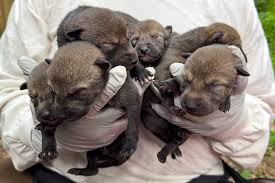
The young stay with the pack until they reach adulthood, when they leave to form their own packs. They are highly social animals that mate for life. They are also great parents and will sometimes care for other wolves’ pups.

The packs travel up to 20 miles per day to hunt for small mammals like rabbits and raccoons, and sometimes deer. Although pack animals the do not hunt in packs.
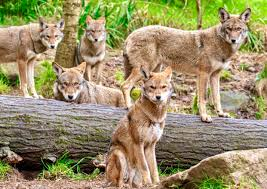
Wolves howl for many reasons, including to assemble the pack, find a mate, protect their pups, and identify each other. 

As they are considered a top predator, also called an apex predator, and has no known predators except humans. Some competition between coyotes and gray wolves can lead to killing of the red wolf but it is not due to predation.

Grey Wolf

This week we are looking at the wolf, also known as the gray wolf or grey wolf, is a canine native to Eurasia and North America. This is the most common wolf in the world.

A Grey wolve is about twice the size of a coyote. They measure up to 6 feet(183cm) in length, including tail, and about 30 inches (80-85cm) in height at the shoulder. Female wolves weigh around 70 – 80 pounds (31-36kg), while males weigh around 95 – 100 pounds, (43-45kg)

The life spans of wild wolves vary dramatically. Although the average lifespan is between 6 and 8 years, many will die sooner, and some can reach 13. Wolves in captivity can live up to 17 years.

Wolves rarely act aggressively toward people, but there have been instances in Alaska and Canada where wolves have attacked people. The first case of wild healthy wolves killing a human in modern North America occurred in Saskatchewan in 2005; a second person was killed in 2010 in Alaska.

Wolves are carnivores—they prefer to eat large-hoofed mammals such as deer, elk, bison, and moose. They also hunt smaller mammals such as beavers, rodents, and hares. Adults can eat 20 pounds of meat in a single meal.

Pups are born in early spring and are cared for by the entire pack. They depend on their mother’s milk for the first month, and then they are gradually weaned and fed regurgitated meat by other pack members. By 7 to 8 months of age, when almost fully grown, the pups begin traveling with the adults.

In a grey wolf pack, it is usually only the male and female alpha who are allowed to breed, the pair mate for life as a way to cement their position as pack leaders, producing a new litter each year and ensuring the stability of the rest of the pack.

Wolves’ vocalizations can be separated into four categories: barking, whimpering, growling, and howling. Sounds created by the wolf may actually be a combination of sounds such as a bark-howl or growl-bark. Barking is used as a warning.

Next week we will look at the Red Wolf.

This week’s wild dog the Dhole

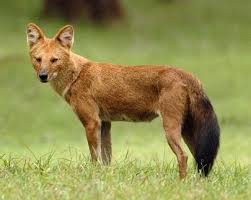
This week we are looking at the dhole, it is a canid native to South, East and Southeast Asia. It is anatomically distinguished from members of the genus Canis in several aspects: its skull is convex rather than concave in profile, it lacks a third lower molar, and the upper molars possess only a single cusp as opposed to between two and four.

It is a highly social animal, living in large clans without rigid dominance hierarchies and containing multiple breeding females.

This highly elusive and skilled jumper is classified with wolves, coyotes, jackals, and foxes in the taxonomic family Canidae. Dholes are unusual dogs for a few reasons. They don’t fit neatly into any of the dog subfamilies (wolf and fox, for instance).

They are very social animals that live in packs of 5–12 members, but packs can be as large as 25 members. They can also be cooperative with a few splitting off from the pack to hunt together. They are apex predators that are highly skilled hunters, they are agile, strong, and can leap up to seven feet vertically and are also excellent swimmers and have high endurance. 

It is believed that they are one of the most talkative canid species, using a variety of vocalizations to communicate, including whistles, clucks, screams, growls, yaps, and squeaks. 

Since their territory is often shared with larger predators like tigers and leopards, the pack must be alert at all times.

They are a medium-sized wild dogs about the size of a border collie. They have a rusty red coat; they are born with a brownish colour which turns more reddish when around three months old. They can also have dark, almost black bushy tails.

They are not generally dangerous to humans and are usually docile and skittish and will typically retreat when they see a person. However, dholes can attack livestock, and humans may retaliate by poisoning the carcasses. This can lead to the deaths of entire packs of dholes, as well as other carnivores and scavengers. 

African Wild Dog

This week we are kicking of the series about wild dogs from around the world and we will start with the African wild dog, also known as the painted dog or Cape hunting dog.

The African wild dog has a colourful, patchy coat. They have large bat-like ears and a bushy tail with a white tip, which may serve as a flag to keep the pack in contact while hunting. Their markings are as unique as a human fingerprint, making it easy to identify individuals.

This dog is native to sub-Saharan Africa

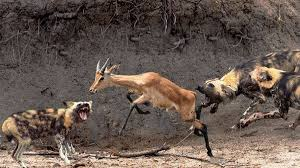
These wild dog packs have an 80% success rate when hunting, thanks to high levels of communication.

They generally live up to the age of 11 when living in the wild.

It can also run up to 70km or 44mph this is the same as a greyhound, over a long time. Of all large carnivores they are regarded as the most efficient hunters as their targeted prey rarely escapes. They hunt for a wide variety of prey, including gazelles and other antelopes, warthogs, wildebeest calves, rats, and birds.

They like to live in packs averaging from seven to 15 members and sometimes up to 40. Before the recent population decline, packs of up to 100 were recorded.  Within the pack, there is a unique social structure.

They cooperate in taking care of the wounded and sick members, there is a general lack of aggression exhibited between members of the pack, and there is little intimidation among the social hierarchy.

Every hunting pack has a dominant pair. They are usually the only pair that remains monogamous for life. Wild dogs also have a large range of vocalizations that include a short bark of alarm, a rallying howl, and a bell-like contact call that can be heard over long distances. Elaborate greeting rituals are accompanied by twittering and whining.

They are pack animals that are quick to defend themselves against any threatening animal. While they don’t prey on humans and typically approach them out of curiosity rather than aggression, it’s best not to go near them.

Puma

This week’s big cat is the puma which is also known as the cougar, panther or mountain lion that can be found in Cananda, North America and parts of South America. Although they are not considered big cats

The puma has a small has a small, broad head with small round ears and long hind legs and a tail with a black tip, it has a powerful body.

An adult puma may have either a grey or reddish-yellow in colour, it’s fur is fawn-grey tipped with reddish-brown or greyish in colour. It has no spots which is one of the main differences between a puma and a jaguar. They can also be black in colour.

While on the hunt, the puma uses the strength of its powerful back legs to lunge at its prey with a simple leap while it is still running. They like to keep under cover while stalking its prey, when it pounces it will grip its preys neck breaking the neck or dragging it to the ground.

They like to hunt alone by day or night and will hide its food in dense undergrowth returning to it over several days. Large prey like elk may provide food for over a week. It can also attack cows and horses; this is the main reason man hunts them.

They can’t roar. They instead produce low-pitched hisses, growls, purrs, as well as chirps and whistles, many of which are comparable to those of domestic cats.

Pumas are rarely dangerous for humans, though attacks are more common in human-dominated landscapes. For that reason, there are more attacks in the United States than in Patagonia, where pumas tend to live in wild, unspoiled places. Attacks on pets and livestock (for instance sheep) might happen in some areas.

Lynx & Ocelot

Not all big cats are as big as Lions, Tigers or Leopards the Lynx and the Ocelot are much smaller, but they are still awesome.  

Both of these cats are good hunters, and both are in danger of extinction. 

The Lynx can be found in parts of Africa, Asia, Europe and North America. They prefer to stay in forests or in rocky brush-covered places. They prefer to sleep in caves or hollow trees and will climb trees and lie on the branches.

They hunt mainly at night feeding on rabbits and other small animals, although if hungry they may kill a fox or deer.

The Lynx’s fur grows long all over its body it is light grey or greyish brown and has a silky feel. It is spotted and striped, they have stubby tails and long turfs of hair on their pointed ears. They also have huge feet which are covered in thick fur, they can act like snowshoes and help it run swiftly over snow.

Now look at the Ocelot which has varies reddish-yellow to smoky-pearl in colour, it’s body is covered with black spots of different sizes. The ones on its legs and feet are like dots while other parts of the body have shell-shaped spots. It also has a pink nose and large translucent eyes.

The ocelot is also known as the leopard or tiger cat of the USA, it lives in an area ranging from Texas to Argentina.  It likes to eat mice, rabbits, snakes, lizards, birds, monkeys and young deer.

They have been hunted for their fur but now there are laws to stop it.

They will fight fiercely, sometimes to the death, in territorial disputes. Like most felines, they are solitary, usually meeting only to mate. However, during the day they rest in trees or other dense foliage and will occasionally share their spot with another ocelot of the same gender.